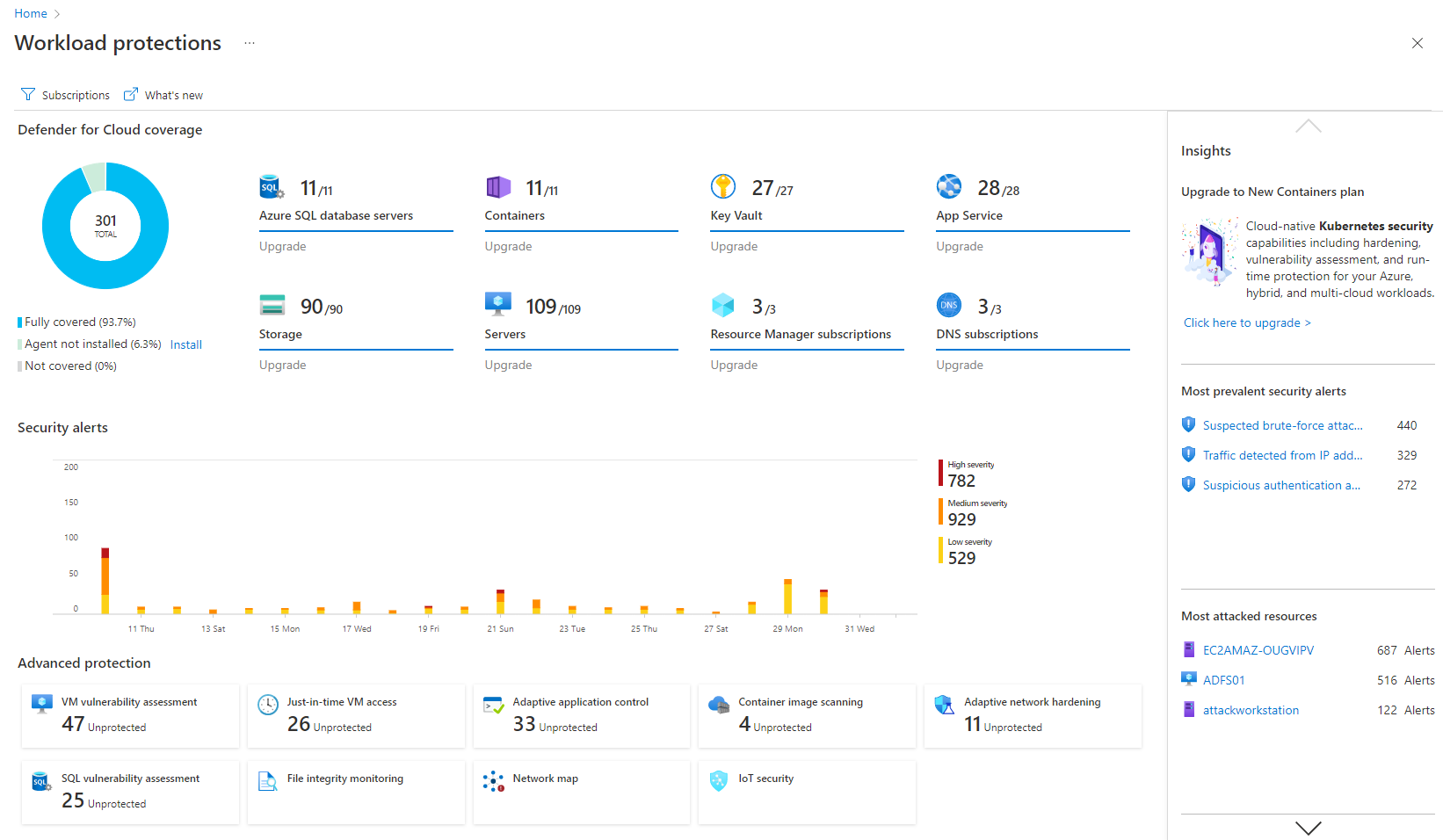
Microsoft Defender for Cloud is a Cloud Security Posture Management (CSPM) and Cloud Workload Protection Platform (CWPP) for Azure, on-premises, and multicloud (Amazon AWS and Google GCP) resources.
N/A
Trend Micro Deep Security
Score 8.0 out of 10
N/A
Trend Micro™ Deep Security™ software provides comprehensive security for virtual, cloud, and container environments. Deep Security allows for consistent security regardless of the workload. It also provides a rich set of application programming interfaces (APIs) so security can be automated.
If you need to proceed with pay as you go service then go ahead with Microsoft Defender for Cloud. This could be expensive in the long run but if the organization usage is slightly less than then this would suite the purpose. Also, it has the latest threat updates, so you're future proof in terms of potential treats.
So far we, unfortunately, have been using it in a limited scenario but we find that it has been very easy to use and manage in that scenario. Integrating the protection of our few saas applications was actually very simple and being able to use a very light weight agent like deep security agent has been very useful. Other agents ate up a lot of CPU or ram or both but this one is very light.
Automation is crucial to managing sprawl and the additional complexity that comes with it. SOC management workbooks and process automation give significant flexibility.
The Security posture score and Security Alerts are neatly centralized and offer me crucial information quickly.
Defender for Cloud avoids the common compromise of simplicity for completeness (former Azure Security Center). The security warnings and advice go into great detail while remaining current and useful.
UI/UX. It can get a little messy when navigating around with all the flyouts in the Azure portal which can be frustrating, particularly when under time pressure.
The query languages for the queries and workbooks are another language that needs to be learned - it would be nice to have kept it closer to T-SQL or something like that to minimize the need to learn new syntax.
Adding cost estimations to the security recommendations would really improve the experience.
It is a great product that integrates nicely when running an Azure platform and even multi-cloud environment. Not looking for point-solutions but a suite that answers most requirements. It is very comfortable being able to use KQL, workbooks and automation that is native to the azure platform
Trend Micro's support is pretty decent, we have had issues in the past and they have been fairly responsive to us and our complaints. Depending on how severe the issue was. Any ticket that had a high priority was handled very shortly especially when we contacted our account rep even if it was after hours, we were still able to get support within a short time period.
I believe Microsoft Defender for Cloud stacks up well against the other tools we looked at. It is native to the Azure platform and provides the same insights as the other tools. We selected Microsoft Defender for Cloud because it integrates well with the Azure resources and gives the needed insight, security alerts and recommendations.
We selected trend micro to take the AV scans and filtering out of the hands of the Windows and Linux vm's we have deployed and move it to the hypervisor level. This has led us to be able to deploy only a single DSVA per host and can protect all VM"s that are on that hosts. This has allowed for more time being spent on other priority security tasks.
100% positive ROI. Without Deep Security we would have to leverage and endpoint protection management solution like Sophos or SEPM (Symantec). Although both are good products, from a cost perspective it would have hit us much harder. Trend Micro Deep Security scales very nicely.
Since Deep Security actually has zero (or at least unnoticeable) resource footprint on monitored VMs, it is a huge cost benefit for us. As previously mentioned, actual antivirus clients installed on each virtual machine (VM) would have significantly affected performance. This would have cost us much more additionally in paying for additional resources to allocate over VMs in the VMware environment. Deep Security is almost completely unintrusive from a resource perspective.
Also, from a layered security perspective, it helps us meet our goals; and since the price of Trend Micro Deep Security quite reasonable, it is that much easier to get approval for this specific internal layer of security.