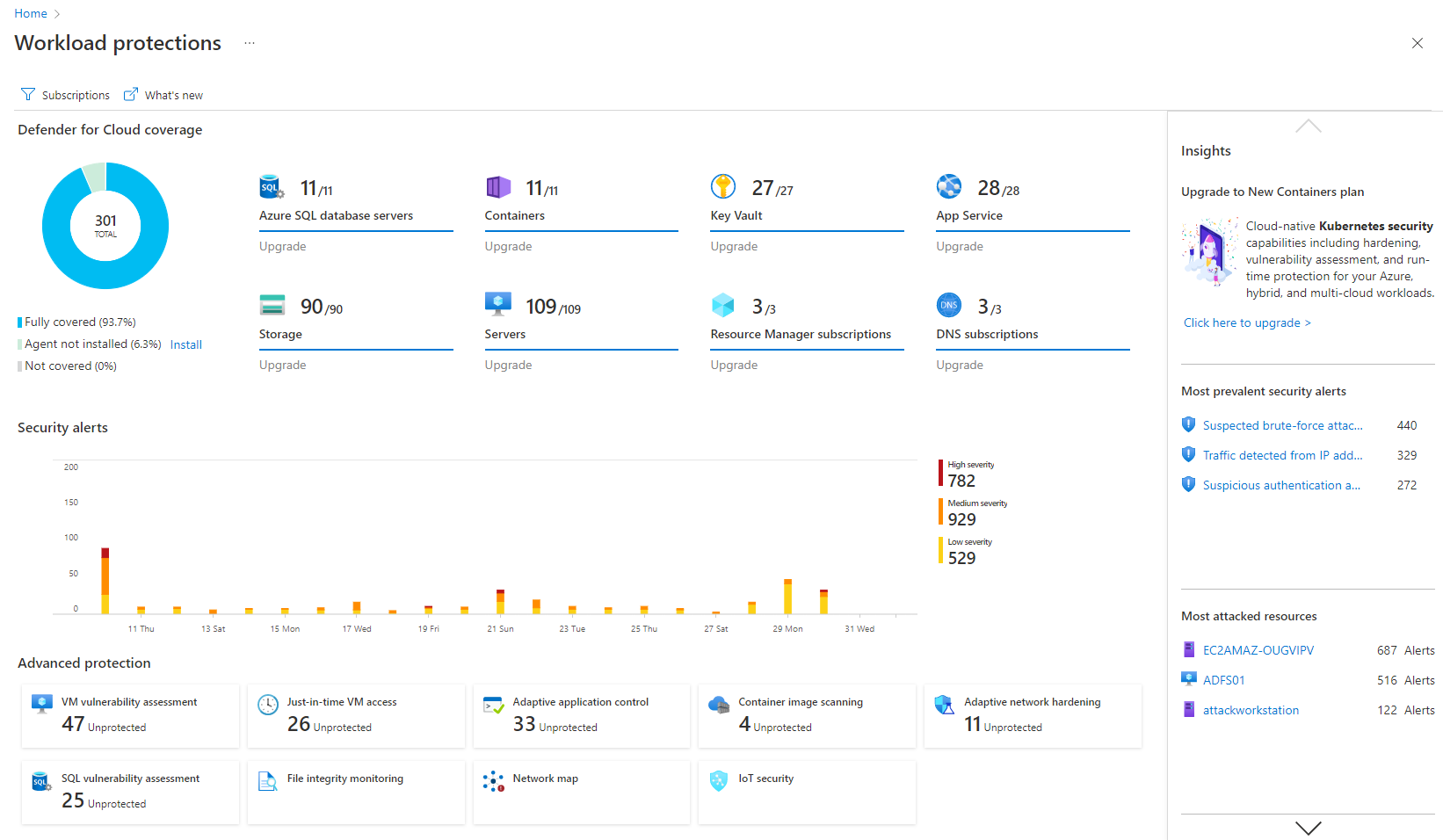
Microsoft Defender for Cloud is a Cloud Security Posture Management (CSPM) and Cloud Workload Protection Platform (CWPP) for Azure, on-premises, and multicloud (Amazon AWS and Google GCP) resources.
N/A
Trellix ePolicy Orchestrator
Score 6.9 out of 10
N/A
Trellix ePolicy Orchestrator (formerly McAfee ePolicy Orchestrator) software centralizes and streamlines management of endpoint, network, data security, and compliance solutions.
N/A
Pricing
Microsoft Defender for Cloud
Trellix ePolicy Orchestrator
Editions & Modules
No answers on this topic
Offerings
Pricing Offerings
Microsoft Defender for Cloud
Trellix ePolicy Orchestrator
Free Trial
Yes
No
Free/Freemium Version
No
No
Premium Consulting/Integration Services
No
No
Entry-level Setup Fee
No setup fee
No setup fee
Additional Details
—
—
More Pricing Information
Community Pulse
Microsoft Defender for Cloud
Trellix ePolicy Orchestrator
Considered Both Products
Microsoft Defender for Cloud
Verified User
Anonymous
Chose Microsoft Defender for Cloud
We haven't really, I mean we've used Google's options, but not really. We've just gotten demos really.

We were one of the first ones to deploy when Microsoft released it, so it's hard to compare, but what we hear from competitors, the fact that Microsoft can see the full ecosystem using this product makes it a lot better as compared to using a third party tool. So it's the ease …
Evaluated between cost. I just think it integrates better with the Microsoft stack and I mean, I think just cost from just that perspective and being the one pane of glass, I think that's enough.
I believe Microsoft Defender for Cloud stacks up well against the other tools we looked at. It is native to the Azure platform and provides the same insights as the other tools. We selected Microsoft Defender for Cloud because it integrates well with the Azure resources and …
Microsoft Defender for Cloud offered a more integrated and comprehensive solution for our multi-cloud environment, integrating well with our security and compliance needs
Microsoft Defender for Cloud is definitely the choice with the latest market trend and attacks that are currently happening. Microsoft has been able to safe guard a lot after the recent serious attacks happening globally in the digital world. There is a trust in this software …
There is the several ways to protect the applications and lot more tools available in the market. Most commonly we used Crowd strike Falcon for endpoint detection and response capabilities. McAfee endpoint protection also provide broad range of security features. Best …
We used to use Symantec and McAfee. It's been mostly defenders since, gosh, the last eight to 10 years. So we're a small organization. We don't have a lot of folks, so single-painted glass is really important to be able to see the whole environment in a single place. And the …
When we purchase this data fund, we check with not competition and we decided to purchase these tools because it's strong and we have a good relationship with Microsoft.
It is very good in comparison to other products that we have used. Its price is very effective and attractive, and it also provides good security policies. threat intelligence is also good and user protection is also very much better, and it also serves new updates as and when …
Microsoft Defender for Cloud supports the hybrid resource assessment which includes Non-Azure Resources, Aws resources, gcp resources. So it is flexible to asses different cloud platforms. Also its pricing is comparatively affordable then Other cloud security tools available in …
Defender for Cloud (previously known as Azure Security Center) is a more comprehensive and extensive security solution. Currently, threat analytics make up only a small portion of the whole picture. It encourages a comprehensive picture of the cloud environment across all of …
Defender for Cloud is definitely less complex a solution and more turn-key. We found that it was easier to grab the information we needed, faster than the Palo solution. In addition, accounting loved the fact that it was less expensive. At the time of implementation, Palo's …
This can be particularly beneficial for organizations with large and complex networks, as it simplifies the management and monitoring process. Trellix ePOoffers a range of customization options.. It allowing IT teams to tailor the solution to meet their specific needs.
McAfee ePolicy Orchestrator really seemed to have all the best pieces in one platform and the network admin and asst. network admin both had previous experience with the product. The others tend to focus more on singular aspects, whereas McAfee ePolicy Orchestrator has data …
If you are using Microsoft Services or newer, cloud ones, it can be worth [it] to try their services but it may be very expensive because of the licensing thing and here Microsoft is very tricky and very difficult to decide the right one. MalwareBytes is good product and adds …
I have used Symantec Endpoint Encryption before. Symantec and EPO are both good in their own ways. EPO allows integration of other McAfee products. I have been using ePolicy Orchestrator for years. I have a lot of experience with the product. That is why I like it.
Trend micro-endpoint management, Symantec/Norton AV Compared to these, McAfee ePolicy Orchestrator provides a much more robust and extensible all-around deployment and ongoing management solution.
We selected McAfee EPO partly because we were already using McAfee VSE, but mostly because there are very few other AV management packages out there that offer the same level of enterprise management tools. That's where it really shines - deployment and management of AV in a …
The price and the licensing options are very good. We were able to negotiate our pricing with plenty of flexibility ePO is one of the best administration console in the security world. Capability of deep customization are one of the biggest advantage. Ability to run PDF …
I think McAfee is a strong competitor and holds up well when compared to other software of its kind. If McAfee antivirus is already being used then it makes sense to go with this product to add another layer of management to the network.
McAfee plays well in not only scanning the endpoint machines like the data which is shared through disks or pen drive but it also helps in internet security. With its wide range threat source it blocks users entering into malicious sites and also blocks suspicious things which …
Other products that were reviewed were Symantec's DLP and Forcepoint. The reason we ultimately went the ePolicy Orchestrator route was that we owned other McAfee products and the logic way to bring them together and to gain the maximum information was to bin them together with …
We have not evaluated any other products in a very long time because moving to another AV product suite would be a very costly and long process. Another AV product would have to provide a very large cost reduction, performance improvements and unknown threat finding. We …
We were using Vipre Anti-virus for years and switched to McAfee. We gained better insight into our environment. Management felt more secure knowing that at any moment we could bring up reports into what was going on in our environment.
If you need to proceed with pay as you go service then go ahead with Microsoft Defender for Cloud. This could be expensive in the long run but if the organization usage is slightly less than then this would suite the purpose. Also, it has the latest threat updates, so you're future proof in terms of potential treats.
McAffee ePolicy Orchestrator is very well suited in large environments. You can load your updates to the repository and deploy them to every node on your network. It has great reporting and auditing features. You can control your users and groups all from the System Tree. DLP is great for USB devices. You can restrict all the ports on a computer and open them up for a limited time to plug in a device. EPO is to bulky for small networks.
Automation is crucial to managing sprawl and the additional complexity that comes with it. SOC management workbooks and process automation give significant flexibility.
The Security posture score and Security Alerts are neatly centralized and offer me crucial information quickly.
Defender for Cloud avoids the common compromise of simplicity for completeness (former Azure Security Center). The security warnings and advice go into great detail while remaining current and useful.
UI/UX. It can get a little messy when navigating around with all the flyouts in the Azure portal which can be frustrating, particularly when under time pressure.
The query languages for the queries and workbooks are another language that needs to be learned - it would be nice to have kept it closer to T-SQL or something like that to minimize the need to learn new syntax.
Adding cost estimations to the security recommendations would really improve the experience.
It has a slow mechanism when adding custom threat feeds. For example, if McAfee didn't have a signature or detection about a new virus and we try to add it to our console it is like a really big process in adding that to our available signatures.
Whenever a scan is performed, the system CPU utilization goes up 100 percent.
Installation fails due to difference in timestamp when we try to shuffle between packages.
It is a great product that integrates nicely when running an Azure platform and even multi-cloud environment. Not looking for point-solutions but a suite that answers most requirements. It is very comfortable being able to use KQL, workbooks and automation that is native to the azure platform
McAfee support is definitely GREAT! It is one of the best technical support on a business level. GOLD support is recommended to business. Their website is easy and quick to create a ticket. Their technical team usually responds right away with an email or call. Via call and web they provide a full and complete support until the issue is resolved. The best, most of the time they explain in detail what is the issue, the reason and how to resolve it.
I believe Microsoft Defender for Cloud stacks up well against the other tools we looked at. It is native to the Azure platform and provides the same insights as the other tools. We selected Microsoft Defender for Cloud because it integrates well with the Azure resources and gives the needed insight, security alerts and recommendations.
McAfee ePolicy Orchestrator really seemed to have all the best pieces in one platform and the network admin and asst. network admin both had previous experience with the product. The others tend to focus more on singular aspects, whereas McAfee ePolicy Orchestrator has data loss prevention, encryption, anti-virus and other functionality and the excel on each of those points equally.
As with most things the price of products goes up and more-so if your business is growing.
We've been able to provide auditors with tangible evidence that our network is protected because of the reporting McAfee ePO provides. Auditors like McAfee because it's been around almost forever and is a mature product.
Being a mature product, though, it's very much set in the way it does things and as such there's not a whole lot of innovation.