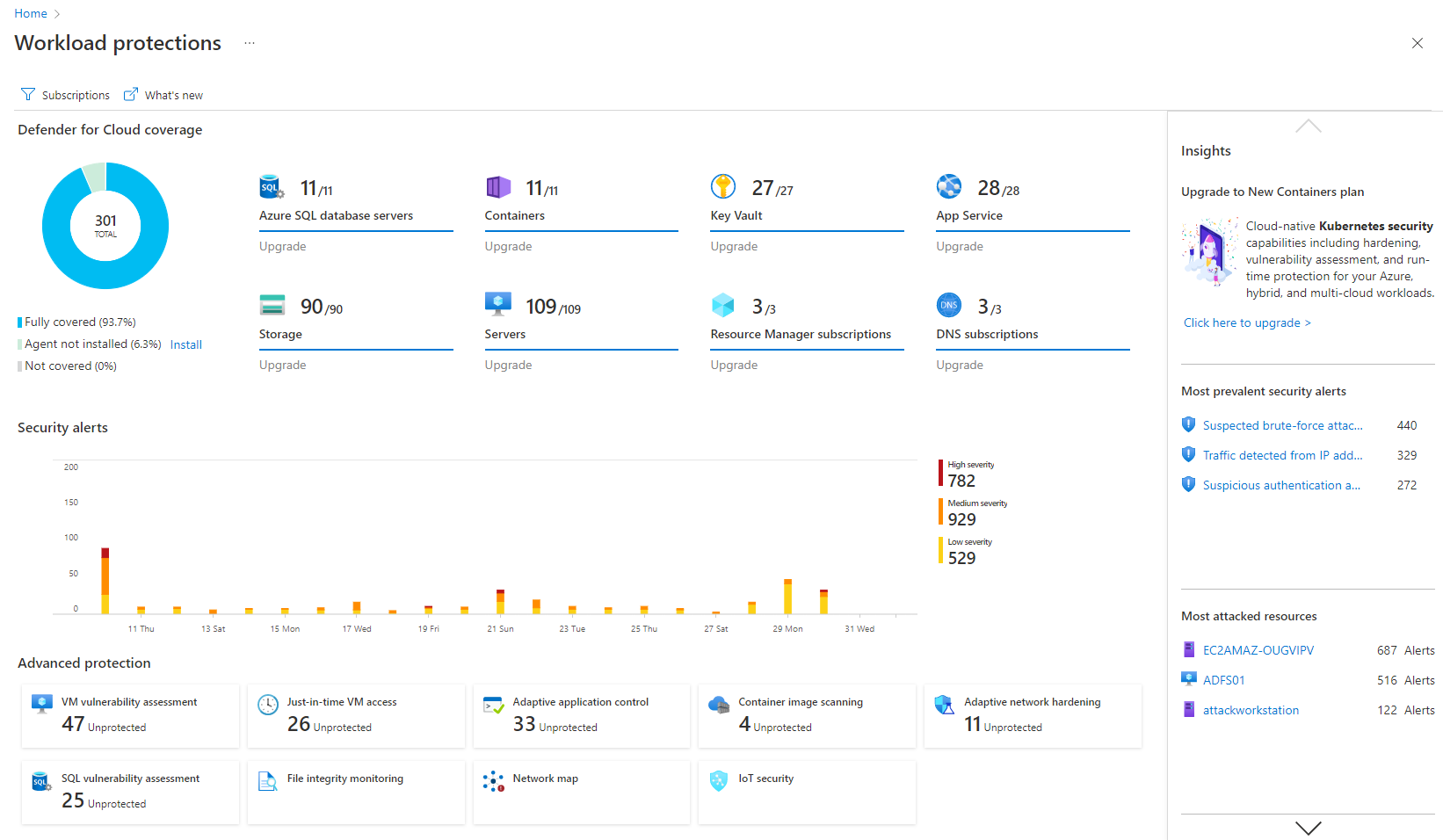
Microsoft Defender for Cloud is a Cloud Security Posture Management (CSPM) and Cloud Workload Protection Platform (CWPP) for Azure, on-premises, and multicloud (Amazon AWS and Google GCP) resources.
N/A
Picus Security
Score 8.2 out of 10
N/A
Picus Security, headquartered in San Francisco, offers Continuous Security Validation and Mitigation as the most proactive approach to ensure cyber-resilience. The Picus Platform measures the effectiveness of defenses by using emerging threat samples in production environments, providing the insight required to build the right security strategy to better manage complex operations.
If you need to proceed with pay as you go service then go ahead with Microsoft Defender for Cloud. This could be expensive in the long run but if the organization usage is slightly less than then this would suite the purpose. Also, it has the latest threat updates, so you're future proof in terms of potential treats.
If you want to analyze the full path focusing on the signatures it’s the best product in the market. If you want to test phishing, data exfiltration/DLP, DNS I don’t recommend Picus. Scenario based attacks also lacking. However Picus support is awesome and I like the development team. When we open a case, they’ll always return with the right answer
Automation is crucial to managing sprawl and the additional complexity that comes with it. SOC management workbooks and process automation give significant flexibility.
The Security posture score and Security Alerts are neatly centralized and offer me crucial information quickly.
Defender for Cloud avoids the common compromise of simplicity for completeness (former Azure Security Center). The security warnings and advice go into great detail while remaining current and useful.
It has thousands of signatures and up-to-date attack vectors (It's the largest set in the market)
Attack vectors are mapped with existing vendors like Checkpoint and Mcafee, where you don't spend time finding out which cve mapped to which protection
Ability to focus/highlght solely new threats, it's superb for 0days and up-to-date protections. As there are always timing issue between updates and apply the updates on the products.
Blocked vs not blocked ratios on the dashboard with drill down menu specifiying the set of protections or signatures on the defensive measures
Already mapped mitre att&ck framework on the dasboard. SOC and analyst team using the Mitre framework.
Detection analytics enhance the analytics capabilities with pinpoint accuracy where to focus and how to prevent
Timeline and scheduled reports from the dashboard in flexible format
UI/UX. It can get a little messy when navigating around with all the flyouts in the Azure portal which can be frustrating, particularly when under time pressure.
The query languages for the queries and workbooks are another language that needs to be learned - it would be nice to have kept it closer to T-SQL or something like that to minimize the need to learn new syntax.
Adding cost estimations to the security recommendations would really improve the experience.
It is a great product that integrates nicely when running an Azure platform and even multi-cloud environment. Not looking for point-solutions but a suite that answers most requirements. It is very comfortable being able to use KQL, workbooks and automation that is native to the azure platform
I believe Microsoft Defender for Cloud stacks up well against the other tools we looked at. It is native to the Azure platform and provides the same insights as the other tools. We selected Microsoft Defender for Cloud because it integrates well with the Azure resources and gives the needed insight, security alerts and recommendations.
We use other vendors Verodin, AttackIQ, SafeBreach, Cymulate etc. All of them have their advantages and disadvantages. Please take a look at TrustRadius reviews of each product. I don’t want to go head to head for each product in this review. I select Picus because it's local startup company in our region. I like their support and engineering team. Support is marvelous. Product is giving what we expected from the product. Price is adequate. Reporting and dashboard is superb.
With Picus we have the tangible KPIs for the security
Detetcion and Prevention rates for the latest attacks are significantly increased
We work with many security vendors. We use picus scores and share specific outputs with the company in case of decreasing score rates where the development and product team analyzes their updates or product engines to increase the rates.
It helps our strategic plans where to focus and invest for the following years and planning/prioritizing the security budgets to specific highlighted areas