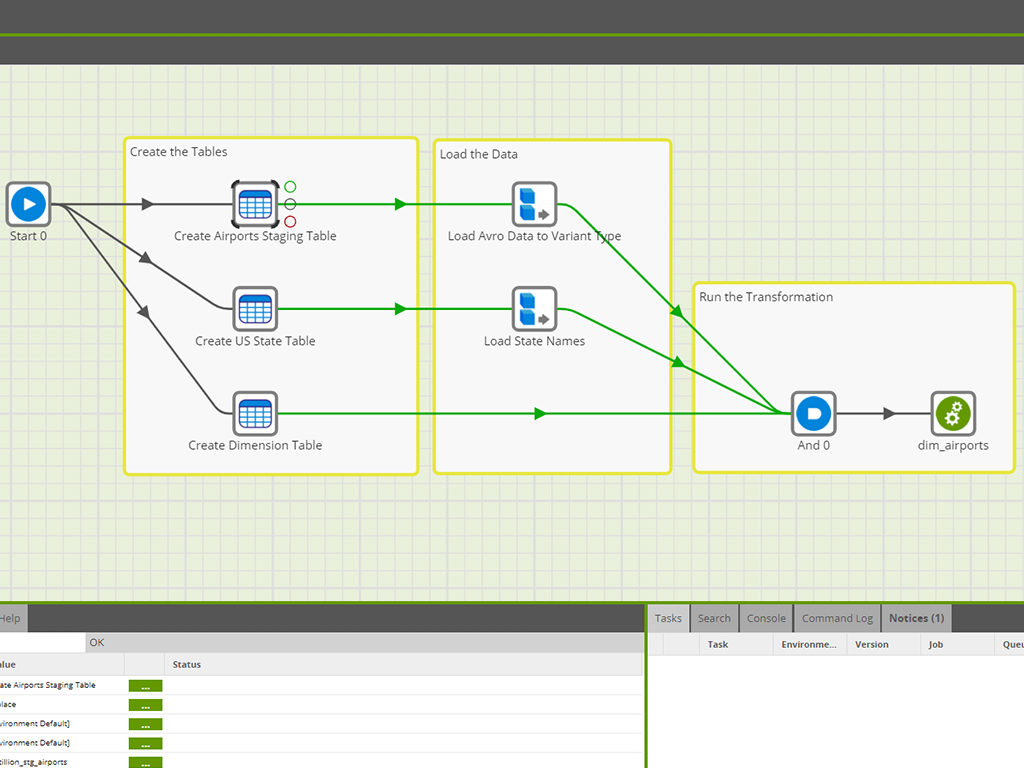
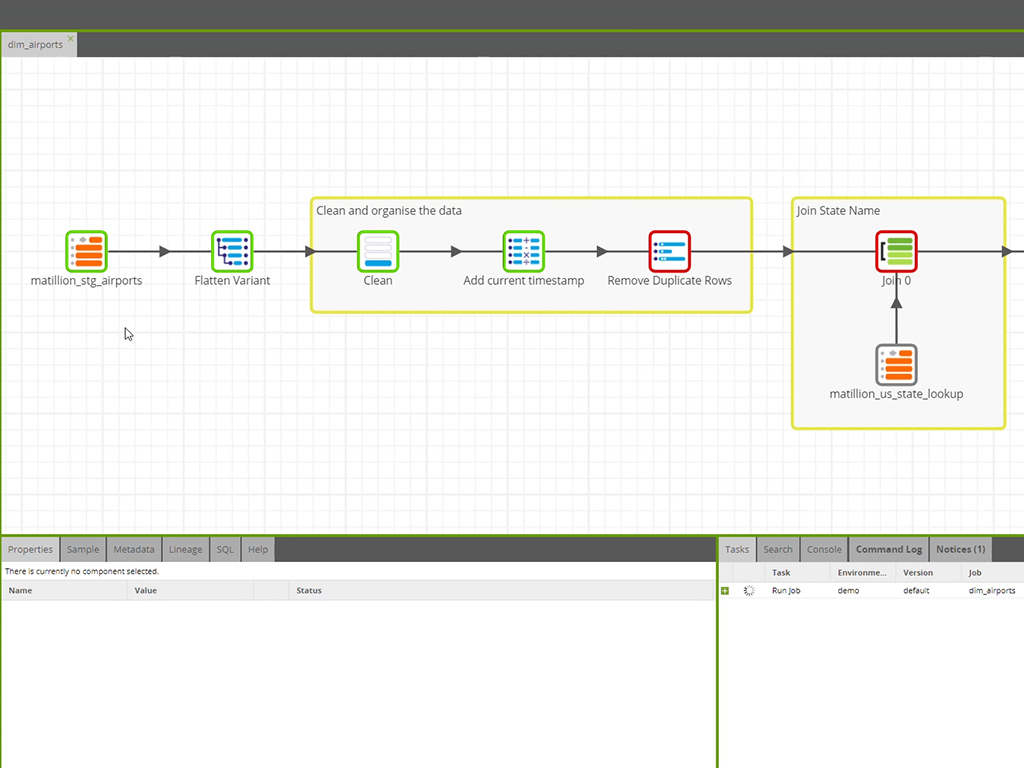
Matillion is a data pipeline platform used to build and manage pipelines. Matillion empowers data teams with no-code and AI capabilities to be more productive, integrating data wherever it lives and delivering data that’s ready for AI and analytics.
$2.50
Pay as you go per user
Talend Data Integration
Score 10.0 out of 10
N/A
The Talend Integration Suite, from Talend, is a set of tools for data integration.
N/A
Pricing
Matillion
Talend Data Integration
Editions & Modules
Developer: For Individuals
$2.50/credit
Pay as you go per user
Basic
$1000
per month 500 prepaid credits (additional credits: $2.18/credit)
Advanced
$2000
per month 750 prepaid credits (additional credits: $2.73/credit)
Enterprise
Request a Quote
No answers on this topic
Offerings
Pricing Offerings
Matillion
Talend Data Integration
Free Trial
Yes
No
Free/Freemium Version
No
No
Premium Consulting/Integration Services
No
No
Entry-level Setup Fee
No setup fee
No setup fee
Additional Details
Billed directly via cloud marketplace on an hourly basis, with annual subscriptions available depending on the customer's cloud data warehouse provider.
Matillion and Talend Data Integration are both data integration tools. Matillion specializes in ETL for cloud-based warehouses. Talend differentiates by offering a free open source version of its data integration platform. Talend is more commonly used at the enterprise level, with a larger focus on big data integration, while Matillion’s cloud focus is gives it functionality across company sizes.
Features
Both Matillion and Talend provide a variety of features for data integration.
Matillion offers a robust Extraction, Transformation, and Loading (ETL) capability. Users highlight its ability to centralize and structure data from a wide range of platforms and cloud environments, particularly AWS applications. Matillion’s focus on cloud-based data warehouses makes it ideal for this use case.
Talend differentiates with its free open source data quality management and integration software, which can be used for simple use cases. At larger scale, Talend also provides a high degree of customizable connectors between different system, including custom-built connectors.
Limitations
Talent and Matillion also both have some limitations to their offerings.
Matillion’s users have struggled to create and utilize the platform’s documentation for updates and project management. This issue is particularly pronounced when implementing or integrating Git.
Talend’s free version is extremely limited for most users. Many ETL tasks quickly scale beyond the technical functionality of the free version, requiring paid upgrades. Talend also struggles with utilizing Git, particularly in the free version of the software.
Pricing
Matillion provides four packages for its ETL capabilities, priced per hour of usage. The “Medium” package, at $1.27/hr, provides 2 users and 6 environments. The “Large” package, at $2.74/hr, supports 5 concurrent users and 15 environments and clustering. The “XLarge” package, at $5.48/hr, supports 12 concurrent users and 35 environments. Enterprise package pricing is available by quote from the vendor.
Talend offers four products around data integration. Data Quality and Data Integration are available in open source versions. There are also Data Integration Entry Level and a Data Management Platform package. The former includes more advanced integration features, and the Data Management Platform includes advanced data profiling and quality governance. Pricing is available by quote from the vendor.
Features
Matillion
Talend Data Integration
Data Source Connection
Comparison of Data Source Connection features of Product A and Product B
Matillion
8.4
Ratings
0% above category average
Talend Data Integration
9.5
Ratings
12% above category average
Connect to traditional data sources
8.80 Ratings
10.00 Ratings
Connecto to Big Data and NoSQL
8.00 Ratings
9.00 Ratings
Data Transformations
Comparison of Data Transformations features of Product A and Product B
Matillion
7.0
Ratings
15% below category average
Talend Data Integration
9.0
Ratings
10% above category average
Simple transformations
7.50 Ratings
9.00 Ratings
Complex transformations
6.40 Ratings
9.00 Ratings
Data Modeling
Comparison of Data Modeling features of Product A and Product B
Matillion
8.3
Ratings
4% above category average
Talend Data Integration
9.0
Ratings
12% above category average
Data model creation
9.10 Ratings
9.00 Ratings
Metadata management
9.10 Ratings
10.00 Ratings
Business rules and workflow
8.30 Ratings
8.00 Ratings
Collaboration
7.40 Ratings
9.00 Ratings
Testing and debugging
7.60 Ratings
9.00 Ratings
Data Governance
Comparison of Data Governance features of Product A and Product B
Great: Need to query simpler APIs, or utilize well known services such as GSheets etc.? Matillion has got some of the best and easiest to use connectors out there. Not so great: Do you need have a competent CI/CD flow that you will be able to update / compare from Matillion as well as other sources at the same time? Good luck, you will need to be extra careful, as you might have to have a deeper dive into your servers Terminal each time you have a git conflict.
The same way you design data integration job can be used to design services. It is easy to enhance by custom components and can adapt to all requirements. Talend Data Integration connects to [a] multitude of data sources and streaming service. Very easy interface to design complex applications without spending much time on coding. Easy to learn and master. Talend constantly strives to better itself by adding more features and functionalities.
We used Talend to ETLing the data from myriad sources such Oracle Database, Clarify, Salesforce, Sugar CRM, SQL DB, MQ, Stibo Step, FTP, Netezza, and Files.
We leverage Talend transformation capabilities for stitching the data , unions and join
We successfully created the final unified set that can be used by business
Static and monolithic, it will show its limits when running multiple concurrent jobs.
Github and versioning implementation is messy and broken. Don't use it.
There's not way to see/query the system resources, just wait for a server to crash due to out of memory. An admin panel would be appreciated + some env variables with updated info.
API implementation is cumbersome and limited.
There's no concept of hub and worker engine, everything happens of the same server (designing workflows and executing them). Having separate light ETL engines to run job could be better. (sort of docker/kubernetes/lambda functions).
Handling of variables is limited especially for returned values from sub components.
Some components could return more metadata at the end of their execution instead of the standard one.
Billing is badly designed not taking into account that the server is hosted by the client. Expensive.
We had several issue with migration where starting a new instance was required and then migrating the content. It was painful and time consuming also have to deal with support and engineering team on Matillion side.
CDC doesn't work as expected or it is not a mature product yet.
Matillion is easy to use and flexible to debug. Performance are good and support is giving us a good service level. There are still some technical points to be developed more (such as SAP extraction). but easy flows are really fast to be developed. We are also using a tool for migration from other tools, and it is useful as Matillion is producing XML code.
Easy tasks are really easy, and complex tasks are still possible. With prior knowledge of general data warehousing principles and experience with other data transformation tools, it's straightforward to get familiar with and use Matillion. I initially used minimal external support from a partner for some more complex tasks but very soon could work entirely independently with Matillion.
We use Talend Data Integration day in and day out. It is the best and easiest tool to jump on to and use. We can build a basic integration super-fast. We could build basic integrations as fast as within the hour. It is also easy to build transformations and use Java to perform some operations.
Overall, I've found Matillion to be responsive and considerate. I feel like they value us as a customer even when I know they have customers who spend more on the product than we do. That speaks to a motive higher than money. They want to make a good product and a good experience for their customers. If I have any complaint, it's that support sometimes feels community-oriented. It isn't always immediately clear to me that my support requests are going to a support engineer and not to the community at large. Usually, though, after a bit of conversation, it's clear that Matillion is watching and responding. And responses are generally quick in coming.
Good support, specially when it relates to PROD environment. The support team has access to the product development team. Things are internally escalated to development team if there is a bug encountered. This helps the customer to get quick fix or patch designed for problem exceptions. I have also seen support showing their willingness to help develop custom connector for a newly available cloud based big data solution
We selected Matillion primarily because of it's ability to connect to numerous data sources and easily create transformation jobs. While Fivetran does a better job managing and examining deltas, it is not easy to use and is very non user friendly. SSIS was not a good fit for our team and required a significant amount of attention and server management that we did not want to invest in.
Talend has many built-in components that reduce the development work. We were able to complete the project sooner than expected. Easy to on-board resources as it is straightforward to use. We can manage all the pipelines in the cloud with simple alerting. No major downtimes. Connectors to all new applications in the market.
We're using Matillion on EC2 instances, and we have about 20 projects for our clients in the same instance. Sometimes, we're struggling to manage schedules for all projects because thread management is not visible, and we can't see the process at the instance level.
Time savings -- we could custom code nearly everything Matillion does, but it would take days/weeks instead of minutes/hours.
There's a bit of a learning curve to truly unlock Matillion's potential, and that can be frustrating for some new users, but once you get over that curve, the possibilities are endless.
It allows us to centralize the hundreds of way to bring data in, so that even if you have to troubleshoot what someone else wrote, it's easy to jump in and understand what is happening.
It’s only been a positive RoI with Talend given we’ve interfaced large datasets between critical on-Prem and cloud-native apps to efficiently run our business operations.