Site24x7 from ManageEngine is a full-stack application, website, server, cloud and network monitoring tool. Site24x7 offers code-level diagnostics and customizable error thresholds, end-to-end monitoring with topology visualization tools, and mobile accessibility.
$9
10 monitors
SolarWinds Pingdom
Score 9.7 out of 10
N/A
SolarWinds Pingdom is a website uptime monitoring and alert tool, with additional reporting and Real User Monitoring capabilities. Pingdom is part of SolarWinds’s DevOps package, enabling full-stack monitoring as a service.
$10
per month
Pricing
ManageEngine Site24x7
SolarWinds Pingdom
Editions & Modules
Starter
$9.00
10 monitors
Pro
$35.00
40 Monitors
Classic
$89.00
100 Monitors
Elite
$225.00
250 Monitors
Enterprise
$449.00
500 Monitors
Enterprise Plus Web
$899.00
2500 Monitors
Synthetic Monitoring
$10
per month
Real User Monitoring
$10
per month
Enterprise
Custom Pricing
Offerings
Pricing Offerings
ManageEngine Site24x7
SolarWinds Pingdom
Free Trial
Yes
Yes
Free/Freemium Version
Yes
No
Premium Consulting/Integration Services
No
No
Entry-level Setup Fee
$1 monitors
No setup fee
Additional Details
Each Pack will also support additional benefits such as Network interfaces, Applogs, Alert credits etc. You can also, purchase add-ons to create custom pricing options. Please visit the vendor's pricing page, for more information.
—
More Pricing Information
Community Pulse
ManageEngine Site24x7
SolarWinds Pingdom
Features
ManageEngine Site24x7
SolarWinds Pingdom
Monitoring Tasks
Comparison of Monitoring Tasks features of Product A and Product B
ManageEngine Site24x7
8.4
Ratings
8% above category average
SolarWinds Pingdom
-
Ratings
Remote monitoring
9.10 Ratings
00 Ratings
Network device monitoring
7.50 Ratings
00 Ratings
Multiple Server Monitoring
8.60 Ratings
00 Ratings
Multi-device monitoring
8.00 Ratings
00 Ratings
Automated alerts and notifications
9.00 Ratings
00 Ratings
Management Tasks
Comparison of Management Tasks features of Product A and Product B
ManageEngine Site24x7
7.4
Ratings
0% above category average
SolarWinds Pingdom
-
Ratings
Policy-based automation
7.40 Ratings
00 Ratings
Reporting
Comparison of Reporting features of Product A and Product B
ManageEngine Site24x7
8.5
Ratings
11% above category average
SolarWinds Pingdom
-
Ratings
Performance data reports
8.10 Ratings
00 Ratings
Customizable reporting
8.40 Ratings
00 Ratings
Data visualization
8.80 Ratings
00 Ratings
Risk analysis
8.60 Ratings
00 Ratings
Security
Comparison of Security features of Product A and Product B
I have tried other tools (PRTG etc) in the past, and switched from US monitor to [Site24x7 All-in-One Monitoring], for all the built-in features and ability to implement by using with or without the agents deployed (ip discovery LAN). This is one tool that encompasses the entire organization and allows that single pane of glass feel (NOC screen view) for an accurate virtual snapshot of your entire organization, either cloud and/or LAN.
Pingdom is well suited to monitor any of your public facing IPs, so you receive an alert by text message or email when the IP you are monitoring does not respond for a given length of time, from an impressive 10ms to 30s. This allows you to be pretty granular with the alerting. It's less appropriate for monitoring IPs on your LAN, unless you NAT these through your firewall.
Alerts: Site24x7 can be configured to send alerts in all sorts of ways, from email, to text messages, to even direct automated phone calls.
Internal monitoring: An agent installed on one or more machines can monitor internal connectivity to other network devices. This means if connectivity to a server goes down, we often know about it before users alert us.
External monitoring: Site24x7 also watched our websites and sends alerts if they're unreachable. It uses multiple locations to do so, which means if there's a partial network outage in some part of the country, we know who is affected.
Alerting, particularly the integration with PagerDuty.
Reporting: the ability to go back and view the history of each status check (including details about every failure) as well as graphs and reports over a longer time period.
Weekly uptime report emails are very convenient.
Programmatic configuration is possible with a third-party Terraform plugin.
there should be some threshold value for when an application is not reachable, it should alert after 30 seconds and keep sending hello packets for those 30 seconds and if still there is no response, then it should send the alert.
Recently added features have made Pingdom less intuitive for our requirements. While Pingdom has a broad offering and remains a good value, it is becoming more than we need. Our customer base is becoming more and more global and Pingdom still lacks Asia-Pacific monitoring, which we will need within a year.
Pingdom is easy to use, very intuitive and has a very short learning curve. From the onset, we've been able to jump in and leverage the tool to accomplish our goals for page speed performance and discover the insights we need to make improvements. Its a well-designed tool and makes for a good user experience.
I have only had to use support once, so I can't go into much detail about their support team. The one time I did use it the response was fast but the resolution took some time.
Customer service from Solarwinds has always been stellar. We've never gone unnoticed, even though we're currently within their tail segment. They're a great partner to us and indeed an important one. When we've had to submit a ticket, we've always received a response within 24 hours. I'd highly recommend SolarWinds to any organization with a server network
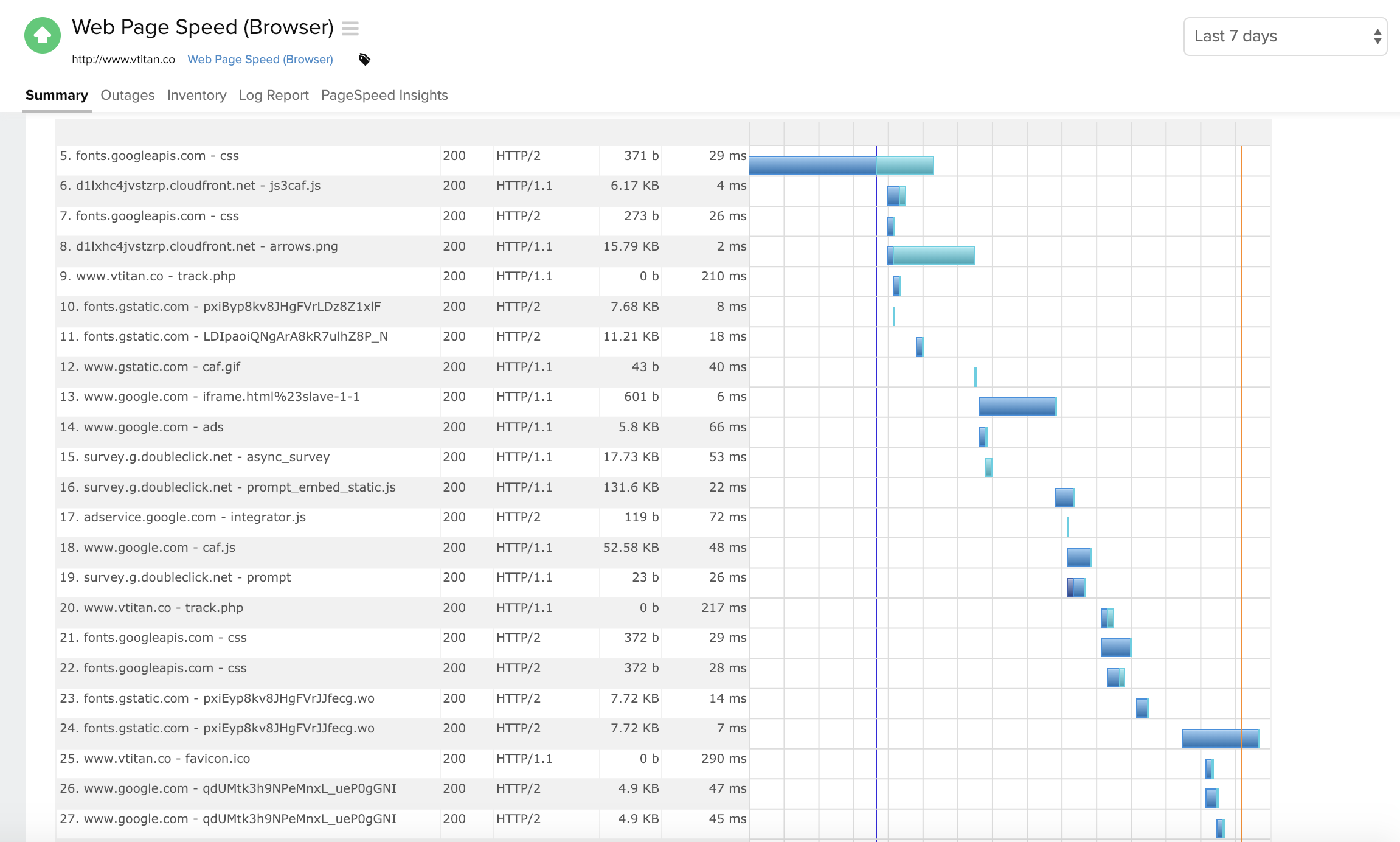
Site24x7 [All-in-One Monitoring] has some similarities to ThousandEyes. Especially in the troubleshooting aspect where both offer Web performance waterfall charts to analyze the issue better. Both have cloud-based servers globally that allow to determine performance on the Internet. Site24x7 has more features available so we selected it instead.
We have only used Pingdom for these needs, so I can't speak directly to competitors. That being said, for the reasons we used Pingdom it was fantastic value and the fact we never bothered to look for a competitor speaks volumes about our satisfaction with the product.
Positivity wise, we're spending a third of what we were on our website monitoring, this has allowed us to focus funding elsewhere (namely SolarWinds).
We have enhanced our core monitoring by now also being able to provide better coverage, whereas we were handicapped with our previous supplier due to the scaling costs of multi-step transactions.
The general feeling from our IT staff is that the platform is not great, which obviously reduces confidence in the ability for the platform to provide accurate monitoring data for our websites.
It has helped our organisation keep up to date about any site traffic fluctuations and help us make educated decisions on appropriate server resources for the site
The service is relatively inexpensive making it easy to cost into our maintenance charges