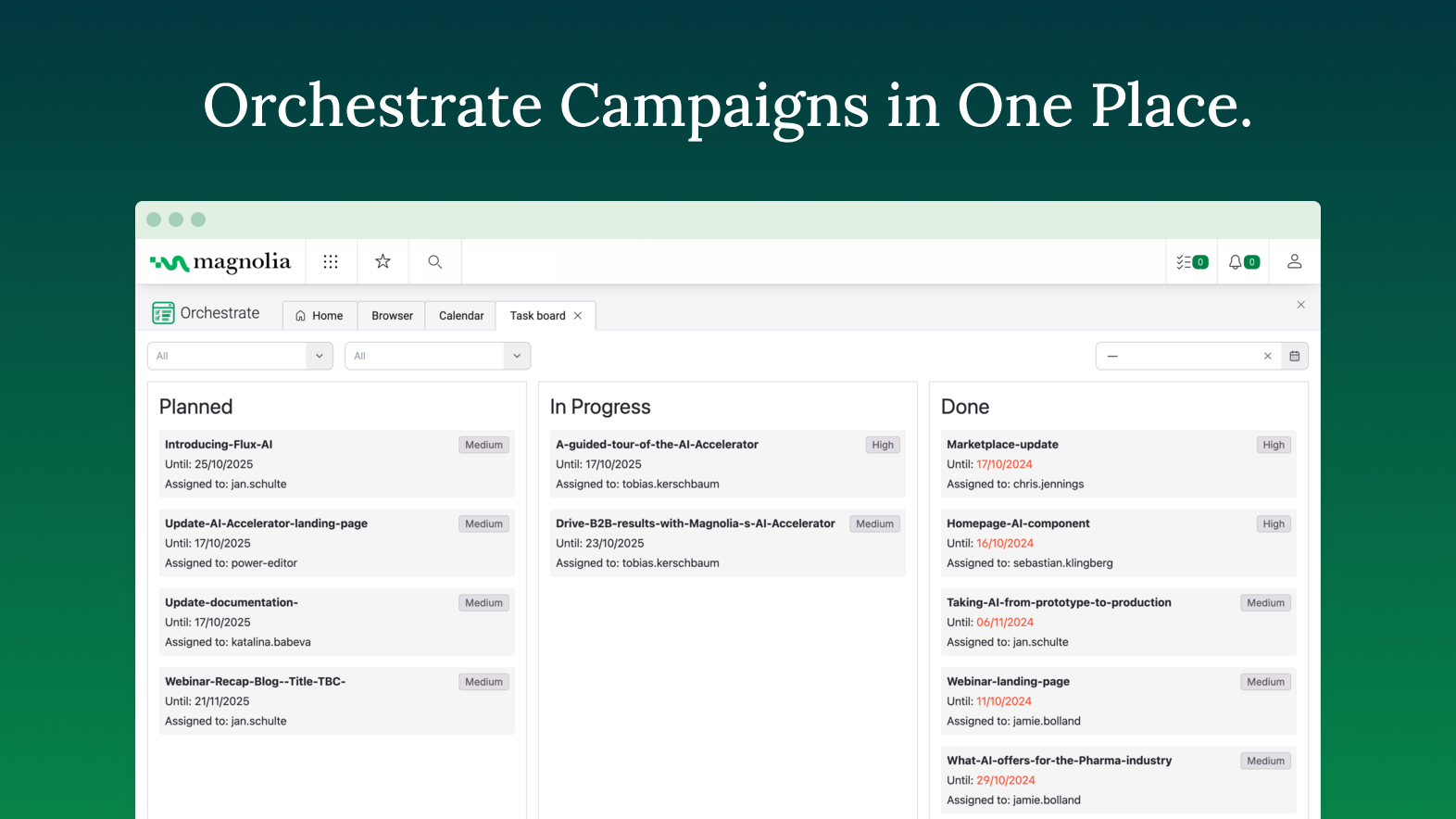
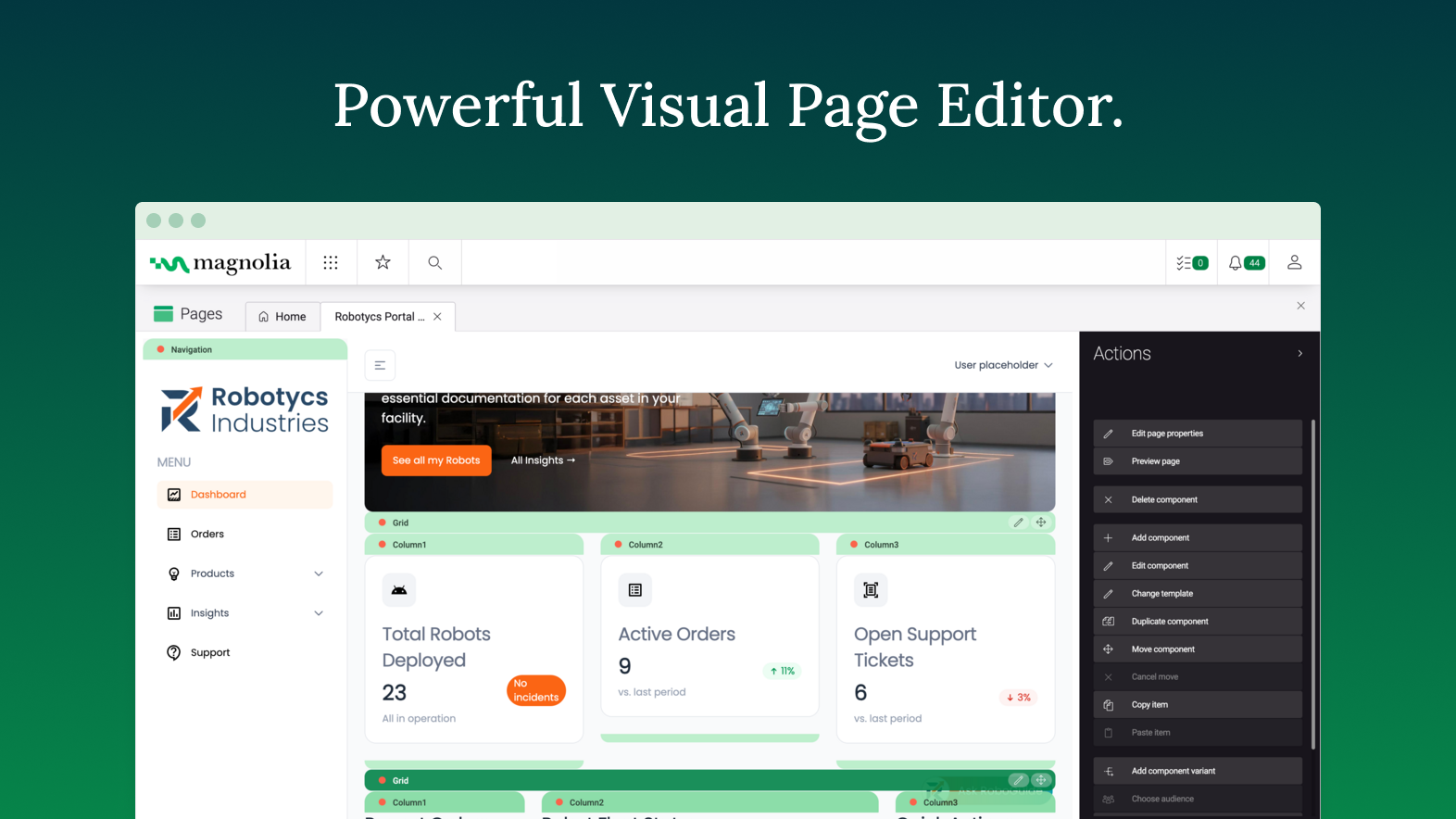
Founded in Switzerland in 1997, Magnolia is a CMS used to build composable digital experiences. Magnolia helps create fully integrated customer experiences and speeds up digital delivery of content. Magnolia boasts 480 enterprise customers, thousands of Community Edition deployments, and more than 200 certified Magnolia Partners around the world. They further state that their enterprise customers include Sanofi, Generali, the Atlassian, The New York Times, Harley Davidson, and Union…
$3,500
per month
Plone
Score 9.0 out of 10
N/A
Plone is a free and open source content management system built on top of the Zope application server. Plone can be used for any kind of website, including blogs, internet sites, webshops, and internal websites.
N/A
Pricing
Magnolia
Plone
Editions & Modules
DX Core
$3500
per month
DX Cloud
$6000
per month
No answers on this topic
Offerings
Pricing Offerings
Magnolia
Plone
Free Trial
Yes
No
Free/Freemium Version
No
No
Premium Consulting/Integration Services
No
No
Entry-level Setup Fee
No setup fee
No setup fee
Additional Details
—
—
More Pricing Information
Community Pulse
Magnolia
Plone
Features
Magnolia
Plone
Security
Comparison of Security features of Product A and Product B
Magnolia
8.1
Ratings
0% above category average
Plone
8.0
Ratings
1% below category average
Role-based user permissions
8.10 Ratings
8.00 Ratings
Platform & Infrastructure
Comparison of Platform & Infrastructure features of Product A and Product B
Magnolia
8.1
Ratings
7% above category average
Plone
8.5
Ratings
11% above category average
API
8.50 Ratings
9.00 Ratings
Internationalization / multi-language
7.70 Ratings
8.00 Ratings
Web Content Creation
Comparison of Web Content Creation features of Product A and Product B
Magnolia
8.0
Ratings
4% above category average
Plone
8.0
Ratings
4% above category average
WYSIWYG editor
8.50 Ratings
8.00 Ratings
Code quality / cleanliness
8.40 Ratings
8.00 Ratings
Admin section
8.00 Ratings
7.00 Ratings
Page templates
8.90 Ratings
10.00 Ratings
Library of website themes
7.00 Ratings
8.00 Ratings
Mobile optimization / responsive design
8.50 Ratings
7.00 Ratings
Publishing workflow
7.50 Ratings
8.00 Ratings
Form generator
6.90 Ratings
8.00 Ratings
Web Content Management
Comparison of Web Content Management features of Product A and Product B
If you need a business CMS that brings along a good amount of features and also give you the chance to develop features on your own, Magnolia would be a good choice. Even if you have not the fitting infrastructure around, Magnolia provides you different ways like SAAS oder PAAS. If you have to review your code our have any problems the team behind will helps in a short time. Without using the connectors it is not so easy to connect special functionalities like Marketing tools or optimization tools. The DAM is very slow if you have an huge amount of documents and pictures to store for your website - you have to add an external DAM.
The larger your organization, the more appropriate Plone will be. This is not to say that Plone is a worse choice for small websites, only that the minimum investment for a Plone site is certainly higher than for other platforms. If you already use Plone for your site and are looking for a redesign or an overhaul, I would only advise switching to a different platform such as WordPress or Drupal if your organization is downsizing. For any other situation, Plone is the natural choice for your growth.
Versatility of defining actions for custom handlers.
Reloading classes when code is modified in a local dev environment is nice. While it doesn't seem to work when changes extend beyond the method body (i.e., adding methods), it remediates the pain of long startup times.
Bullets and formatting sometimes make it difficult to add text to an existing paragraph. The 'code' button is useful in those cases, but only to those who know html.
Sometimes the pages don't save correctly and you use information.
Uploading and displaying images is a bit too much work.
Magnolia is an innovative CMS, for example it is possible to use the ipad to manage the contents. Magnolia’s team works hard to improve the product; the community is small but active and the support for the enterprise version is good. Magnolia’s team asks the users what they think and what they need, and the new functionalities planned for Magnolia 5.3 are very exciting for example the content personalization.
Plone has been used for more than ten years and it already has an interesting roadmap for its future. I do not know any other open source CMS with the same story of continuous evolution and security track. Interesting new features are added at each release and new modules are created continuously
There are a ton of small things that could make this CMS great Off the top of my head... 1) Better navigation between a component and its corresponding node in the jcr ( devs often have to flip between a page and a spot in the jcr even though there could be a button to take you from a page/component in the pages app to its location in the JCR) 2) Why does a content editor need to open the page to edit the page properties? They could just as easily edit the dialog from the tree view if they have many pages to touch, and it would save them time by not having to render the page.
Compared to the amount of Plone sites, users and customizations we have in our organization, the amount of support requests and training needed is really small.
The new user interface in Plone 6 is even better, it is super fast, has lots of different blocks for enhancing the page, has flexible layout system and is easy to extend with more features.
Our Plone sites are very robust. We have critical systems on Plone and we have been running sites on Plone for over 20 years with very little unexpected downtime.
It's a lean and performant platform. You don't need to put reverse proxy servers in front of it to speed it up (although that does make it go even quicker) as there are various layers of caching built in to the application. While it's a little cryptic, the internal caching system is actually quite configurable and can be tuned to the right sort of content.
Often what tends to surprise many an IT manager is that you can run it on relatively modest hardware. We've often been met with "are you sure ?" but the reality is that it doesn't need a whole lot of horsepower.
Plone is very intensive in its operations, and if not configured well it can be slow. However it is designed and built with speed in mind and with proper use of coding, templates and caching can perform extremely well under high loads. It is capable of scaling to very high load availability environments with no specific coding requirements.
You always get an answer based on your SLA. But you always get a solution. That's the successfactor in this case. To often i was frustrated about people in a company without even a clue what there product is about or how to solve a problem. Magnolia's Support Team does a very good job and try to help you in most of the cases
Magnolia DXP offers similar or more capability compared to the other platform, while much easier to implement. For example, Adobe Experience Manager tend to be more monolithic in nature, heavier footprint compared to Magnolia. Hence when implementing a DXP, it is much faster to build using Magnolia, at a much lower TCO. The other platform like Kontent.ai and Strapi are pure headless platform and offer lesser features. What really make Magnolia different is the APAC team, who are all out to support their client in the implementation, ensuring their client maximize their platform and the project implementation is successful. This is some thing that is not experienced when using other platform(s)
Plone is much harder to learn then Wordpress. Development in Wordpress is learnt in day's, where development in Plone really takes years to get to the full depth. That said, once you're able to develop in Plone, is it a rock solid system, with readable code. In my experience Wordpress websites need to be updated so often, and the code feels bad organised. I have been building Wordpress websites, choosing Wordpress only when the client has almost no money. But I can never deliver the quality I want to deliver when using Wordpress. Plone does offer the possibility to deliver professional websites. As for Joomla, in the past I have done some Joomla development, but the whole CMS-paradigm could not settle in my brain. Being a web developer for over 15 years now, Joomla always felt contra-intuitive. Let alone the task of teaching this to my clients. Plone is now my only choice. It gives me a fast development-cycle, a user-friendly CMS and a rock stable and very secure system.
We have placed web content management in the hands of the organisation than retained it within the technology team.
We were able to quickly move to MVP and release and we are now focussed on moving the platform forward at some pace whilst not being burdened with BAU work inside the technology team as so much as self-service to trained organisational users
The use of the SAAS/PASS has inbuilt business resiliency as specialist work and aspects such as underlying security is done by Magnolia and we are able to focus internal effort on building out the platform.
We thought that tapping into the user/content management tooling of Plone would be a good and useful thing, however it turned out to be a major pain to tie into those parts of Plone.
I wish we would have built the extra functionality completely outside Plone and found a way to integrate it. It would have been much easier.