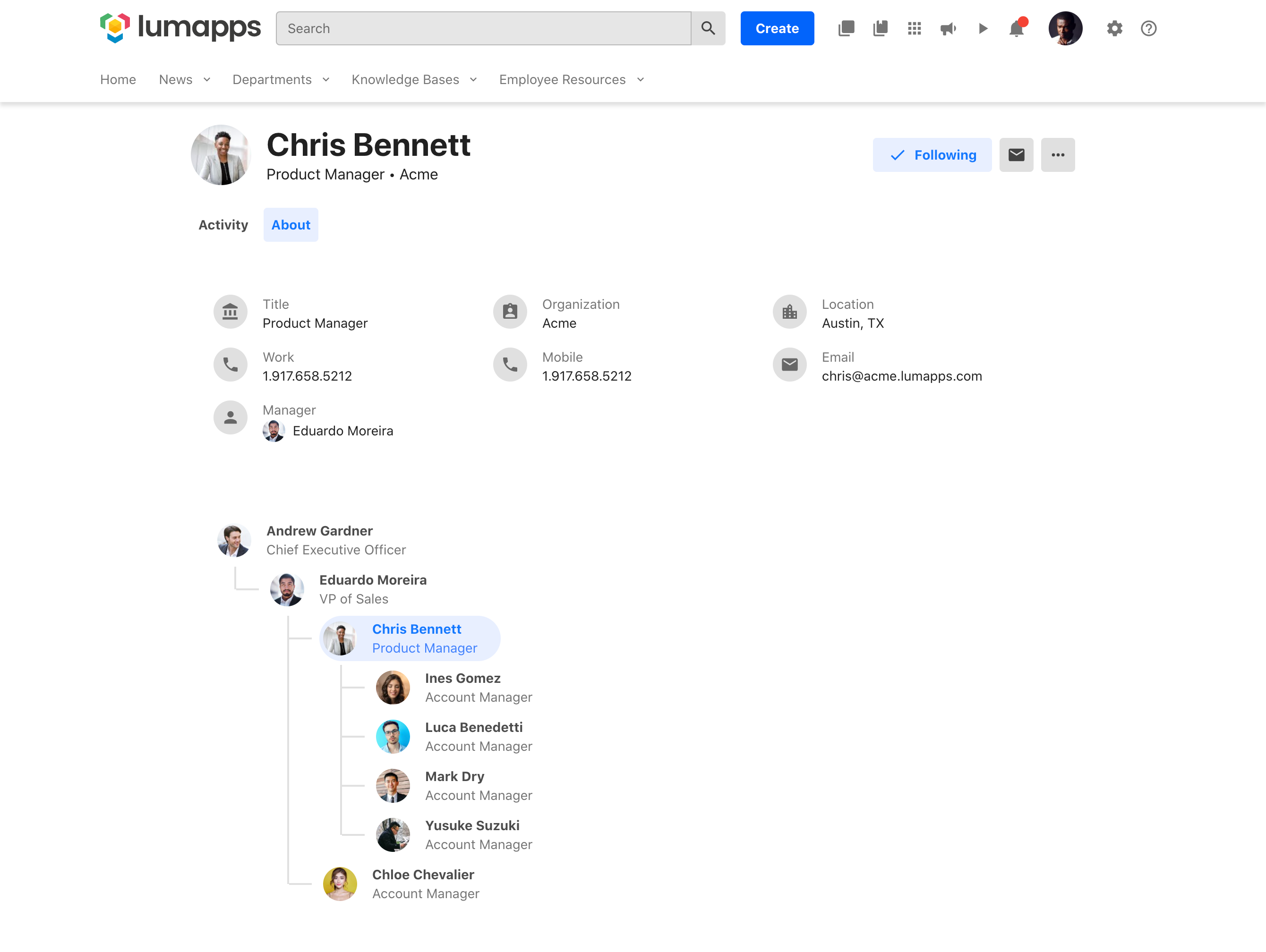
LumApps is an Employee Experience Platform that engages every employee with personalized communications, regardless of location, and empowers them to do their best work by connecting them with the tools, people, and information they need to get the job done. Integrations with both Microsoft and Google enables employees to share knowledge, resources, and connect with each other. The employee experience platform aligns and engages digital workplaces, and enables…
N/A
OpenText Vibe
Score 6.0 out of 10
N/A
OpenText Vibe (formerly Micro Focus Vibe) is a web-based team collaboration platform developed by Novell, and was initially released by Novell in June 2008 under the name of Novell Teaming. Novell's acquisition by Micro Focus was completed in April 2015.
LumApps is THE employee experience platform! With its customizable meta-data, I was able to create over 700 pieces of content to deploy a regionalized user experience for our global sales and customer success teams. No longer were employees inundated with content that did not apply to their region or market. With LumApps’ best in class functionality, the integrations that our organization uses, such as Google and Slack were easily integrated within LumApps to create a seamless user experience for a global audience.
How fast can I implement it fully for an organisation?
How many hours must I invest to get it up and running?
How does it compare to the competitors similar software?
Once up and running how much time and money will it cost me?
From the point of how it looks I would like to use it. As it is part of the Novell suite I would like to use it as I have already paid for it. So in conclusion with the help of Novell I might be able to implement it the way I want it but without extra cost.
You can create electronic forms with powerful workflows behind them. This allows for supervisor approval/rejection of forms. The workflows also allow for email alerts when certain stages are met.
Built in social media tools. Each employee has a feed which other employees can follow.
Allows employees to create teams in which they can chose members and rights.
The editing user interface is a bit wonky and occasionally glitchy.
The back-end options are not organized super well, which can make it confusing to find the right settings.
The customization options are somewhat limited without advanced CSS/dev skills, and the basic functions can be a bit challenging for some non-technical users.
We would never go back to a spreadsheet to manage our inventory! Since Vibe is essentially free for us there's no reason not to continue using it. We plan on rolling out more processes in other departments for the coming year. The biggest obstacle is change. People don't want to change doing things they have been doing for years. If the workflow saves time people will embrace it.
As I said before, LumApps platform is not intuitive at all, people have a lot of trouble using the tool, the curve to learn is too high, mainly the style part, is so confusing what I am adjusting there, is the outside of the widget? What does the padding do, what does the margin does.
At this moment it still looks you need to do a lot to be able to use it and to be honest that time should be used for work not for configuring a communication tool for the business. Yes I understand that it takes time to learn something to use in the organisation , but with this tool I see the help desk having to answer a lot of questions on how to use it or once someone has done something how to undo it.
Question and bug support are very helpful and quick. About the feature requests, we don’t have much visibility of the features that we suggested, or If they are going to implement some solutions or not.
It overall stacked up incredibly against all its competitors. Its customer service, simple to use format, and ease of implementation were hard to beat. We got up and running in about 6-8 months and it was right on schedule for implementation. It's feature set was smaller then it's competitors but even at first glance it was much easier to use for the amount customization it contained. We considered factors when purchasing like ease of use, adaptability, and look/feel overall as a product. No product came close to LumApps on these features.
I think the closest well known product that stacks up to Vibe is Microsoft SharePoint. But I really can't make a true comparison because when I tried SharePoint, I didn't know quite know where to start which really dissuaded me from exploring further. With SharePoint, I hear and see that it can do a lot of things, but I feel like I have to be a coder of some sort in order to know what to do. And the templates available to start from is far from what I actually need in order to be productive in my industry. What my team migrated from was an open source platform called Projectfork. I really loved that platform, but it is easy to break. So in search from something stable, I stumbled across Vibe. It gave me the features I was accustomed to having plus the reporting, improved document versioning, easier flow of setting up users and permissions, and push notifications.
It is starting to reduce our reliance on email, and the overall volume of email.
It has created a smoother induction process for new starters because it is a central place where all employees can go for the core information and resources they need to stay informed and do their job.