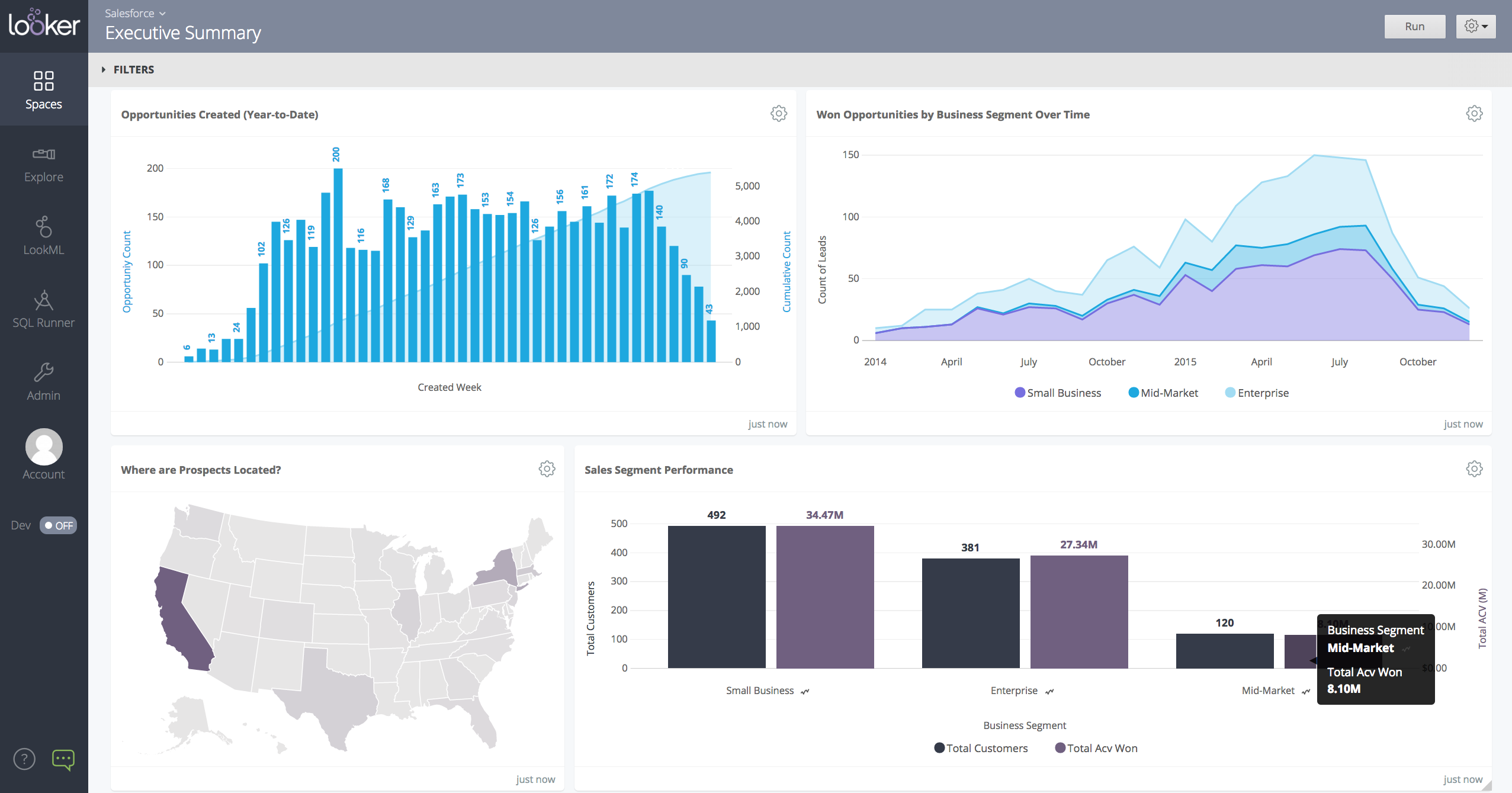
Looker is a BI application with an analytics-oriented application server that sits on top of relational data stores. It includes an end-user interface for exploring data, a reusable development paradigm for data discovery, and an API for supporting data in other systems.
N/A
Tableau Desktop
Score8.1 out of 10
N/A
Tableau Desktop is a data visualization product from Tableau. It connects to a variety of data sources for combining disparate data sources without coding. It provides tools for discovering patterns and insights, data calculations, forecasts, and statistical summaries and visual storytelling.
$75
per month
Pricing
Looker
Tableau Desktop
Editions & Modules
No answers on this topic
Tableau
$75
per month per user
Tableau Enterprise
$115
per month per user
Offerings
Pricing Offerings
Looker
Tableau Desktop
Free Trial
Yes
No
Free/Freemium Version
No
No
Premium Consulting/Integration Services
Yes
Yes
Entry-level Setup Fee
Required
No setup fee
Additional Details
Must contact sales team for pricing.
All pricing plans are billed annually.
More Pricing Information
Community Pulse
Looker
Tableau Desktop
Considered Both Products
Google
Verified User
Chose Looker
Better in terms of data configuration with slight harder learning curve, available help material is not that much and we usually have to connect with Looker Help with chat for our data and analysis questions. While Looker offers a wide range of visualization options, there were …
A de minimis incentive was given to thank the reviewer for their time. The incentive was not used to bias or drive a particular response, nor was the incentive contingent on a positive endorsement. More Info
Verified User
Chose Looker
It takes forever sometimes to have data ready in Tableau dashboard, and also it takes effort to maintain each dashboards. We do not have so many efforts to maintain all. Also, we need to be able to see data faster and therefore take actions and work faster. With Looker we might …
A de minimis incentive was given to thank the reviewer for their time. The incentive was not used to bias or drive a particular response, nor was the incentive contingent on a positive endorsement. More Info
Senior Manager of Digital Paid Marketing in Marketing at BAYADA Home Health Care (Hospital & Health Care, 10,001+ employees)
Chose Looker
Looker Studio is not as robust as Tableau or Microsoft BI. So it does not provide quite as much insight or depth and it has more limitations overall then the other major reporting products. However, it is also free and connects perfectly with other Google products. Plus, all of …
A de minimis incentive was given to thank the reviewer for their time. The incentive was not used to bias or drive a particular response, nor was the incentive contingent on a positive endorsement. More Info
Verified User
Chose Looker
The learning curve for Tableau Cloud was too steep for our team. After watching a couple of YouTube videos, anyone can begin connecting data sources and creating reports with Looker. Looker is also free with Google Workspace, making the decision between Looker and Tableau a …
A de minimis incentive was given to thank the reviewer for their time. The incentive was not used to bias or drive a particular response, nor was the incentive contingent on a positive endorsement. More Info
Senior Marketing Data Analyst in Marketing at Brondell (Marketing and Advertising, 51-200 employees)
Chose Looker
Tableau did not have the customization that we were told it had, and it was expensive. Domo looks promising, but is also expensive so we haven't purchased it (we may in the future). Google Sheets was very basic and did fine for what it was, but we needed something a bit more …
A de minimis incentive was given to thank the reviewer for their time. The incentive was not used to bias or drive a particular response, nor was the incentive contingent on a positive endorsement. More Info
Verified User
Chose Looker
I don't remember much about Tableau, but it was chaotic and poorly set up for our company.
A de minimis incentive was given to thank the reviewer for their time. The incentive was not used to bias or drive a particular response, nor was the incentive contingent on a positive endorsement. More Info
Verified User
Chose Looker
Looker is free, so it's certainly better bang for your buck. It's a good platform for someone who just needs a quick way to look at the data they have. It doesn't have some of the advanced functionality that Tableau has, but it integrates well with the Google ecosystem, so it's …
A de minimis incentive was given to thank the reviewer for their time. The incentive was not used to bias or drive a particular response, nor was the incentive contingent on a positive endorsement. More Info
Verified User
Chose Looker
Looker and Tableau are similar products with benefits and drawbacks according to which software you choose to employ. Looker is a Google product whereas Tableau is a Salesforce product. Depending on your existing tech stack it is recommended to leverage the integrated, native …
A de minimis incentive was given to thank the reviewer for their time. The incentive was not used to bias or drive a particular response, nor was the incentive contingent on a positive endorsement. TR verified that a representative sample of customers was invited. More Info
Verified User
Chose Looker
We use both Looker and Tableau. It depends on the specific team. However, there is a clear correlation that we use Tableau more often when there are more data sources, including financial data.
A de minimis incentive was given to thank the reviewer for their time. The incentive was not used to bias or drive a particular response, nor was the incentive contingent on a positive endorsement. TR verified that a representative sample of customers was invited. More Info
Verified User
Chose Looker
Looker is considerably easier to learn than any of the other tools listed above. For example, Tableau does offer a robust selection of visualizations, however setting them up and plotting the data correctly is considerably harder than in Looker. Another major advantage of …
A de minimis incentive was given to thank the reviewer for their time. The incentive was not used to bias or drive a particular response, nor was the incentive contingent on a positive endorsement. TR verified that a representative sample of customers was invited. More Info
Verified User
Chose Looker
In terms of user interface and freedom of customization, Tableau is probably still better than Looker. However, Looker is very good in scenarios where multiple data sources and dashboards already exist within the organization and need to be integrated/unified in one place. That …
A de minimis incentive was given to thank the reviewer for their time. The incentive was not used to bias or drive a particular response, nor was the incentive contingent on a positive endorsement. TR verified that a representative sample of customers was invited. More Info
Data Lord in Engineering at PlaceIQ (Internet, 51-200 employees)
Chose Looker
Looker was easier to use, better integration with non-standard datastores, such as Prestodb, and Snowflake, and BigTable. Ease of manageability. Creation of reports faster and easier compared to QlikView. Tableau has better heat maps, however, Looker has better drill down in …
A de minimis incentive was given to thank the reviewer for their time. The incentive was not used to bias or drive a particular response, nor was the incentive contingent on a positive endorsement. More Info
Senior DevOps Engineer in Information Technology at Simpli.fi (Online Media, 201-500 employees)
Chose Looker
Looker is cheaper, by far. Easier to manage. In the end, Looker was a better choice for us, even with its maintenance warts and the headaches with the APIs. Tableau licensing is difficult to manage, at the very least, whereas Looker is not. User management is much easier to …
A de minimis incentive was given to thank the reviewer for their time. The incentive was not used to bias or drive a particular response, nor was the incentive contingent on a positive endorsement. More Info
Verified User
Chose Looker
Looker is a lot easier to connect with our data pipelines and for users to create their own scalable Explores. Before, analysts would have to create separate Tableau dashboards for each ask, but now with Lookers Explores, some teams are able to self serve and create their own …
A de minimis incentive was given to thank the reviewer for their time. The incentive was not used to bias or drive a particular response, nor was the incentive contingent on a positive endorsement. More Info
A de minimis incentive was given to thank the reviewer for their time. The incentive was not used to bias or drive a particular response, nor was the incentive contingent on a positive endorsement. More Info
Verified User
Chose Looker
Looker empowers users to create their own views/dashboards from its web application. The last time I used Tableau (in 2015), only certain license holders could create content from the desktop application. Everyone else was a view only user. On that theme, we found Looker to be …
A de minimis incentive was given to thank the reviewer for their time. The incentive was not used to bias or drive a particular response, nor was the incentive contingent on a positive endorsement. More Info
Verified User
Chose Looker
Tableau has an adoption issue of having to upgrade to the most recent Tableau reader. In my experience it was very difficult to get the sales team to do this.
microstrategy was the most overly complicated reporting software I have ever used. You need a consultant to do …
A de minimis incentive was given to thank the reviewer for their time. The incentive was not used to bias or drive a particular response, nor was the incentive contingent on a positive endorsement. More Info
Senior PLM engineer in Manufacturing at IGW (Mechanical Or Industrial Engineering, 5001-10,000 employees)
Chose Looker
Looker is a great fit for our company because we have collaborative analytics workflows and complicated data ecosystems and because of its strengths in data modeling, integration, and collaboration. Brand name and peer recommendations also helps us to select Looker against …
A de minimis incentive was given to thank the reviewer for their time. The incentive was not used to bias or drive a particular response, nor was the incentive contingent on a positive endorsement. More Info
Verified User
Chose Looker
We haven't had a proper benchmarking done. We might consider looking at other options, but this thing is deeply integrated into our platform, so not anytime soon.
A de minimis incentive was given to thank the reviewer for their time. The incentive was not used to bias or drive a particular response, nor was the incentive contingent on a positive endorsement. More Info
Verified User
Chose Looker
I choose Looker when I need quick charts. It is easier to start and configure, browser-based, and easy to connect with Google Sheets. This gives it a good competitive advantage when comparing pricing—other similar tools have expensive licenses. In a corporate Google …
A de minimis incentive was given to thank the reviewer for their time. The incentive was not used to bias or drive a particular response, nor was the incentive contingent on a positive endorsement. More Info
Director of Social Media in Marketing at Gaytravel (Marketing & Advertising, 51-200 employees)
Chose Looker
Looker is overall the best software for data visualization simply because it does not take a lot of time to onboard someone for this software and it still has tons of functionality.
A de minimis incentive was given to thank the reviewer for their time. The incentive was not used to bias or drive a particular response, nor was the incentive contingent on a positive endorsement. More Info
Graduate Research Assistant in Research & Development at Western Kentucky University (Higher Education, 1001-5000 employees)
Chose Looker
Looker provides really excellent customer service in comparison to other similar products. The sharing aspect of Looker is also a big plus, which allows multiple users to access the data at the same time. We have also found it to stand out among competitors with its dashboard …
A de minimis incentive was given to thank the reviewer for their time. The incentive was not used to bias or drive a particular response, nor was the incentive contingent on a positive endorsement. More Info
Verified User
Chose Looker
Most of the other BI tools are fairly similar in terms of charting capabilities and performance. Looker stands out with its modeling layer and SQL free end-user interface. It also has a feature-rich API enabling you to embed Looker into your own web app to customize it further …
A de minimis incentive was given to thank the reviewer for their time. The incentive was not used to bias or drive a particular response, nor was the incentive contingent on a positive endorsement. More Info
Senior Business Analyst in Product Management at Schibsted Marketplaces (Consumer Services, 501-1000 employees)
Chose Tableau Desktop
Tableau is more flexible than these - I liked QlikView old version a lot but have not used the Qlik Sense etc new ones. Tableau user logic is harder to understand than Looker Studio. However it's more trust worthy. Connecting internet sources to Tableau Desktop is much harder. …
A de minimis incentive was given to thank the reviewer for their time. The incentive was not used to bias or drive a particular response, nor was the incentive contingent on a positive endorsement. More Info
Verified User
Chose Tableau Desktop
Looker has the benefit of being owned by Google and seamless interface with BigQuery. We didn't use BigQuery at the time, so the benefit wasn't realized. However, we are starting to use it more and more, and will be evaluating Looker again.
A de minimis incentive was given to thank the reviewer for their time. The incentive was not used to bias or drive a particular response, nor was the incentive contingent on a positive endorsement. More Info
Data analyst in Information Technology at OnlineSales.ai (Information Technology & Services, 51-200 employees)
Chose Tableau Desktop
Tableau can create visually attractive customizable dashboards than can quickly by drag-drop while in power bi we can create simple dashboard. Power bi support lesser data source while in Tableau there is a lot of options When we talk about data handling tableau is a clear …
A de minimis incentive was given to thank the reviewer for their time. The incentive was not used to bias or drive a particular response, nor was the incentive contingent on a positive endorsement. More Info
Assistant Professor at Geetanjali Institute of Technical Studies, Udaipur (Higher Education, 51-200 employees)
Chose Tableau Desktop
We shifted to Tableau as it performs better than power BI. Tableau can handle data from multiple data sources while Power BI is restricted to limited data sources.
A de minimis incentive was given to thank the reviewer for their time. The incentive was not used to bias or drive a particular response, nor was the incentive contingent on a positive endorsement. More Info
Verified User
Chose Tableau Desktop
It's easy to use and has a great selection of color palettes and templates.
A de minimis incentive was given to thank the reviewer for their time. The incentive was not used to bias or drive a particular response, nor was the incentive contingent on a positive endorsement. More Info
Looker and Tableau Desktop are Business Intelligence tools designed to help users perform data analysis and create visualizations to display their findings. Both Business Intelligence tools are used by businesses of all sizes, though large enterprises prefer Tableau Desktop while Looker is most popular with mid-sized businesses.
Tableau Desktop offers strong visualization features that allow data analysts to create sophisticated visualizations. Looker has robust analytics features that enable non-technical users to create simple queries, while technical staff can create complex, customized queries.
Features
Looker and Tableau Desktop both provide essential business intelligence features such as data visualization and analysis, but they also both have some standout features.
Looker includes a library of analytics code blocks that allow new users to perform analysis on stored data easily. These code blocks are entirely customizable as well, so advanced users can create custom queries. Looker also offers many built-in integrations and has a flexible system for pulling in data from applications that don’t have a native integration. As a result, Looker can collect data from many sources without issue.
Tableau Desktop includes OLAP compatibility, allowing for web-based analytics and data collection. Additionally, Tableau Desktop has APIs for many big data analytics tools, allowing for visualizations based on data analysis performed by big data software. Lastly, Tableau has robust visualization features that help users to create simple visualizations, or use advanced features to create complex, interactive visualizations.
Limitations
Though Looker and Tableau Desktop both have comprehensive features for business intelligence, they also have a few important limitations.
Looker doesn’t have any support for OLAP, which makes web-based analytics more difficult. Companies that need to make use of OLAP may not be able to use Looker. Additionally, Looker doesn’t offer as many tools or integrations for big data analysis. Lastly, though Looker offers visualization features, they are not as sophisticated as the advanced visualizations that Tableau Desktop provides.
Tableau Desktop doesn’t offer analytics tools that are as straightforward as Lookers analytics blocks. Performing analytics using Tableau requires technical staff to write queries using Tableau Desktop’s visual query language. Tableau Desktop’s tools for third-party data collection are not as robust as Looker’s multiple integrations and tools for third-party data collection.
Pricing
Looker pricing depends on the size and user needs of the business. Quotes from Looker can include or remove features as needed by the organization.
Tableau Desktop pricing depends on the number of licenses purchased. The Viewer license costs $12.00 per month per user and allows for data viewing and interaction. The Explorer package costs $35.00 per month per user and allows for data querying and content sharing. Lastly, the Creator package costs $70.00 per month per user and allows for the creation of sophisticated visualization.
Features
Looker
Tableau Desktop
BI Standard Reporting
Comparison of BI Standard Reporting features of Looker and Tableau Desktop
Feature
Looker
8.5
116 Ratings
4% above category average
Tableau Desktop
8.3
167 Ratings
2% above category average
Pixel Perfect reports
8.195 Ratings
8.8139 Ratings
Customizable dashboards
9.0115 Ratings
8.4166 Ratings
Report Formatting Templates
8.499 Ratings
7.8145 Ratings
Ad-hoc Reporting
Comparison of Ad-hoc Reporting features of Looker and Tableau Desktop
Feature
Looker
8.5
116 Ratings
5% above category average
Tableau Desktop
8.7
164 Ratings
8% above category average
Drill-down analysis
8.2112 Ratings
8.6159 Ratings
Formatting capabilities
7.9114 Ratings
9.2162 Ratings
Integration with R or other statistical packages
8.947 Ratings
7.7122 Ratings
Report sharing and collaboration
9.2116 Ratings
9.2157 Ratings
Report Output and Scheduling
Comparison of Report Output and Scheduling features of Looker and Tableau Desktop
Feature
Looker
8.9
112 Ratings
7% above category average
Tableau Desktop
8.1
158 Ratings
3% below category average
Publish to Web
8.494 Ratings
7.3149 Ratings
Publish to PDF
9.1100 Ratings
7.9149 Ratings
Report Versioning
8.775 Ratings
8.2116 Ratings
Report Delivery Scheduling
9.297 Ratings
9.2123 Ratings
Delivery to Remote Servers
00 Ratings
8.073 Ratings
Data Discovery and Visualization
Comparison of Data Discovery and Visualization features of Looker and Tableau Desktop
Looker is ideal if you are heavily invested in Google Services, particularly marketing related services, and you with to quickly create reporting dashboards for that data. It gets more difficult when you try to tie in data from other services, and I would not use this were I already using BI package - it is not anywhere near as well supported or as widely known as some of its major competitors, but what it does do, it does do well.
A de minimis incentive was given to thank the reviewer for their time. The incentive was not used to bias or drive a particular response, nor was the incentive contingent on a positive endorsement. More Info
The best scenario is definitely to collect data from several sources and create dedicated dashboards for specific recipients. However, I miss the possibility of explaining these reports in more detail. Sometimes, we order a report, and after half a year, we don't remember the meaning of some data (I know it's our fault as an organization, but the tool could force better practices).
A de minimis incentive was given to thank the reviewer for their time. The incentive was not used to bias or drive a particular response, nor was the incentive contingent on a positive endorsement. More Info
Show visited pages - sessions, pageviews - which programs are viewed the most.
Displays session source/medium views to see where users are coming from.
It shows the video titles, URLs, and event counts so we can monitor the performance of our videos.
It gives a graphic face to the numbers, such as using bar charts, pie graphs, and other charts to show user trends or which channels are driving engagement.
Our clients like to see the top pages visited for a month.
I like the drop-and-drag approach, and building charts is a little easier than it was before.
A de minimis incentive was given to thank the reviewer for their time. The incentive was not used to bias or drive a particular response, nor was the incentive contingent on a positive endorsement. More Info
An excellent tool for data visualization, it presents information in an appealing visual format—an exceptional platform for storing and analyzing data in any size organization.
Through interactive parameters, it enables real-time interaction with the user and is easy to learn and get support from the community.
A de minimis incentive was given to thank the reviewer for their time. The incentive was not used to bias or drive a particular response, nor was the incentive contingent on a positive endorsement. More Info
A de minimis incentive was given to thank the reviewer for their time. The incentive was not used to bias or drive a particular response, nor was the incentive contingent on a positive endorsement. More Info
I give it this rating because it deems as effective, I am able to complete majority of my tasks using this app. It is very helpful when analyzing the data provided and shown in the app and it's just overall a great app for Operational use, despite the small hiccups it has (live data).
A de minimis incentive was given to thank the reviewer for their time. The incentive was not used to bias or drive a particular response, nor was the incentive contingent on a positive endorsement. TR verified that a representative sample of customers was invited. More Info
Our use of Tableau Desktop is still fairly low, and will continue over time. The only real concern is around cost of the licenses, and I have mentioned this to Tableau and fully expect the development of more sensible models for our industry. This will remove any impediment to expansion of our use.
A de minimis incentive was given to thank the reviewer for their time. The incentive was not used to bias or drive a particular response, nor was the incentive contingent on a positive endorsement. More Info
Looker is relatively easy to use, even as it is set up. The customers for the front-end only have issues with the initial setup for looker ml creations. Other "looks" are relatively easy to set up, depending on the ETL and the data which is coming into Looker on a regular basis.
A de minimis incentive was given to thank the reviewer for their time. The incentive was not used to bias or drive a particular response, nor was the incentive contingent on a positive endorsement. More Info
Tableau Desktop has proven to be a lifesaver in many situations. Once we've completed the initial setup, it's simple to use. It has all of the features we need to quickly and efficiently synthesize our data. Tableau Desktop has advanced capabilities to improve our company's data structure and enable self-service for our employees.
A de minimis incentive was given to thank the reviewer for their time. The incentive was not used to bias or drive a particular response, nor was the incentive contingent on a positive endorsement. TR verified that a representative sample of customers was invited. More Info
When used as a stand-alone tool, Tableau Desktop has unlimited uptime, which is always nice. When used in conjunction with Tableau Server, this tool has as much uptime as your server admins are willing to give it. All in all, I've never had an issue with Tableau's availability.
Somehow resources heavy, both on server and client. I recommned at least 50Mbs data rate and high performance desktop comouter to be abke to run comolex tasks and configure larger amount of data. On the other hand, the client does not need to worry when viewing, the performance is usually ok
A de minimis incentive was given to thank the reviewer for their time. The incentive was not used to bias or drive a particular response, nor was the incentive contingent on a positive endorsement. TR verified that a representative sample of customers was invited. More Info
Tableau Desktop's performance is solid. You can really dig into a large dataset in the form of a spreadsheet, and it exhibits similarly good performance when accessing a moderately sized Oracle database. I noticed that with Tableau Desktop 9.3, the performance using a spreadsheet started to slow around 75K rows by about 60 columns. This was easily remedied by creating an extract and pushing it to Tableau Server, where performance went to lightning fast
A de minimis incentive was given to thank the reviewer for their time. The incentive was not used to bias or drive a particular response, nor was the incentive contingent on a positive endorsement. More Info
Never had to work with support for issues. Any questions we had, they would respond promptly and clearly. The one-time setup was easy, by reading documentation. If the feature is not supported, they will add a feature request. In this case, LDAP support was requested over OKTA. They are looking into it.
A de minimis incentive was given to thank the reviewer for their time. The incentive was not used to bias or drive a particular response, nor was the incentive contingent on a positive endorsement. More Info
Tableau support has been extremely responsive and willing to help with all of our requests. They have assisted with creating advanced analysis and many different types of custom icons, data formatting, formulas, and actions embedded into graphs. Tableau offers a weekly presentation of features and assists with internal company projects.
A de minimis incentive was given to thank the reviewer for their time. The incentive was not used to bias or drive a particular response, nor was the incentive contingent on a positive endorsement. More Info
It is admittedly hard to train a group of people with disparate levels of ability coming in, but the software is so easy to use that this is not a huge problem; anyone who can follow simple instructions can catch up pretty quickly.
I think the training was good overall, but it was maybe stating the obvious things that a tech savvy young engineer would be able to pick up themselves too. However, the example work books were good and Tableau web community has helped me with many problems
A de minimis incentive was given to thank the reviewer for their time. The incentive was not used to bias or drive a particular response, nor was the incentive contingent on a positive endorsement. More Info
A de minimis incentive was given to thank the reviewer for their time. The incentive was not used to bias or drive a particular response, nor was the incentive contingent on a positive endorsement. TR verified that a representative sample of customers was invited. More Info
Again, training is the key and the company provides a lot of example videos that will help users discover use cases that will greatly assist their creation of original visualizations. As with any new software tool, productivity will decline for a period. In the case of Tableau, the decline period is short and the later gains are well worth it.
A de minimis incentive was given to thank the reviewer for their time. The incentive was not used to bias or drive a particular response, nor was the incentive contingent on a positive endorsement. More Info
Looker Studio, you can easily report on data from various sources without programming. Looker Studio is available at no charge for creators and report viewers. Enterprise customers who upgrade to Looker Studio Pro will receive support and expanded administrative features, including team content management. So it's good.
A de minimis incentive was given to thank the reviewer for their time. The incentive was not used to bias or drive a particular response, nor was the incentive contingent on a positive endorsement. TR verified that a representative sample of customers was invited. More Info
I have used Power BI as well, the pricing is better, and also training costs or certifications are not that high. Since there is python integration in Power BI where I can use data cleaning and visualizing libraries and also some machine learning models. I can import my python scripts and create a visualization on processed data.
A de minimis incentive was given to thank the reviewer for their time. The incentive was not used to bias or drive a particular response, nor was the incentive contingent on a positive endorsement. More Info
A de minimis incentive was given to thank the reviewer for their time. The incentive was not used to bias or drive a particular response, nor was the incentive contingent on a positive endorsement. TR verified that a representative sample of customers was invited. More Info
Tableau Desktop's scaleability is really limited to the scale of your back-end data systems. If you want to pull down an extract and work quickly in-memory, in my application it scaled to a few tens of millions of rows using the in-memory engine. But it's really only limited by your back-end data store if you have or are willing to invest in an optimized SQL store or purpose-built query engine like Veritca or Netezza or something similar.
Looker has a poignant impact on our business's ROI objectives. As an advertising exchange we have specific goals for daily requests and fill, and having premade Looks to monitor this is an integral piece of our operational capability
To facilitate an efficient monthly billing cycle in our organization, Looker is essential to track estimated revenue and impression delivery by publisher. Without the Looks we have set up, we would spend considerably more time and effort segmenting revenue by vertical.
Looker's unique value proposition is making analytical tools more digestible to people without conventional analytical experience. Other competing tools like Tableau require considerably more training and context to successfully use, and the ability to easily plot different visualizations is one of its greatest selling points.
A de minimis incentive was given to thank the reviewer for their time. The incentive was not used to bias or drive a particular response, nor was the incentive contingent on a positive endorsement. TR verified that a representative sample of customers was invited. More Info
Tableau was acquired years ago, and has provided good value with the content created.
Ongoing maintenance costs for the platform, both to maintain desktop and server licensing has made the continuing value questionable when compared to other offerings in the marketplace.
Users have largely been satisfied with the content, but not with the overall performance. This is due to a combination of factors including the performance of the Tableau engines as well as development deficiencies.
A de minimis incentive was given to thank the reviewer for their time. The incentive was not used to bias or drive a particular response, nor was the incentive contingent on a positive endorsement. More Info