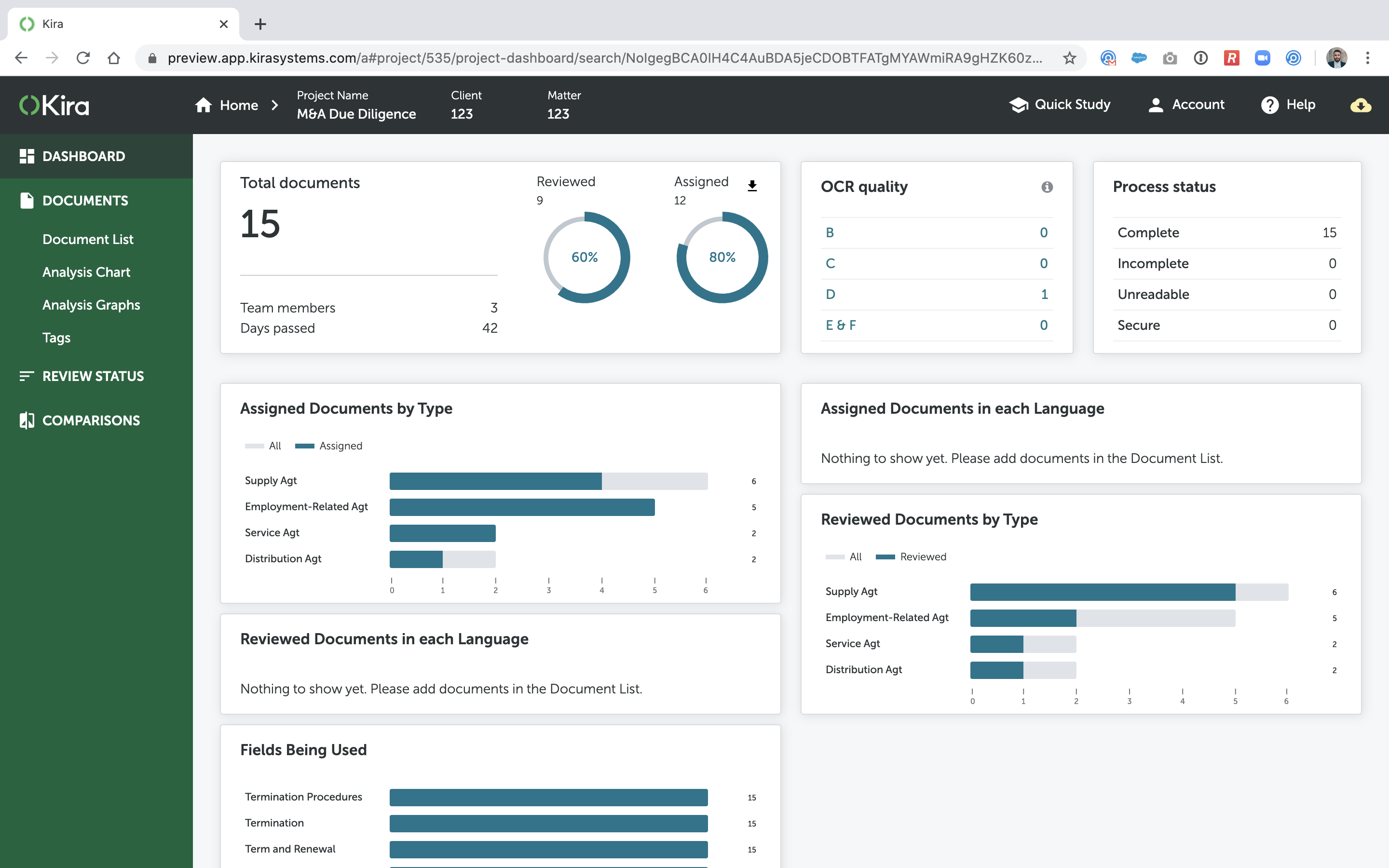
Kira, now from Litera (acquired August, 2021) is software that searches and analyzes contract text. Kira offers pre-built, machine learning models covering due diligence, general commercial, corporate organization, real estate and compliance. Using Kira Quick Study, anyone can train additional models that can identify any desired clause. Kira can be deployed on virtual data rooms and other large repositories of contracts, creating summary analyses.
N/A
TensorFlow
Score8.2 out of 10
N/A
TensorFlow is an open-source machine learning software library for numerical computation using data flow graphs. It was originally developed by Google.
Kira is a great due diligence tool and can be well utilised on both large and small transactions. It also has good application if you are looking to compare multiple documents against a model form document or market standard templates. Kira is less useful if you are looking to review emails (e.g. as part of a disclosure exercise); or if your review involves non-Latin based script languages.
TensorFlow is great for most deep learning purposes. This is especially true in two domains: 1. Computer vision: image classification, object detection and image generation via generative adversarial networks 2. Natural language processing: text classification and generation. The good community support often means that a lot of off-the-shelf models can be used to prove a concept or test an idea quickly. That, and Google's promotion of Colab means that ideas can be shared quite freely. Training, visualizing and debugging models is very easy in TensorFlow, compared to other platforms (especially the good old Caffe days). In terms of productionizing, it's a bit of a mixed bag. In our case, most of our feature building is performed via Apache Spark. This means having to convert Parquet (columnar optimized) files to a TensorFlow friendly format i.e., protobufs. The lack of good JVM bindings mean that our projects end up being a mix of Python and Scala. This makes it hard to reuse some of the tooling and support we wrote in Scala. This is where MXNet shines better (though its Scala API could do with more work).
A de minimis incentive was given to thank the reviewer for their time. The incentive was not used to bias or drive a particular response, nor was the incentive contingent on a positive endorsement. More Info
A de minimis incentive was given to thank the reviewer for their time. The incentive was not used to bias or drive a particular response, nor was the incentive contingent on a positive endorsement. More Info
A de minimis incentive was given to thank the reviewer for their time. The incentive was not used to bias or drive a particular response, nor was the incentive contingent on a positive endorsement. More Info
Inability to relabel smart fields to suit the review process means it is hard to align it to particular projects (e.g. it would be useful to relabel the "Assignment" smart field as "Is the contract assignable?")
Not enough non-English smart fields.
Needs the ability to resell user-trained smart fields in a marketplace.
Output is not customizable enough.
Built-in analysis tools are useful but a little basic.
A de minimis incentive was given to thank the reviewer for their time. The incentive was not used to bias or drive a particular response, nor was the incentive contingent on a positive endorsement. More Info
Theano is perhaps a bit faster and eats up less memory than TensorFlow on a given GPU, perhaps due to element-wise ops. Tensorflow wins for multi-GPU and “compilation” time.
If our firm had more contracts in English, the usability of Kira would be rated higher. However, since we have to train clauses in Portuguese in order to use Kira, it makes its usability lower. We still are not able to fully use Kira for reading contracts in Portuguese. It takes a long time and many associate hours to make Kira usable in other languages.
A de minimis incentive was given to thank the reviewer for their time. The incentive was not used to bias or drive a particular response, nor was the incentive contingent on a positive endorsement. More Info
A de minimis incentive was given to thank the reviewer for their time. The incentive was not used to bias or drive a particular response, nor was the incentive contingent on a positive endorsement. More Info
Customer Support is excellent. The online help portal is probably the best I have ever seen. Great videos with content easily found. The HelpLine is staffed by knowledgeable people. The videos have saved us providing a lot of in-house training, which we would struggle to resource. The account managers really know the product and their law firm clients and share best practices and trends.
A de minimis incentive was given to thank the reviewer for their time. The incentive was not used to bias or drive a particular response, nor was the incentive contingent on a positive endorsement. More Info
Community support for TensorFlow is great. There's a huge community that truly loves the platform and there are many examples of development in TensorFlow. Often, when a new good technique is published, there will be a TensorFlow implementation not long after. This makes it quick to ally the latest techniques from academia straight to production-grade systems. Tooling around TensorFlow is also good. TensorBoard has been such a useful tool, I can't imagine how hard it would be to debug a deep neural network gone wrong without TensorBoard.
A de minimis incentive was given to thank the reviewer for their time. The incentive was not used to bias or drive a particular response, nor was the incentive contingent on a positive endorsement. More Info
A de minimis incentive was given to thank the reviewer for their time. The incentive was not used to bias or drive a particular response, nor was the incentive contingent on a positive endorsement. More Info
Kira offers a lot more out of the box than other providers and is also more flexible around integrations. This, plus the clear pricing structure, is why we went for it instead of (or as well as) others. Diligen, RAVN, Leverton, Della, Seal not in list.
A de minimis incentive was given to thank the reviewer for their time. The incentive was not used to bias or drive a particular response, nor was the incentive contingent on a positive endorsement. More Info
Keras is built on top of TensorFlow, but it is much simpler to use and more Python style friendly, so if you don't want to focus on too many details or control and not focus on some advanced features, Keras is one of the best options, but as far as if you want to dig into more, for sure TensorFlow is the right choice
A de minimis incentive was given to thank the reviewer for their time. The incentive was not used to bias or drive a particular response, nor was the incentive contingent on a positive endorsement. More Info
A de minimis incentive was given to thank the reviewer for their time. The incentive was not used to bias or drive a particular response, nor was the incentive contingent on a positive endorsement. More Info
A de minimis incentive was given to thank the reviewer for their time. The incentive was not used to bias or drive a particular response, nor was the incentive contingent on a positive endorsement. More Info