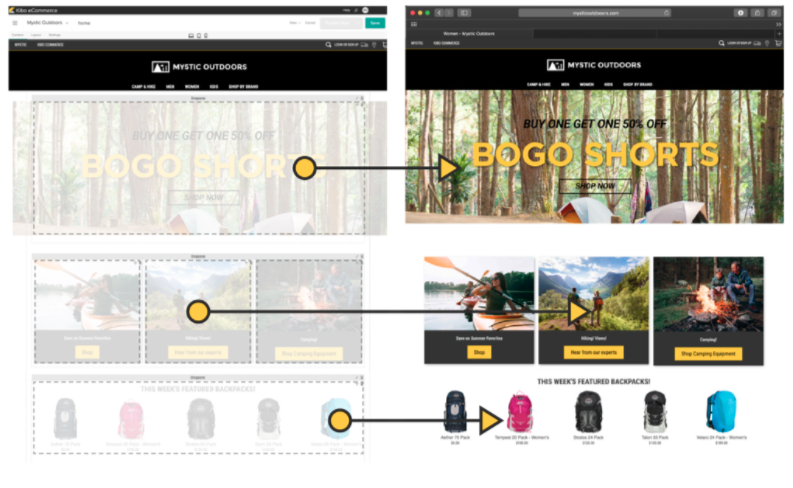
Kibo Software offers Kibo eCommerce (formerly Mozu), designed to support retailers with online offer creation and deployment, content publishing and landing pages, and many tools and widgets out of the box with a retail-oriented ecommerce solution.
Mozu was acquired by Kibo Software from Volusion in October 2016.
N/A
Volusion
Score 4.8 out of 10
N/A
Volusion is a cloud-based ecommerce solution from the company of the same name in Austin, TX. It features an intuitive dashboard, built-in marketing and promos, SEO, templates, and tools to customize look and appearance.
$29
per month
Pricing
Kibo eCommerce
Volusion
Editions & Modules
No answers on this topic
Personal
$29
per month
Pro
$79
per month
Startup
$179
per month
Business
$299
per month
Offerings
Pricing Offerings
Kibo eCommerce
Volusion
Free Trial
No
Yes
Free/Freemium Version
No
No
Premium Consulting/Integration Services
No
No
Entry-level Setup Fee
No setup fee
No setup fee
Additional Details
—
—
More Pricing Information
Community Pulse
Kibo eCommerce
Volusion
Features
Kibo eCommerce
Volusion
Online Storefront
Comparison of Online Storefront features of Product A and Product B
Kibo eCommerce
8.3
Ratings
6% above category average
Volusion
3.6
Ratings
74% below category average
Product catalog & listings
8.40 Ratings
4.30 Ratings
Product management
8.20 Ratings
4.30 Ratings
Bulk product upload
7.60 Ratings
4.20 Ratings
Branding
8.20 Ratings
3.60 Ratings
Mobile storefront
8.50 Ratings
1.20 Ratings
Product variations
8.50 Ratings
4.70 Ratings
Website integration
8.00 Ratings
3.30 Ratings
Visual customization
8.10 Ratings
5.10 Ratings
CMS
8.70 Ratings
2.20 Ratings
Online Shopping Cart
Comparison of Online Shopping Cart features of Product A and Product B
Kibo eCommerce
9.0
Ratings
16% above category average
Volusion
3.6
Ratings
72% below category average
Checkout user experience
9.00 Ratings
3.70 Ratings
Abandoned cart recovery
00 Ratings
3.60 Ratings
Online Payment System
Comparison of Online Payment System features of Product A and Product B
Kibo eCommerce
8.4
Ratings
1% above category average
Volusion
4.1
Ratings
68% below category average
eCommerce security
8.40 Ratings
4.10 Ratings
eCommerce Marketing
Comparison of eCommerce Marketing features of Product A and Product B
Kibo eCommerce
7.7
Ratings
0% below category average
Volusion
2.6
Ratings
99% below category average
Promotions & discounts
8.50 Ratings
4.80 Ratings
SEO
7.00 Ratings
1.20 Ratings
Personalized recommendations
00 Ratings
1.80 Ratings
eCommerce Business Management
Comparison of eCommerce Business Management features of Product A and Product B
For a small business in need of a few more tools than basic platforms, Volusion is a good option. However, if you want infinitely customizable [tools] or to have multiple integrations extracting your orders and products data, then Volusion is quite limited. Additionally, if you lack in-house development teams, Volusion is a good product that is friendly for users who are not necessarily tech-savvy.
Easy to Use. Non-technical employees can be simply trained. If you can use a social network, you can manage the backend of Volusion.
All-In-One -- without any add-ons, Volusion is a turnkey solution for eCommerce. No programming knowledge is required, no modules are needed (unless you have very advanced needs), and it features everything from website text, products, email marketing, customer accounts, shipping calculations, and back-end payment and order processing.
Allows for inventory tracking (such as Small, Medium, Large or Male/Female)
Allows for kitting (creating product bundles, up-sells, add-ons, and more)
Easy to customize -- with a little HTML knowledge, you can easily customize the free templates included in Volusion to create a personalized, dynamic web presence without the need for hiring expensive designers
Provides a great experience for the customer. Everything from search results, product display, shopping carts, wishlists, and the actual order process are delivered in a professional manner that will keep your customer feeling confident about making their purchase.
Easily integratable with Google Analytics with Sales Goal tracking -- this allows you to see where customers are coming from, what they are looking at, what they are purchasing, and when they are abandoning their carts.
Prebuilt Integration - There is not currently a large number of preexisting integrations, but custom integrations are fairly quick
Time to Deploy - Don't get me wrong, We have deployed in the timeline we expected, but if you are trying to get something off the ground fast, Kibo might not be right for you. It is a robust platform that take some time to get up and running.
Complicated Shipping - if you have a complicated shipped process, you might want to look for a tool to help, Kibo does not have very robust out of the box shipping capabilities.
Feature implementation. While they have a ton of features, they're often released haphazardly in my opinion. Sometimes it seems like they don't have testers. Typically, I'm unable to use new features until about 6 months after they're released (and over a year after I asked for them) because it takes that long to get the quirks smoothed out well enough for us to use them. It seems that they often don't understand programs that they integrate with well enough to do a proper implementation.
Timeliness of features. This can be taken with a grain of salt for many looking to compare. I'm a super-experienced user with many, many needs. We're often limited when it comes to Google (and other platform) beta programs, and even just early adoption because I have to wait for Volusion to catch up. What's tough is that I often NEED them to make a change in order for me to move forward, it's not my own limitation (but that's what you can expect when you use a third party software to run your site rather than your own team of developers).
Customer service in regards to live chat. While I LOVE that they have live chat (I'm needy, I constantly need support) - the operators are rude 75% of the time. They come into the conversation assuming I have no idea what I'm talking about and have a 'customer's always wrong' attitude. I'm sure it's frustrating to deal with ecommerce customers who don't know the first thing about websites - but I'm not one of those and I deserve respect. Our conversations nearly always begin with "Clear your cache" and "I don't see the problem" from the operator and end in "Oh, you're right. Well I don't know." from them. I will say I've dealt with one or two who actually know what they're talking about. Live chat is useless when the operators know less about the software than I do.
Slow to updates. They are often way behind when it comes to development and code. Example: They use jQuery v 1.4. We're up to 1.10 now and I'm experiencing issues for which the blame has been passed back on to me. I'm keeping up. They should be too. For me personally, the quality of development should come first. THEN worry about all of those features.
New live editor. It's seen a lot of scrutiny, which you'll find easily by Googling. My problem is that I don't need a WYSIWYG. I write in html. You have to pass through the WYSIWYG to get to the html editor. This has caused my javascript to get executed, so once I get to the html editor, I have to re-write my script because it's now shown as the execution. That's poor development. They should have an option to disable.
Inability to access pages in FTP. If you are someone who needs customization and writes in html, have fun. You can't actually access your product or category pages unless you do it through the content editors. You can absolutely access & edit your template and css files. But if you need a unique header in a product page - say a script to run, you'll have to put it in the template - adding overhead to ALL of your pages. The only workaround is hard-coding pages as "articles," which can make a mess of things.
When you spend so much time with a product like this and not only have you witnessed its growth, but you almost feel like you are next those that make the decisions of building features a certain way, you can't help but want to stay and be a part of their continued growth. It's simply a great product. Can it improve? By all means! But it will only improve because of users and avid resellers like me.
One positive note is that I have always been able to get someone on the phone in support whenever I have called, even at 1 AM. Getting someone on the phone is only half the battle though. In the first few months of using Mozu it often seemed that support didn’t know anymore about Mozu than we did. This has slowly started to change, but as a daily user you are likely to be on par with support in terms of knowing what to do when you encounter a problem. The support phone number is really most useful for having them put in a support ticket for you rather than typing it all out yourself and emailing it. It is very rare that the support reps are actually empowered to solve the problem at hand. Unless the issue you are having is user error, they will just take your information and pass it on the proper department. Your request or problem will then be ignored for months on end. Some day, it might actually get fixed but you are unlikely to be notified that this has happened. Most of these issues are assigned an internal ID that they use for tracking. Support is more than happy to pass this ID along, but it is useless. There is no way to actually see where the issue lies in the endless queue of similar issues.
You have to wait on hold for at least 45 minutes every call—the tech support person never knows the answer right away so they put you on 10 minute holds only to come back and say they're still looking for answers. The chat function could take days to get a response. Our "Dedicated Account Manager" never checks in or answers, nor are they ever in the office when we call. It's like they try to be as unavailable as possible until you forget why you even called in the first place. Insane.
At the time of our implementation Mozu did not have any processes or procedures set up around going live. We basically were forced to just wing it and hope for the best
It is best to use the built-in features and recommended services for the most turn-key experience (ie. Skipjack for payment processing so that it can all be done from the Volusion backend).
We had a custom, in-house ecommerce website before moving to Kibo. It was brittle, slow, and wasn't going to scale nearly well enough or fast enough to keep up with our requirements
I've also used Shopify as a base platform, as well as Magento. Both are better. My company has looked into moving there twice since I've been here, and the only thing stopping them is the complications of making such a move. I think Shopify offers similar value for the money with a cleaner albeit more minimalist look. Both are better options in my opinion. I would only recommend Volusion if someone had used it before and doesn't plan on making it a crucial part of their business plan.
Increased product database efficiency. It's really easy to import and export products/categories. Has likely saved us hundreds of hours.
Integration with other platforms. Integrations with comparison shopping feeds, email auto-responder tools and fulfillment tools is quite easy. This saves us on the cost for custom integrations.
Because it is a hosted solution, Volusion takes care of all the PCI and other security compliancies. Not having to monitor this and update ourselves saves money and gives us piece of mind.