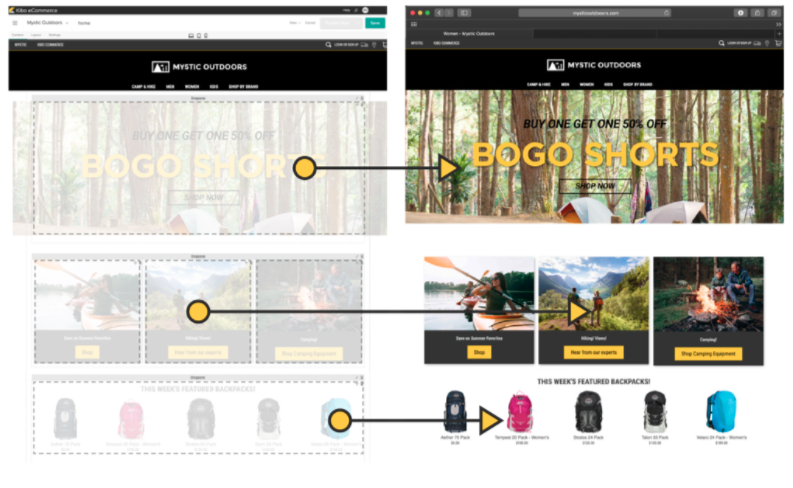
Kibo Software offers Kibo eCommerce (formerly Mozu), designed to support retailers with online offer creation and deployment, content publishing and landing pages, and many tools and widgets out of the box with a retail-oriented ecommerce solution.
Mozu was acquired by Kibo Software from Volusion in October 2016.
N/A
Magento Open Source
Score 8.5 out of 10
N/A
Magento Open Source is an ecommerce content management solution originally developed by Varien Inc and presently supported by Adobe. The Open Source product is for developers and merchants that is available as a free download, and supported with free upgrades from the Magento Community.
N/A
Pricing
Kibo eCommerce
Magento Open Source
Editions & Modules
No answers on this topic
No answers on this topic
Offerings
Pricing Offerings
Kibo eCommerce
Magento Open Source
Free Trial
No
No
Free/Freemium Version
No
No
Premium Consulting/Integration Services
No
No
Entry-level Setup Fee
No setup fee
No setup fee
Additional Details
—
Pricing for Magento will vary greatly depending on outsourcing support and maintenance services.
More Pricing Information
Community Pulse
Kibo eCommerce
Magento Open Source
Features
Kibo eCommerce
Magento Open Source
Online Storefront
Comparison of Online Storefront features of Product A and Product B
Kibo eCommerce
8.3
Ratings
6% above category average
Magento Open Source
7.7
Ratings
2% below category average
Product catalog & listings
8.40 Ratings
8.50 Ratings
Product management
8.20 Ratings
9.50 Ratings
Bulk product upload
7.60 Ratings
8.00 Ratings
Branding
8.20 Ratings
6.50 Ratings
Mobile storefront
8.50 Ratings
4.00 Ratings
Product variations
8.50 Ratings
9.50 Ratings
Website integration
8.00 Ratings
8.00 Ratings
Visual customization
8.10 Ratings
6.50 Ratings
CMS
8.70 Ratings
8.50 Ratings
Online Shopping Cart
Comparison of Online Shopping Cart features of Product A and Product B
Kibo eCommerce
9.0
Ratings
16% above category average
Magento Open Source
8.0
Ratings
4% above category average
Checkout user experience
9.00 Ratings
9.00 Ratings
Abandoned cart recovery
00 Ratings
7.10 Ratings
Online Payment System
Comparison of Online Payment System features of Product A and Product B
Kibo eCommerce
8.4
Ratings
1% above category average
Magento Open Source
6.6
Ratings
23% below category average
eCommerce security
8.40 Ratings
6.60 Ratings
eCommerce Marketing
Comparison of eCommerce Marketing features of Product A and Product B
Kibo eCommerce
7.7
Ratings
0% below category average
Magento Open Source
4.2
Ratings
59% below category average
Promotions & discounts
8.50 Ratings
5.60 Ratings
SEO
7.00 Ratings
5.10 Ratings
Personalized recommendations
00 Ratings
2.00 Ratings
eCommerce Business Management
Comparison of eCommerce Business Management features of Product A and Product B
It's well suited for large eCommerce stores as it requires much effort to set up and the development cost for setting it up is high. It's less appropriate to use Magento where you are looking for quick development and launch of the store. Also, it is required to have a developer or sometimes the entire tech team to manage an e-commerce store, so you may need to hire a few PHP developers.
Prebuilt Integration - There is not currently a large number of preexisting integrations, but custom integrations are fairly quick
Time to Deploy - Don't get me wrong, We have deployed in the timeline we expected, but if you are trying to get something off the ground fast, Kibo might not be right for you. It is a robust platform that take some time to get up and running.
Complicated Shipping - if you have a complicated shipped process, you might want to look for a tool to help, Kibo does not have very robust out of the box shipping capabilities.
Magento 2 community is full of known and new bugs with long-pending pull requests and the community is on the hook for changes. Submit an very obvious issue to the github repo, and you will likely be met with a "this is open source and you use at your own risk." I counter this poor attitude with the fact that open source community has standards, and we do not label a "release" until those standards are met. Otherwise it's just a alpha, beta or numbered build. We don't release obviously bad software until it's fully working.
Magento is expensive to maintain. You will need a well-paid php developer with apache and hosting knowledge, or you will have to hire an external firm. Either option will turn your website into an additional $100k/yr cost center, so you'd better be ready to ramp up sales. Every feature update or bugfix in the past year has uncovered more bugs, which my devs fix, but at the cost of timelines and billed hours way outside of my budget and target dates.
It's the dominant force in the SMB open source market. With the continued support of eBay/PayPal, Magento will continue to evolve and should be a market leader for some time.
Magento has a relly step learning curve. This means that you need to find experienced developers who can lead junior ones, otherwise the overall development process can be a disaster. However, once you are comfortable in developing on the platform, the customization capability are basically limitless and you can adapt the platform to any use case you can imagine. Also, there are many alredy developed marketplace modules that can solve, out of the box, many problems you may face.
One positive note is that I have always been able to get someone on the phone in support whenever I have called, even at 1 AM. Getting someone on the phone is only half the battle though. In the first few months of using Mozu it often seemed that support didn’t know anymore about Mozu than we did. This has slowly started to change, but as a daily user you are likely to be on par with support in terms of knowing what to do when you encounter a problem. The support phone number is really most useful for having them put in a support ticket for you rather than typing it all out yourself and emailing it. It is very rare that the support reps are actually empowered to solve the problem at hand. Unless the issue you are having is user error, they will just take your information and pass it on the proper department. Your request or problem will then be ignored for months on end. Some day, it might actually get fixed but you are unlikely to be notified that this has happened. Most of these issues are assigned an internal ID that they use for tracking. Support is more than happy to pass this ID along, but it is useless. There is no way to actually see where the issue lies in the endless queue of similar issues.
At the time of our implementation Mozu did not have any processes or procedures set up around going live. We basically were forced to just wing it and hope for the best
We had a custom, in-house ecommerce website before moving to Kibo. It was brittle, slow, and wasn't going to scale nearly well enough or fast enough to keep up with our requirements
Shopify is a closed ecosystem; the moment a client has a complex, custom workflow or needs to integrate with a legacy ERP system, Shopify’s app-based model falls short. WooCommerce just does not scale like Magento, and its architecture is not made for enterprise-scale e-commerce. SAP Commerce Cloud is a very close competitor, but it comes with licensing costs and sometimes can be overkill. It's, however, perfect if the customer already has something SAP in their ecosystem.
Better Total Cost of Ownership than bespoke e-commerce solutions due to being open source and the wide range of free/commercial extensions available to extend the platform.
Often more extensive to set up and maintain than other open source alternatives, such as WooCommerce.