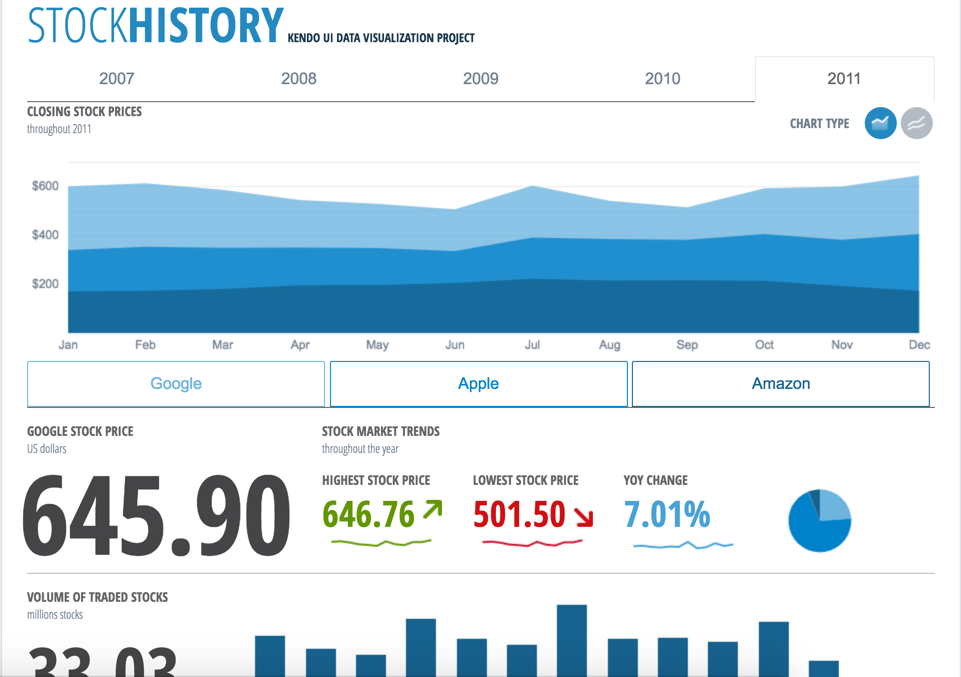
Kendo UI is a JavaScript UI toolkit that allows users to build responsive web-based apps integrated into their framework of choice (jQuery, Angular, React, or Vue). The vendor’s value proposition is that Kendo UI offers a large library of popular and configurable components ranging from sophisticated grids and charts to basic buttons, so users don’t have to waste development time building their UI. The vendor also says the large library of customizable themes means users can easily deploy a…
$999
per developer, royalty-free
OutSystems
Score 7.3 out of 10
N/A
The OutSystems Platform is a Platform-as-a-Service solution for rapid delivery of responsive web and mobile applications. It includes functionalities required to develop, deploy, manage and change web and mobile applications. It is targeted at the delivery of enterprise applications that require integration with backend systems, complex business rules and logic, usable interfaces and flexibility to change. It can be deployed in the cloud, on-premises or in hybrid environments.
$4,000
per month
Pricing
Progress Kendo UI
OutSystems
Editions & Modules
Kendo UI with Priority Support
$999
per developer, royalty-free
DevCraft UI
$1,299
per developer, royalty-free
DevCraft Complete
$1,499
per developer, royalty-free
DevCraft Ultimate
$2,199
per developer, royalty-free
Basic
$4,000.00
per month
Pro
$10,000.00
per month
Offerings
Pricing Offerings
Progress Kendo UI
OutSystems
Free Trial
Yes
Yes
Free/Freemium Version
No
Yes
Premium Consulting/Integration Services
No
No
Entry-level Setup Fee
No setup fee
No setup fee
Additional Details
—
—
More Pricing Information
Community Pulse
Progress Kendo UI
OutSystems
Features
Progress Kendo UI
OutSystems
Low-Code Development
Comparison of Low-Code Development features of Product A and Product B
Kendo UI works well if developing web UI applications which have simple layout designs. - Good A scenario where there are a lot of Kendo widgets on a single UI page, and each has a complex initialization. - Not so good
OutSystems excels with building web interfaces fast and lends itself to custom integrations written in .Net. Most anything can be brought in given this ability to be extended. One of the drawbacks to the speed of development is that most quality control teams become quickly overwhelmed and may be unable to keep up.
Kendo Grid for presenting a timeline of research grants as they are being approved. Our users love the ability to export the data to various mime formats.
Kendo Scheduler for presenting the upcoming calendar events in the available conference rooms in a building. This is used together with a 3rd party vendor API for appointment booking.
Kendo Treeview is used to present a hierarchy of topics that our users can navigate through easily.
Deployment management – OutSystems has a built in robust, multi-environment deployment system that helps ensures the clean and error free deployment of applications through the development, testing and production product lifecycle
Rapid application development – Through the low code, graphical development environment you can develop applications far quicker than with more traditional development environments
Cross platform mobile development – OutSystems handle the development and building of mobile application for both iOS and Android in a simple streamlined way that removes 90% of the problems normally associated with multi platform development
Kendo UI is always moving forward and staying current with latest development trends. While that is beneficial, that can cause some issues when supporting customers (particularly government) that don't move their IT infrastructure along nearly as fast. A prime example is web font icons. Great and easy to use, but where Kendo UI utilizes web font icons as the sole means of displaying an icon, not all organizations (again, especially government) allow the use of these. There have been times where Kendo UI became unusable and we had to downgrade to a version a few years old. Makes continued payment for licenses sometimes feel wasted as we may not be able to always use the new releases
Kendo UI has a wonderful feedback system and they do indeed listen to the community. However, there do seem to be some instances where there is large support for a new feature/component and it never gets addressed. It is easy to understand that not all ideas are easy or even prudent to implement, but would be nice to see a better follow-up on ideas with a current status
Refreshing Kendo UI grids is simple, yet the standard API method causes the grid to return to the default state. We have many use cases where we would love to update the grid data but need current grid state (such as expanded detail rows, sorts, filters, etc) preserved after the grid is updated so that users do not have to perform grid actions again to return to the desired state.
The platform controls all the parts. While great for development and overall maintenance, it could lead to discussions with your DBA (who has to trust the platform). As a developer I love the platform, as a DBA I would like more control.
By making software development model driven using flows, you are forced to rethink the way of programming. It makes it easier, but sometimes the way of working leads to code which could be optimized (standard problem in model based software development).
Most of the code is generated, so the technical knowledge of the inner working of coding are not Essentials. This could lead to degration of this knowlegde. As part of this, most technologies will only be used when OutSystems supports it. They do a good job on implementing these things. But things like Node.js would be nice.
Since we are using Kendo on a legacy product, there is likely a time when we will no longer support it. We are evaluating Kendo for our future product, in which case we may continue to use Kendo for an extended period of time.
We are very happy with OutSystems and our developers deliver good work. OutSystems lets us build new software on a regulare (2 weekly) basis, which is highly flexible and adjustable. Even without very much experience, our developers manage to build usefull software, which is working a lot better than our previous (legacy) software.
My initial score would be 10, but I am aware of the high price for its implementation. Therefore, I would recommend it only in large projects where a large profit margin can be obtained. But in general, I recommend it. I am currently using it without problems.
OutSystems has a feature in which we can develop a functionality in a application and can use that functionality in another application without developing it again. That is main plus point for the development team so they can work with different functionalities rather focusing on the same thing again and again. if we want to make any change on the user side then we can make it live with just the deployment using the service center.
Overall, we are satisfied with the support offered by the Progress Kendo UI team. We had raised few helpline incidents in the past and they have been resolved timely by the team. Also, we were satisfied with the level of information and support provided by the team.
The tech support is very reachable. Usually by [email] from but also by phone if needed. We had some difficulties at the start with understanding "what our machine was doing" under high performance load. After some good sessions understanding our needs they delivered good solutions for our problems we had in the beginning.
The online training material is well designed and explanations are step by step, helping trainees to understand and follow each exercise and new concept.
I think the main thing is to get into a Kendo mindset. Components that I've used in the past had a much different mindset and I think it got in my way. Sometimes I would use something different if I felt that the Kendo component was being too obstinate. I would go back later and replace that with the Kendo component when I had time to work with it further.
In a large company, patiently and consistently work the behind the scenes politics with business and IT partners across the firm. This is transformational - you will need a solid set of key business partners to lock arms together to move forward.
I did not experience the other product that has such an integrated and user-friendly feature. It works more like an everyday query with the UI element in a totally aesthetic and attractive view. With the Kendo library, we don't need to develop every UI component from the beginning. It was one of the faster development of applications.
Totally different products of cource. Sitecore is best suited for full fledged websites with extensive support for analytics. OutSystems for modular business processes with a UI. Hence, there is no overlap. But even for small websites, or even landingpages, I would recommend OutSystems, with a custom made analytics part or a plugin.
Positive impact is that it helps development team to focus on business logic rather than developing UI control and that resulted in good productivity savings. productivity saving is significant (like 30% of product development cost).
The ease of use of the OutSystems development process has been the biggest ROI for us. We have developed our Framework product and maintained/enhanced it with only 4 workers.
OutSystems has enhanced their product very significantly over the last 4 years. They have gone from a simple to use tool to a very simple to use sophisticated tool that covers the standard mainframe-based computing apps and the apps used on handheld mobile devices all using the same basic set of development tools.