Kaspersky Endpoint Security Cloud provides a solution for organizations' IT security needs, blocking ransomware, file-less malware, zero-day attacks and other emerging threats. Kaspersky’s cloud-based approach helps users to work securely on any device, and collaborate safely online, at work or at home, from remote offices and in the field. The cloud-native console means the organization's security can be managed from anywhere, any time.
$215
per year starting with 5 devices
Microsoft Defender for Cloud
Score 8.5 out of 10
N/A
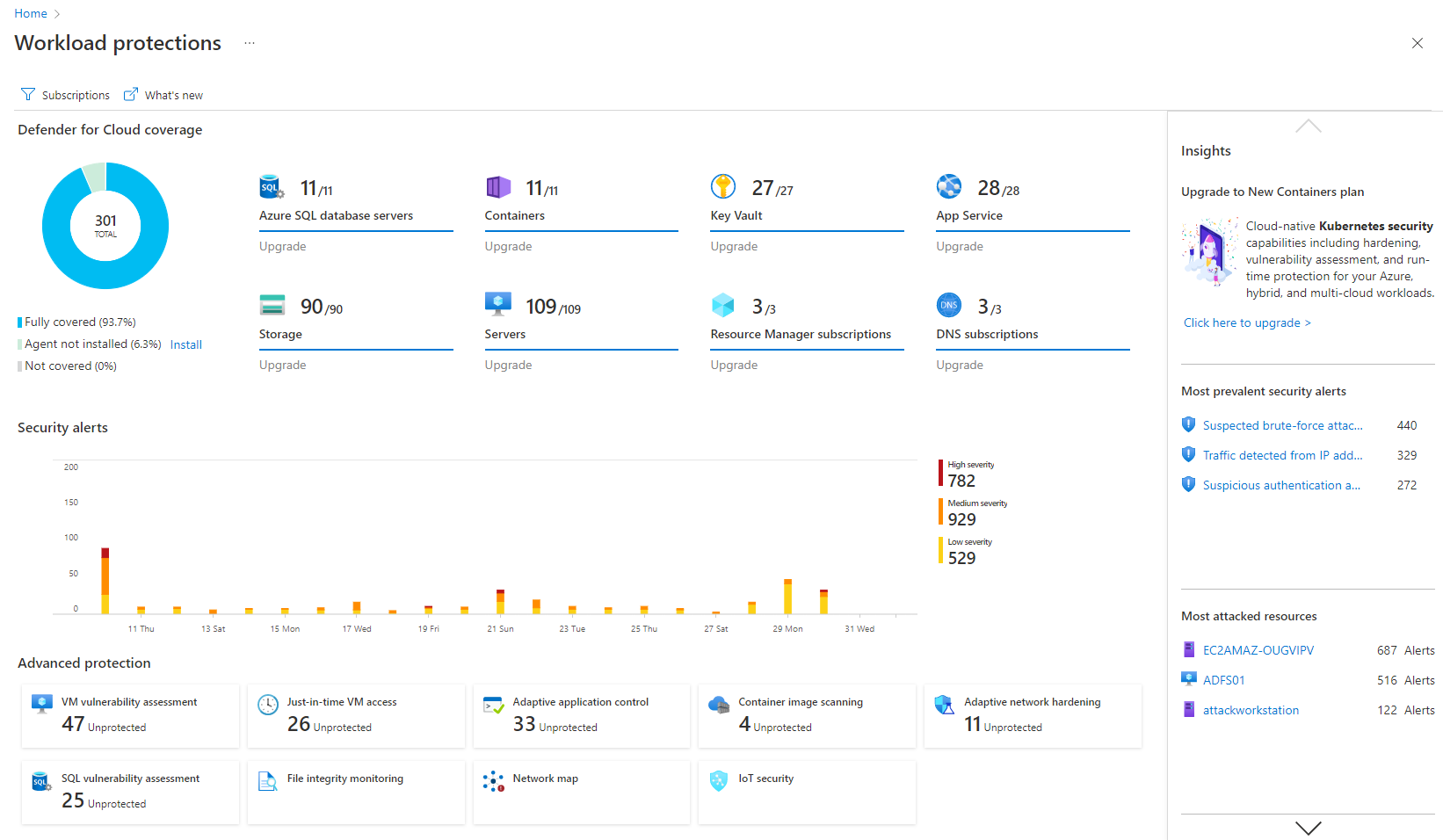
Microsoft Defender for Cloud is a Cloud Security Posture Management (CSPM) and Cloud Workload Protection Platform (CWPP) for Azure, on-premises, and multicloud (Amazon AWS and Google GCP) resources.
For me KES Cloud is well suited for any company, small or large since it has a proper solution for anyone. As it's named Endpoint, it is because of the tools it has to solve each one of everything that can arise, from a simple virus to a full hack attack, helping on each one of the configurable options within the console for each company and also added to this to a personalized Security profiles by level of management, this because not all of the users need access to certain sites, data, networks, even applications when using standard PC image (as an example). All this is great although for IT can be work but it makes a better control by user level experience and guidelines that each department needs to have.
If you need to proceed with pay as you go service then go ahead with Microsoft Defender for Cloud. This could be expensive in the long run but if the organization usage is slightly less than then this would suite the purpose. Also, it has the latest threat updates, so you're future proof in terms of potential treats.
Scalability: Whether you're a small business or a large enterprise, Kaspersky Endpoint Security Cloud is designed to scale. It adapts to the evolving needs of the organization, providing robust security regardless of the size or complexity of the network.
Device Control: This feature empowers administrators to regulate the use of external devices within the network. It ensures that only authorized and secure devices can connect, mitigating the risk of data leakage through unauthorized peripherals.
Cloud-Based Management: The cloud-based architecture enables centralized management of security policies. This is particularly advantageous for businesses with diverse and distributed networks, allowing administrators to apply consistent security measures across the entire organization.
Advanced Threat Protection: Kaspersky employs sophisticated antivirus and anti-malware technologies to proactively identify and neutralize a wide range of threats. It doesn't just rely on known signatures; it employs heuristic and behavioral analysis to detect new and evolving threats.
Automation is crucial to managing sprawl and the additional complexity that comes with it. SOC management workbooks and process automation give significant flexibility.
The Security posture score and Security Alerts are neatly centralized and offer me crucial information quickly.
Defender for Cloud avoids the common compromise of simplicity for completeness (former Azure Security Center). The security warnings and advice go into great detail while remaining current and useful.
Management console with multiple tenants gives an overall summary of critical level vulnerabilities. In my experience, you cannot click on the count and easily understand which devices are affected.
False positives occur. The positive is that Kaspersky Endpoint Security Cloud has a reporting mechanism that addresses these programs in a quick and timely manner.
UI/UX. It can get a little messy when navigating around with all the flyouts in the Azure portal which can be frustrating, particularly when under time pressure.
The query languages for the queries and workbooks are another language that needs to be learned - it would be nice to have kept it closer to T-SQL or something like that to minimize the need to learn new syntax.
Adding cost estimations to the security recommendations would really improve the experience.
We have been using Kaspersky Endpoint Security products for several years and the jump to the console cloud has been very comfortable for us since we do not have to dedicate a server to the Kaspersky Endpoint Security console but rather the console is in the cloud so that we save the server and its financial amount, electrical expense, cost of its housing in the CPD.
It is a great product that integrates nicely when running an Azure platform and even multi-cloud environment. Not looking for point-solutions but a suite that answers most requirements. It is very comfortable being able to use KQL, workbooks and automation that is native to the azure platform
It allows us to roll out endpoint protection quickly from a cloud interface to hundreds of users within seconds and keep those devices secure. From deployment of BitLocker and keeping track of the keys from the interface has saves many users from stolen laptops and devices since we used Kaspersky as our main device protection.
Kaspersky is a market leader company, so I had no doubt that I could trust their cloud services availability. As of now, I haven't experienced any downtime on their cloud portal or any issue in the agent itself. I would recommend it in terms of reliability.
Most of the time performance is fine and there are occasation slowness challenges comes due to complexity of the program or heavy data load in the process. Some kind of cache mode option might help to remove these kind of problem. We have not integrated with any other systems at this stage.
We only had to send a query to Kaspersky Endpoint Security Cloud support. We had a problem accessing the cloud console and we opened a case with them. They assisted us quickly and gave us precise and concise instructions to access the Kaspersky Endpoint Security cloud console.After completing the steps indicated we were able to access the console
The Kaspersky Endpoint Security Cloud online training was very complete and access to the console and the main administration tasks were explained to us.Also how to view security events, customer inventories and reports.In addition, Kaspersky provides a large number of manuals, web help, and videos to refresh your knowledge in the future.
The Kaspersky Endpoint Security Cloud online training was very complete and access to the console and the main administration tasks were explained to us.Also how to view security events, customer inventories and reports.In addition, Kaspersky provides a large number of manuals, web help, and videos to refresh your knowledge in the future.
The implementation of this product is easy, the console is mounted and from it the client is distributed to the rest of the computers. In this way, the Kaspersky Endpoint Security client is installed on all the computers in the company's IT park and its servers.The installation of clients requires that they have visibility with the console that is in the cloud.
Comparison: Scope and Sophistication: Kaspersky Endpoint Security Cloud offers a comprehensive security suite with a focus on simplicity and cloud-based management.Kaspersky EDR Expert is specialized in advanced threat detection and response, suited for organizations with a higher level of cybersecurity maturity and a need for proactive threat hunting.Target Audience:Kaspersky Endpoint Security Cloud is ideal for SMBs seeking a user-friendly, all-in-one security solution.Kaspersky EDR Expert caters to larger enterprises with a focus on in-depth threat analysis, incident response, and continuous monitoring.Deployment Options:Kaspersky Endpoint Security Cloud is cloud-centric, simplifying deployment and management.Kaspersky EDR Expert provides flexibility with on-premises or hybrid deployment, accommodating diverse IT infrastructures.Ultimately, the choice between the two depends on the organization's size, cybersecurity maturity, and specific requirements. Kaspersky Endpoint Security Cloud is a versatile and accessible solution, while Kaspersky EDR Expert is tailored for organizations with a heightened focus on advanced threat detection and response capabilities.
I believe Microsoft Defender for Cloud stacks up well against the other tools we looked at. It is native to the Azure platform and provides the same insights as the other tools. We selected Microsoft Defender for Cloud because it integrates well with the Azure resources and gives the needed insight, security alerts and recommendations.
Kaspersky Endpoint Security Cloud is a distributed product, you connect to the console and the client is installed on the computers and servers and the only configuration it needs is the console address. Then they connect and the console downloads the virus definitions and defined policies.There are no client limitations, you can even have multiple consoles if you want to have "separate" clients.
After implementing the Kaspersky Endpoint Security Cloud in our organization the security has been improved tremendously also it provides the centralized management so it is very effortless to manage the resources and users on cloud.
The Cyber attacks on the users and there sensitive data has been reduced greatly.
If someone wants to grow there organizations business then Kaspersky Endpoint Security Cloud is the best platform for doing so as it reduces the overhead of managing and protecting the users from carious Cyber attacks.