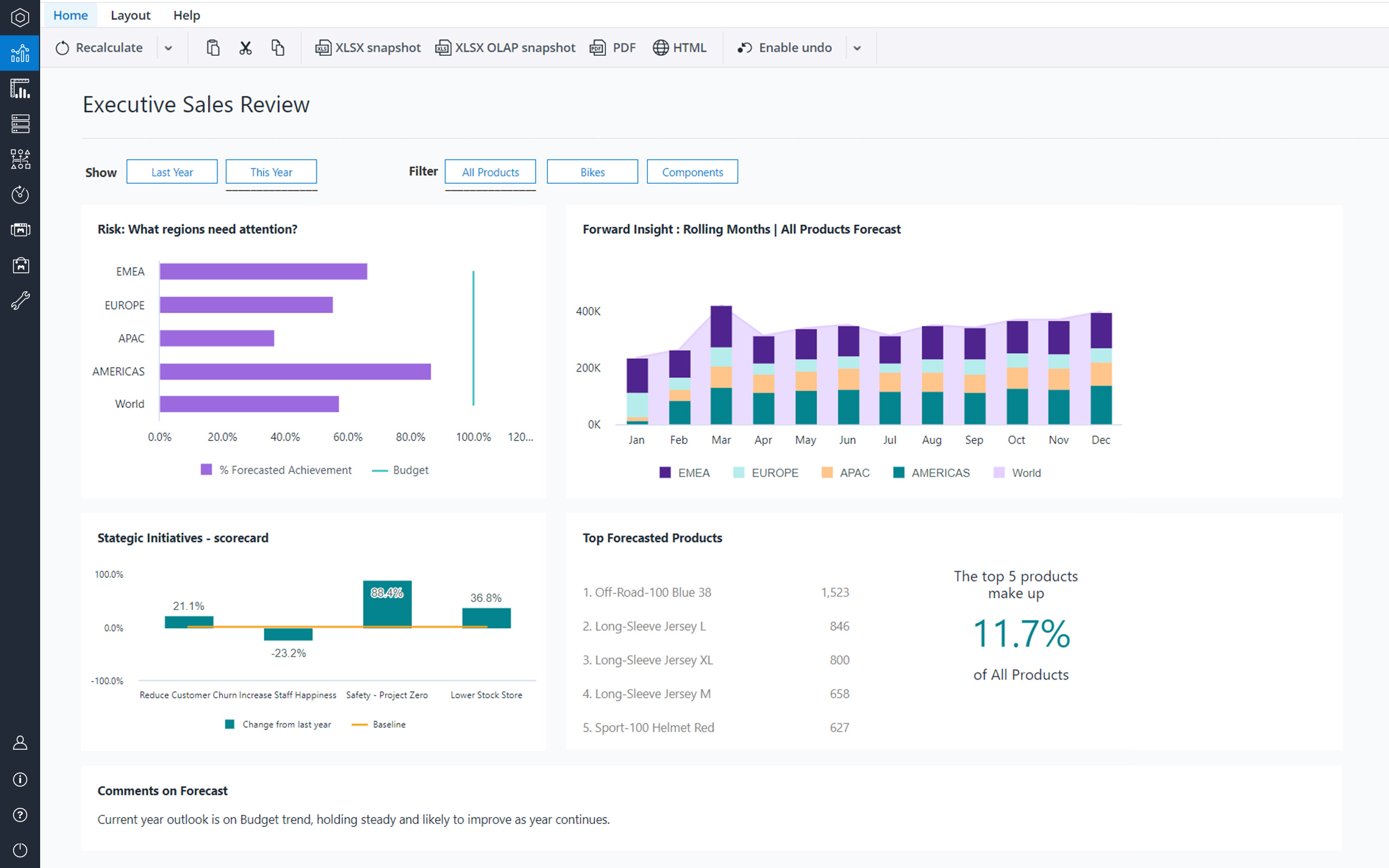
Jedox is a Business Intelligence and Corporate Performance Management solution. According to the vendor, their solution’s unified planning, analysis and reporting empowers decision makers from finance, sales, purchasing and marketing. Additionally, the vendor says this solution helps business users work smarter, streamline business collaboration, and make insight-based decisions with confidence. The vendor also says 1,900 organizations in 127 countries are using Jedox for real-time planning…
N/A
Workday Adaptive Planning
Score 7.7 out of 10
Mid-Size Companies (51-1,000 employees)
Workday Adaptive Planning streamlines planning workflows, using AI and real-time data integration to improve collaboration and provide predictive forecasts for better strategic analysis.
N/A
Pricing
Jedox
Workday Adaptive Planning
Editions & Modules
No answers on this topic
No answers on this topic
Offerings
Pricing Offerings
Jedox
Workday Adaptive Planning
Free Trial
Yes
Yes
Free/Freemium Version
Yes
No
Premium Consulting/Integration Services
No
No
Entry-level Setup Fee
No setup fee
Optional
Additional Details
—
—
More Pricing Information
Community Pulse
Jedox
Workday Adaptive Planning
Features
Jedox
Workday Adaptive Planning
BI Standard Reporting
Comparison of BI Standard Reporting features of Product A and Product B
Jedox
9.1
Ratings
17% above category average
Workday Adaptive Planning
9.3
Ratings
20% above category average
Pixel Perfect reports
9.10 Ratings
9.00 Ratings
Customizable dashboards
9.10 Ratings
10.00 Ratings
Report Formatting Templates
9.10 Ratings
9.00 Ratings
Ad-hoc Reporting
Comparison of Ad-hoc Reporting features of Product A and Product B
Jedox
8.3
Ratings
2% above category average
Workday Adaptive Planning
8.0
Ratings
2% below category average
Drill-down analysis
8.20 Ratings
9.00 Ratings
Formatting capabilities
8.20 Ratings
7.00 Ratings
Integration with R or other statistical packages
8.50 Ratings
8.00 Ratings
Report sharing and collaboration
8.50 Ratings
8.00 Ratings
Report Output and Scheduling
Comparison of Report Output and Scheduling features of Product A and Product B
Jedox
7.9
Ratings
4% below category average
Workday Adaptive Planning
8.0
Ratings
3% below category average
Publish to Web
8.50 Ratings
00 Ratings
Publish to PDF
7.90 Ratings
8.00 Ratings
Report Versioning
7.00 Ratings
8.00 Ratings
Report Delivery Scheduling
8.20 Ratings
8.00 Ratings
Data Discovery and Visualization
Comparison of Data Discovery and Visualization features of Product A and Product B
Jedox is really good when being applied to a specific use case or scenario (such as a budget or planning process). Once embedded, users then start to really understand how it can be used in other, less well defined, areas of their business. It is therefore not as easy to apply it on an enterprise-wide deployment from a "Big Bang" perspective. But very few tools / projects ever meet this goal.
In a previous company, I was hired based on my experience with Workday Adaptive Planning. After being hired and reviewing the company, I quickly determined they were not large of enough of a company to need the program. Instead, we made better Excel budget templates, utilized OneDrive and created a better experience without the cost. Left the job after 9 months because I worked my way out of the position. My next role I looked for bigger companies and had better success with implementation.
Version Management. Adaptive lets us manage many versions/scenarios all in one platform with the robust ability to compare them to each other.
Processing Performance. With the Elastic Hypercube technology that was implemented a few years back, we can watch changes flow through a complex web of formulas and arrive at an answer within seconds.
Audit Trail. Our administrators love the ability to see and report on who made what changes when, which leads to real accountability within the organization.
Web reports and sheets are not great for in-depth reporting, and require the use of the OfficeConnect for Excel plugin and, therefore, the use of Excel for extensive reporting capabilities.
It has limited formula functionality in some instances, requiring again the use of OfficeConnect for Excel for extensive calculations.
I would like to see new planning sheet types or upgrades to existing sheet types; functionality has been the same for over 10 years.
For one we're in way too deep to not move forward with Adaptive. We're integrated with Workday, we do a ton of reporting with Adaptive, and it's working very well for planning and forecasting. No reason to look back or change course.
To me Jedox deserves 10/10 because it is a consistent one-in-all platform with a modern look and feel. It is intuitive to use and allows you to make intuitive applications integrating traditional business intelligence with performance management functionality. It certainly has a short learning curve, especially for those that are familiar with MS Excel. An example: I've lost count but Jedox it is available in more than 25 languages. Another: Jedox does not require programming skills... it is developed to be used by the business.
Workday Adaptive Planning has detailed online help with both articles and videos that are comprehensive. It has a lot of similarities to Excel, which most finance people are already familiar with, plus the user interface is intuitive and easy to pick up. The online support team is quick to respond and very knowledgeable.
Jedox has very few bugs. Reports are available through an Excel add-in, the web and/or mobile device (IOS/Android). In my opinion, availability also means high performance, not having to wait for the system to give you the required reports, analysis, dashboards instantly.
There haven't been any lately. The only one issue I can think of is when there was an update in Adaptive that altered our reports. Before I realized there was an issue, Adaptive reached out to let me know, so that it could be fixed.
All aspects of Adaptive Insights perform well. One area that I wish was quicker was integration. When importing data from Intacct our accounting ERP platform, it can sometimes take 4 hours for the import to process. The earlier imports are done, the quicker they complete. My estimate for a quick upload is about two hours.
The Jedox support team are highly knowledgeable about both the product and how it is used in real life. They also are typically proactive in resolving issues.
Whenever we have had any questions, issues, or concerns, the support has been quick and thorough. [This] allow[s] us to be able to fully resolve any issues, or be connected with the right group quickly to attain the result we were after; be it from simple formatting to adding new detailed reporting.
This was extremely helpful so that they could walk you through the model and teach you more about the complexity of various areas. It is most helpful when it is specific to your organization's model. The larger in-person trainings were helpful but they tended to be more generic and entry level. The trainings that are more tailored to your specific needs are the most helpful.
They often times tended to be way too generic or entry level. They would also become sales pitches to upgrade or get new Adaptive Planning products. The questions in the training would be very niche and specific to other organizations. They were rarely helpful to the group at large.
The implementation of SSO, SAML Authentication, HTTPS, Server splitting (Frontend / Backend servers) could be more standardized and made more user friendly to set up (e.g. via setup guide). Otherwise the implementation of Jedox is quick and simple when compared to other similar technologies.
Trust the expertise of very strong 3rd party implementers. Having deployed Adaptive at a separate company before, I thought I knew it all (hubris, I know). Fortunately, I began to (very quickly) trust the judgment of our Carlson implementation team, and they provided invaluable insights and best-in-class processes that have benefitted me and my team greatly.
Power BI in some respects is easier to set up using tabular analysis, which makes creating new models relatively easy in comparison to Jedox, however, the DAX language is more complex to learn than the Groovy script used by Jedox. Jedox's power comes in its ability to write back to models and flexibility in setting up reports. We use both for different applications, but if I was wanting to create a model that needed user input I would pick Jedox.
For best-in-class capabilities, you'll very likely need to split the various HR and financial systems into separate systems rather than using a consolidated platform like Workday. However, a consolidated platform provides benefits by being a single location for employees and a single system for IT developers to work with. This would need to be compared to employee efficiencies gained by working with better systems.
Scalability is often another word for speed. Given enough data, enough users or enough calculations, the tool becomes slower and slower. You will find that Jedox has a very high performance that can even be increased by the use of grafical cards. Other thaen that it does not only offer BI (looking back based on historical ERP data) but also allows you to look forward through integrated budgetting, planning, forecasting, workflow and collaboration. Not easy to find a tool that can support so much business functionality. So, also pretty scalable in that respect.
We went from 2 users to 70+ users over a 2 year period of time. The application scaled wonderfully. 65 of those users were non-finance users so they were able to quickly learn the software and prepare budgets quickly and efficiently. That is the power of Adaptive and its ability to scale
Financial budgeting and Forecasting are done in a centralized fashion in Jedox now instead of a decentralized excel based approach. A lot of cost savings and improved reliability
Easy to use self-help Dashboards and detailed reports