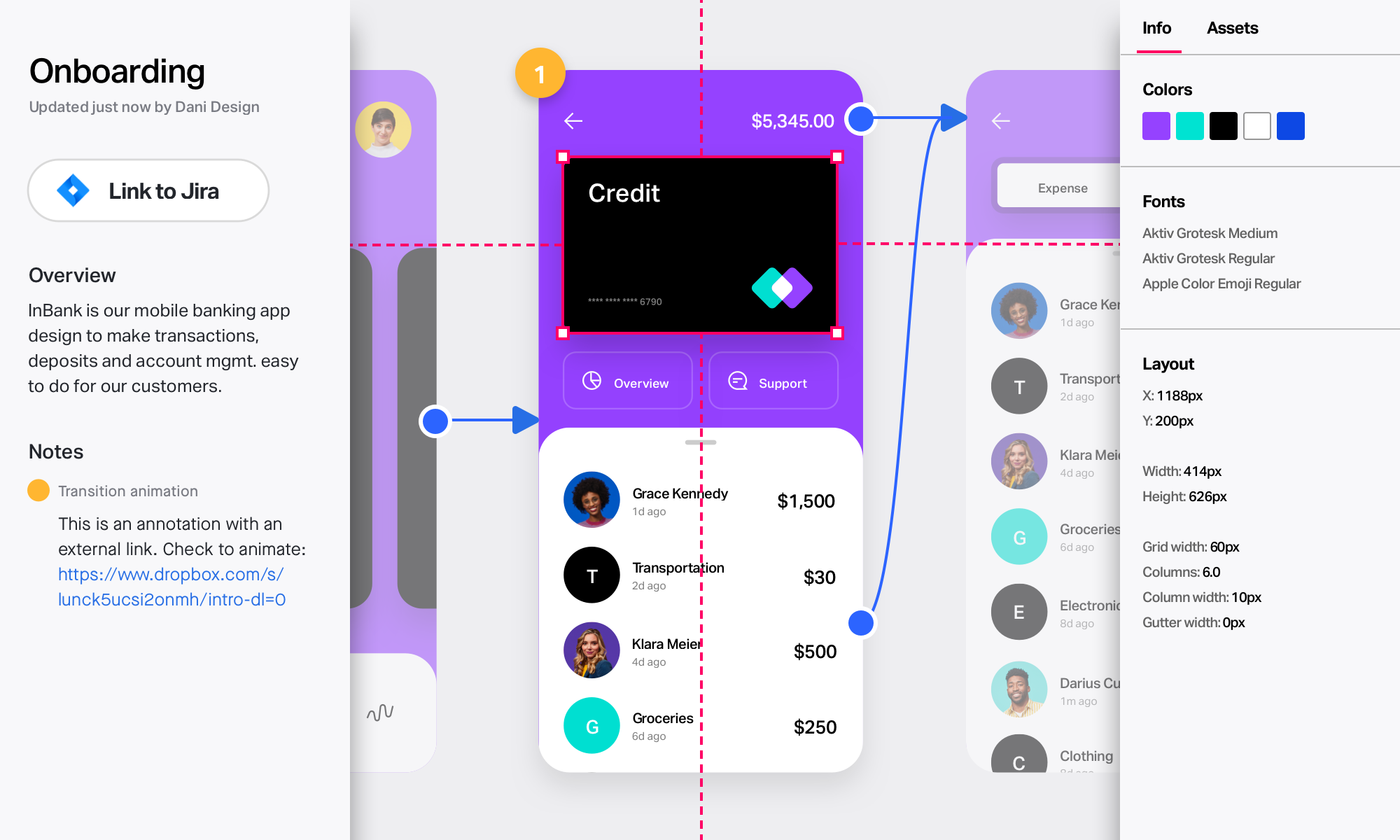
InVision is a collaborative design and prototyping platform with features such as freehand drafting mode and interactive mockups, collaboration, idea management, user testing, and integration with Slack and other collaboration tools. According to the vendor, 1 million designers are using the free version.
$0
Sketch
Score4.5 out of 10
N/A
Sketch is a visual design tool of use for application prototyping, coming with a wide variety of extensions, plugins, and an active user community.
$10
per month billed yearly per editor
Pricing
InVision
Sketch
Editions & Modules
Free
$0
Pro
$7.75
per user/per month
Enterprise
Contact Sales
Standard Subscription
$10
per month billed yearly per editor
Standard Subscription
$12
per month per editor
Mac-only license
$12
per seat
Business Subscription
$22
per month billed yearly per editor
Offerings
Pricing Offerings
InVision
Sketch
Free Trial
No
No
Free/Freemium Version
No
No
Premium Consulting/Integration Services
No
No
Entry-level Setup Fee
No setup fee
No setup fee
Additional Details
—
—
More Pricing Information
Community Pulse
InVision
Sketch
Considered Both Products
InVisionApp Inc.
Verified User
Chose InVision
We went with InVision because we were already bought into that ecosystem. We have since decided to move to Figma, as we were not receiving the features we needed from InVision and the associated tools (Whimsical, Sketch, Abstract, and Zeplin). The ROI of Figma allows us to free …
A de minimis incentive was given to thank the reviewer for their time. The incentive was not used to bias or drive a particular response, nor was the incentive contingent on a positive endorsement. More Info
Director Of Operations at Clearfire, Inc. (Internet, 1-10 employees)
Chose InVision
InVision can be a powerful tool when paired with Sketch and other platforms like Freehand. However, Figma is currently the industry leader in terms of functionality and usability for collaborative UI design and prototyping. Invision's sharing and prototyping features are its …
A de minimis incentive was given to thank the reviewer for their time. The incentive was not used to bias or drive a particular response, nor was the incentive contingent on a positive endorsement. More Info
Verified User
Chose InVision
I choose InVision over Sketch, however Figma is leading because of the cloud feature collaboration and open source plugins
A de minimis incentive was given to thank the reviewer for their time. The incentive was not used to bias or drive a particular response, nor was the incentive contingent on a positive endorsement. More Info
Verified User
Chose InVision
InVision's design is much more polished and seamless due to its apps on mobile and web. They are very easy to learn and gather feedback compared to Sketch or Principle. Although these features are quickly coming to the other apps, InVision has an upper hand at the moment with …
A de minimis incentive was given to thank the reviewer for their time. The incentive was not used to bias or drive a particular response, nor was the incentive contingent on a positive endorsement. More Info
Verified User
Chose InVision
Truthfully, while we have looked at others, InVision has the name recognition in the web design community and a tight integration with Sketch which is what was important to us. We have not seriously considered others, but may in the future as our needs change. This is our first …
A de minimis incentive was given to thank the reviewer for their time. The incentive was not used to bias or drive a particular response, nor was the incentive contingent on a positive endorsement. More Info
Verified User
Chose InVision
InVision was the best tool for our team. It has the features that best fit our process but is also flexible enough for make it work in various situations where visuals are a core component. We've been using InVision for over 5 years and we're not likely to move to another …
A de minimis incentive was given to thank the reviewer for their time. The incentive was not used to bias or drive a particular response, nor was the incentive contingent on a positive endorsement. More Info
UX Designer in Product Management at SimpleNexus (Financial Services, 51-200 employees)
Chose InVision
Other design tools have been creating their own prototyping functionality, which has made InVision less valuable over time. It is much more convenient to use the same tool for both design and prototyping, because it removes the unnecessary steps of exporting, importing, and …
A de minimis incentive was given to thank the reviewer for their time. The incentive was not used to bias or drive a particular response, nor was the incentive contingent on a positive endorsement. More Info
Sr. Experience Designer in Information Technology at Maestro Health (Human Resources, 201-500 employees)
Chose InVision
InVision works seamlessly and easily when sharing and requesting comments from others. Other products I've used like Balsamiq and Dropbox (earlier versions) provided online displays of work, but no easy way to collect feedback or quickly update. InVision provides enterprise …
A de minimis incentive was given to thank the reviewer for their time. The incentive was not used to bias or drive a particular response, nor was the incentive contingent on a positive endorsement. More Info
Verified User
Chose InVision
As the industry leader, XD and Figma have had some catching up to do. I think now InVision will have to innovate to hold these products off. Several are doing what made InVision famous, and in some instances do it even better. There is an insane amount of competition and …
A de minimis incentive was given to thank the reviewer for their time. The incentive was not used to bias or drive a particular response, nor was the incentive contingent on a positive endorsement. More Info
A de minimis incentive was given to thank the reviewer for their time. The incentive was not used to bias or drive a particular response, nor was the incentive contingent on a positive endorsement. More Info
Executive Vice President in Corporate at Stevens Advertising (Marketing and Advertising, 11-50 employees)
Chose Sketch
Sketch works in a similar way to programs like Figma and InVision. Sketch is a mac only program so it works well in a mac environment. Tools like Figma and InVision have better collaboration tools and are both cross-platform. Sketch is easier to use and more intuitive for most …
A de minimis incentive was given to thank the reviewer for their time. The incentive was not used to bias or drive a particular response, nor was the incentive contingent on a positive endorsement. More Info
Verified User
Chose Sketch
We use Sketch for its clarity. While Figma and InVision Studio have some "google-doc-escrow" collaboration tools, I've found them hard to make pixel-perfect designs, which is necessary while working with IT and clients.
Illustrator may have been the first of these vector-based …
A de minimis incentive was given to thank the reviewer for their time. The incentive was not used to bias or drive a particular response, nor was the incentive contingent on a positive endorsement. More Info
Verified User
Chose Sketch
Although there's a lot of overlap, we use these different platforms for different purposes. InVision allows us to create more robust prototypes, Zeplin is a better tool for design/dev handoffs, and Marvel is great for basic wireframes. None of these tools beat Sketch when it …
A de minimis incentive was given to thank the reviewer for their time. The incentive was not used to bias or drive a particular response, nor was the incentive contingent on a positive endorsement. More Info
Verified User
Chose Sketch
Unlike the Adobe Suite, Sketch was specifically designed for designing digital interfaces. Having built-in prototyping, useful default artboard sizes and shared libraries makes it really useful. Adobe XD is really exciting, but honestly, our files are so invested in Sketch it …
A de minimis incentive was given to thank the reviewer for their time. The incentive was not used to bias or drive a particular response, nor was the incentive contingent on a positive endorsement. More Info
Freelance Handlettering Chalkboard Artist & Graphic Desinger at CaringBridge (Non-profit Organization Management, 51-200 employees)
Chose Sketch
The interfaces of Adobe and Figma are very similar, but I would say that Figma's collaboration tool is great with onboard live collaboration. For Sketch, that is a separate payment. XD is great for free usage and for Windows collaboration, but some parts of the collaboration …
A de minimis incentive was given to thank the reviewer for their time. The incentive was not used to bias or drive a particular response, nor was the incentive contingent on a positive endorsement. More Info
Featured Speaker in Product Management at Product School (Internet, 1001-5000 employees)
Chose Sketch
Sketch had been great and improved a lot in the past, but so has Adobe. If you are going to start new, it's better to plan long term and based on needs see what suits more. Figma is relying a lot on new technologies which are not bug-free, but that may be the future of design.
A de minimis incentive was given to thank the reviewer for their time. The incentive was not used to bias or drive a particular response, nor was the incentive contingent on a positive endorsement. More Info
UX Designer in Product Management at SimpleNexus (Financial Services, 51-200 employees)
Chose Sketch
Sketch is the industry leader when it comes to visual design for mobile apps and websites. However, its competitors are catching up very quickly and starting to offer features that Sketch doesn't have. While I think Sketch is still the best visual design software out there for …
A de minimis incentive was given to thank the reviewer for their time. The incentive was not used to bias or drive a particular response, nor was the incentive contingent on a positive endorsement. More Info
Sr. Experience Designer in Information Technology at Maestro Health (Human Resources, 201-500 employees)
Chose Sketch
Sketch is designed for a specific need, in my opinion, creating screen designs with tools you can reuse and share across a project. There are no extra features to get in your way or slow you down. Other products I've used are good at creating the same type of work products, but …
A de minimis incentive was given to thank the reviewer for their time. The incentive was not used to bias or drive a particular response, nor was the incentive contingent on a positive endorsement. More Info
Verified User
Chose Sketch
At the time of purchase, Sketch was the industry standard. It's affordable and we liked it wasn't tied to a subscription model. We're on Macs so it being an OSX exclusive wasn't a deterrent. Sketch has set the bar high, but there is a massive amount of competition in this …
A de minimis incentive was given to thank the reviewer for their time. The incentive was not used to bias or drive a particular response, nor was the incentive contingent on a positive endorsement. More Info
InVision is well suited for design reviews and immersing yourself in the experience of an app-to-be. As a Product Manager, it's difficult to take abstract concepts, user pain points, and business needs, and produce a vision for an app without a visual aid to communicate a vision. InVIsion offers PMs, designers, and developers the opportunity to sketch a vision, communicate about it with inline commenting, and shareable with other stakeholders.
A de minimis incentive was given to thank the reviewer for their time. The incentive was not used to bias or drive a particular response, nor was the incentive contingent on a positive endorsement. More Info
Here’s the proofread version: Sketch is a simple and lightweight tool for vector graphics, ideal for individuals. I would recommend it to anyone working alone on design tasks such as UI or website design. I have started and completed many projects in Sketch, ranging from simple websites to complex automotive UIs with extensive libraries.
A de minimis incentive was given to thank the reviewer for their time. The incentive was not used to bias or drive a particular response, nor was the incentive contingent on a positive endorsement. More Info
A de minimis incentive was given to thank the reviewer for their time. The incentive was not used to bias or drive a particular response, nor was the incentive contingent on a positive endorsement. More Info
Sketch is great for drawing and creating shapes, like buttons or icons. It lets you adjust every curve and line perfectly, so you can make your designs look exactly how you want. (All design tools can do that, though).
Sketch is built just for Apple computers, so it runs smoothly and uses all the special Mac features. If you’re already using Apple tools, Sketch feels like a natural fit. (The downside of this is that non-Apple users can't use it.)
If you make something, like a button, and need it in many places, Sketch lets you save it as a "Symbol." You can use it repeatedly, and if you change the Symbol, it updates everywhere automatically. (Figma can do this too.)
A de minimis incentive was given to thank the reviewer for their time. The incentive was not used to bias or drive a particular response, nor was the incentive contingent on a positive endorsement. More Info
A de minimis incentive was given to thank the reviewer for their time. The incentive was not used to bias or drive a particular response, nor was the incentive contingent on a positive endorsement. TR verified that a representative sample of customers was invited. More Info
The software can be buggy right after a release. It appears that they do very little QA testing right after releasing a new version
The software can crash a lot. And when it does, I continuously have issues with it reloading my plugins.
Only available for Mac. If you have a cross platform team, it may not be the best.
Lack of features in the software, so you will have to use plugins for those additional features (Designs system management, accessibility, repository and live collaboration without paying a premium)
A de minimis incentive was given to thank the reviewer for their time. The incentive was not used to bias or drive a particular response, nor was the incentive contingent on a positive endorsement. More Info
Sketch is a core tool for us and the cost to keep it going with our teams is low. It provides a good alternative to other screen design tools for our team members who prefer to use it.
A de minimis incentive was given to thank the reviewer for their time. The incentive was not used to bias or drive a particular response, nor was the incentive contingent on a positive endorsement. More Info
A de minimis incentive was given to thank the reviewer for their time. The incentive was not used to bias or drive a particular response, nor was the incentive contingent on a positive endorsement. More Info
At the end of the day, it's just simple. This goes a long way in design and goes even further when your talking productivity, intuitive design and turnover rate. It's not difficult to figure something out even if it's not something your directly familiar with, i.e. if you want to export in certain file formats or change the size of the canvas, you don't have to delay your end product trying to figure it out. Similar situations took me less than 30 seconds to solve without a Google search. That's Usability.
A de minimis incentive was given to thank the reviewer for their time. The incentive was not used to bias or drive a particular response, nor was the incentive contingent on a positive endorsement. More Info
I didn't need to contact InVision support, as I've never needed it. They have an intuitive UI, and most of the questions are answered in their help portal or in tutorials online. Since many people use it, there a great resources available on for example YouTube. No problems so far with InVision.
A de minimis incentive was given to thank the reviewer for their time. The incentive was not used to bias or drive a particular response, nor was the incentive contingent on a positive endorsement. More Info
The support is relatively decent, and they are quick to respond. However, their releases are not great. Sketch could use more robust testing of their software before releases. Over the last four years, I have had many days lost while waiting for Sketch to patch issues with their releases. It's actually a running joke in our office. So, support, good. Releases in the first place? Not great.
A de minimis incentive was given to thank the reviewer for their time. The incentive was not used to bias or drive a particular response, nor was the incentive contingent on a positive endorsement. More Info
We only tested out using Adobe XD for similar uses and found it to be more challenging to fit within our processes. It didn't have as robust a set of capabilities as InVision and wasn't as easy to use enterprise wide. I recall also having issues with working with Sketch.
A de minimis incentive was given to thank the reviewer for their time. The incentive was not used to bias or drive a particular response, nor was the incentive contingent on a positive endorsement. More Info
Sketch's approachable UI allowed those using outdated technologies to transition efficiently. Among its peers, Sketch performs comparably with most prototyping tools. It falls behind compared to those that can better handle movement, like InVision Studio, which combines animation and prototyping into a single platform. However, these types of programs have a steep learning curve, whereas Sketch is approachable immediately.
A de minimis incentive was given to thank the reviewer for their time. The incentive was not used to bias or drive a particular response, nor was the incentive contingent on a positive endorsement. More Info
InVision helps our team better and more professionally portray the value and the work we do as designers, leading to more company buy-in in supporting and funding our work. In the past, we would create PowerPoints with screenshots to portray a user workflow that we would share out to stakeholders. Once we began to use this app, where stakeholders could click through and comment as though they were “real” users, stakeholders began to better understand our work, designs, and workflows. This has led to more productive conversations that, in turn, lead to more effective end products that have more consistently served our business goals in tangible ways.
InVision helps us save production time, effort, and cost, as we are able to solve design issues early in the process by having clickable prototypes to show to internal stakeholders and external users. It’s, understandably, difficult for people to provide effective feedback on screenshots. Using the clickable prototypes we created in InVision, we are able to get more effective feedback to solve user workflow issues before we spend time and money developing problematic designs (and later having to redesign them).
It’s easier to market designs to potential buyers with clickable prototypes than with screenshots. With these prototypes, we’ve been able to sell more digital products before product release dates, which has helped to secure many contracts and new business relationships that continue to this day.
A de minimis incentive was given to thank the reviewer for their time. The incentive was not used to bias or drive a particular response, nor was the incentive contingent on a positive endorsement. More Info
Saved time -- Intuitive interface saves us lots of time/money because it is reliable and easy to use. Other programs have caused serious confusion, leading to project delays.
More captivating wireframes -- Stakeholders have been finding it easier to visualize potential “final products” with vector-based Sketch designs. Because of this, we’ve been able to have more targeted, focused discussions that lead to improved final products (with fewer immediate post-launch revisions!).
Increased productivity -- Because Sketch is so easy to use, our designers have had more time to do more work. Rather than finagling difficult tools in previously used products, our designers feel no hesitation with Sketch, and are producing more often and more creatively.
A de minimis incentive was given to thank the reviewer for their time. The incentive was not used to bias or drive a particular response, nor was the incentive contingent on a positive endorsement. More Info