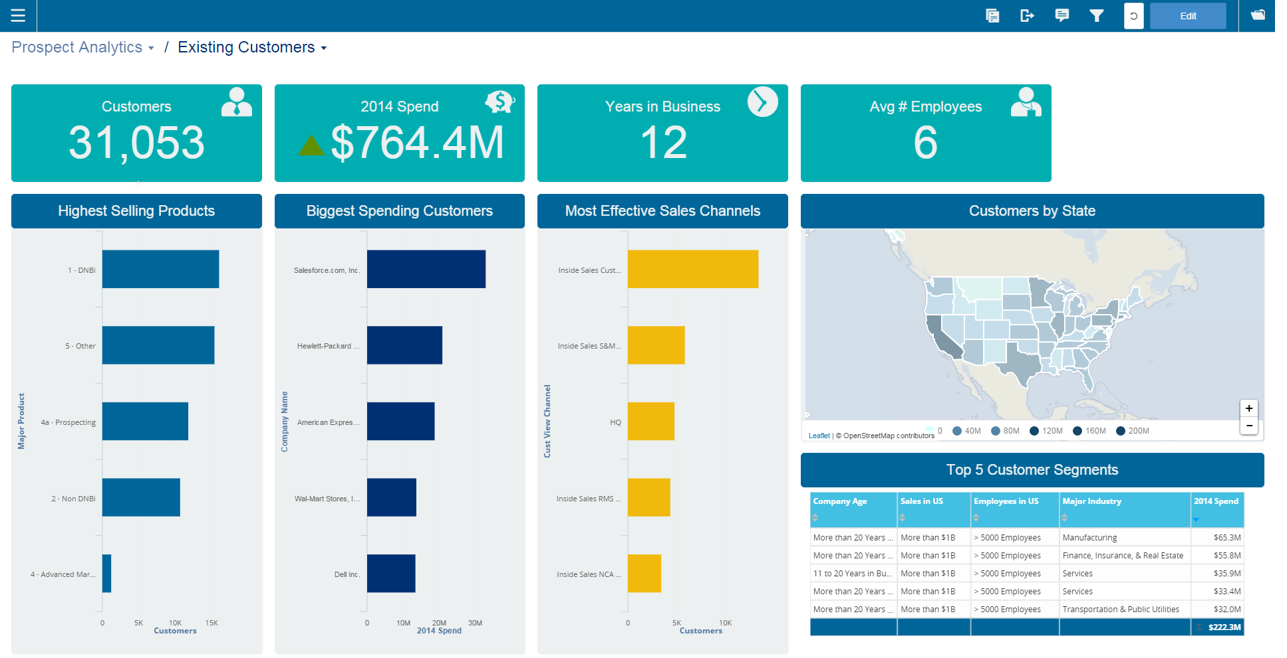
Infor Birst offers multi-tenant cloud BI for deployment in a public or private cloud, or on-premises. It provides an in-memory columnar data store and a BI layer comprising a reporting engine, predictive analytics tools, mobile native apps, dashboards, discovery tools, and an open client interface.
N/A
SAP Lumira Discovery
Score 4.4 out of 10
N/A
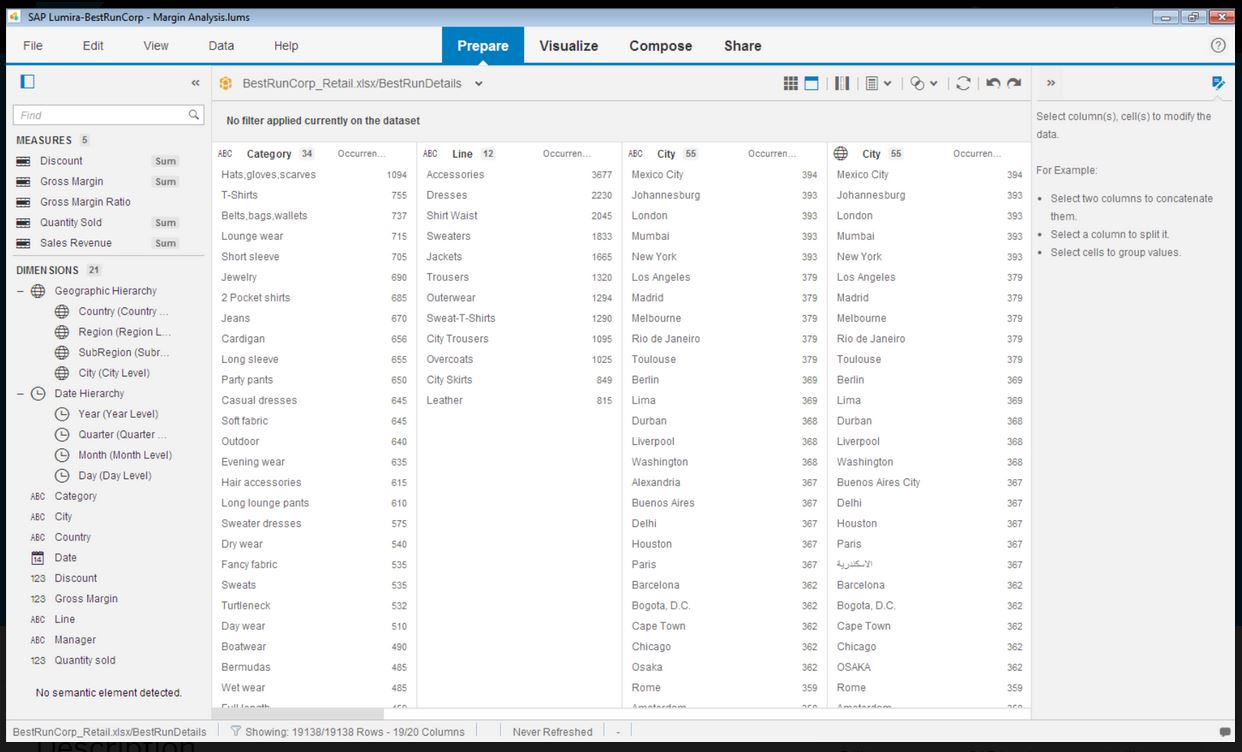
SAP Lumira Discovery is SAP’s data visualization and discovery application. It facilitates data discovery, visualization, and analysis by assisting users with creation of dashboards, infographics, presentations, data facets, tag clouds, and more.
$185
per user
Pricing
Infor Birst
SAP Lumira Discovery
Editions & Modules
No answers on this topic
SAP Lumira, standard edition
$185
per user
Offerings
Pricing Offerings
Infor Birst
SAP Lumira Discovery
Free Trial
No
Yes
Free/Freemium Version
No
No
Premium Consulting/Integration Services
No
No
Entry-level Setup Fee
No setup fee
No setup fee
Additional Details
—
—
More Pricing Information
Community Pulse
Infor Birst
SAP Lumira Discovery
Features
Infor Birst
SAP Lumira Discovery
BI Standard Reporting
Comparison of BI Standard Reporting features of Product A and Product B
Infor Birst
7.4
Ratings
10% below category average
SAP Lumira Discovery
8.0
Ratings
2% below category average
Pixel Perfect reports
7.00 Ratings
00 Ratings
Customizable dashboards
8.00 Ratings
8.00 Ratings
Report Formatting Templates
7.10 Ratings
00 Ratings
Ad-hoc Reporting
Comparison of Ad-hoc Reporting features of Product A and Product B
Infor Birst
7.0
Ratings
14% below category average
SAP Lumira Discovery
7.3
Ratings
10% below category average
Drill-down analysis
8.00 Ratings
10.00 Ratings
Formatting capabilities
7.00 Ratings
7.00 Ratings
Integration with R or other statistical packages
6.10 Ratings
00 Ratings
Report sharing and collaboration
7.00 Ratings
5.00 Ratings
Report Output and Scheduling
Comparison of Report Output and Scheduling features of Product A and Product B
Infor Birst
8.0
Ratings
4% below category average
SAP Lumira Discovery
6.1
Ratings
31% below category average
Publish to Web
8.00 Ratings
7.00 Ratings
Publish to PDF
8.00 Ratings
5.00 Ratings
Report Versioning
7.20 Ratings
00 Ratings
Report Delivery Scheduling
9.00 Ratings
6.30 Ratings
Data Discovery and Visualization
Comparison of Data Discovery and Visualization features of Product A and Product B
Birst is well suited for an organization looking for a cloud-hosted analytics solution that is contained within one package. It is able to connect to a very wide variety of different data sources, and has options for either light or involved ETL procedures, depending on the users experience with preparing data. As with any BI project, it would not be suitable for an organization where there is no dedicated team to maintain and manage the project.
SAP Lumira helped to create intuitive and real-time dashboards in a story format to the organization. However with new capabilities of SAP, like SAP Analytics Cloud (SAC) providing more planning and analytical capabilities. Thus the identification of the use cases with the available products should be done. SAC is more integrated and the go to product in SAP roadmap.
Birst is an platform that provides connectors to some of the applications we use, but also allows us to bring in data from disparate systems to perform ETL and integrate all of the data for analyses. It makes no assumptions about your data, which is good for us, as we have a lot of customizations to many of our systems.
Control over data import formatting - for example where amount and currency values are imported there is not enough control over the transformation and formatting and this has caused us data import difficulties where values read have been truncated due to punctuation in the amount fields.
The user interface is simplified, but the terminology and screen layout do not always make it obvious how to start the process for a new user - for example to add a new data source or create a new report.
We have been able to overcome any of the drawbacks we've found with Birst easily and it has fulfilled almost all of our analytic needs to date. Having seen their roadmap it would be highly unlikely we would move away from this platform any time soon. You simply can't beat the functionality that Birst provides for the price and the things I see coming out of the company solidify that our decision to choose Birst was the best possible choice. We have never regretted the decision.
Birst is a reliable BI platform that has developed through uploads via the cloud, easy tabular views, quick manual uploads and links to SQL databases. It however does not compete with other BI tools with the data manipulation and connections when your data is uploaded in the platform and the visualisation and customisations available. The automation aspect is very useful and is one of the top features, alongside the user hierarchy and permissions. Birst is an easy and useful tool for finicial reporting, however is not currently the best option on the market for providing easy to understand, edit and present visualisations.
It has good features, the data connectivity and merging is really good, and it has helped our IT team. Nevertheless, it can sometimes be hard to use and some of the features can be found outdated. As we don't have a lot of data, it is a decent tool for our data analytics, but I wouldn't recommend for bigger or more complex businesses with large amounts of data.
We frequently experience -103 errors due to us using the Live Connect functionality, which does not seem to handle even minor interruptions in connectivity, and treats all future connection attempts or data requests as errors, even if the issue does not exist any longer
Lumira is a desktop application runs in its own JVM. It installs its own java runtime libraries to avoid any core java version conflicts. The availability of the application is completely relies on individual machine hardware configuration. On a decent desktop, it performs well and always launches in either 32 or 64 bit environment based on the hosts system's OS
In a reporting and analytics package there are two distinct performance times to look at. First is the performance of calculating the report data and metrics. I would rate a 9 for this. However, the interface rendering is slow, rating a 7. Dashboards can take 3-5 seconds to load. This is probably not a problem for normal users, as the dashboard render is performed once. My application integrated the dashboard into a commercial product though, with hundreds of customers - so my demands are higher with a large number of end users.
The performance is linear with amount of data that is being explored. We have done some benchmarks acquiring 10million data cells without having any performance problems. We need to make proper adjustments to jvm run time properties to start with higher heap size and other parameters that optimizes the run time performance
It does not have many bugs or issues since not a lot of new features are being added. The customer support for SAP Lumira Discovery is good and anyone considering this as a self-service tool would be happy. It integrates well in the SAP BI suite of products and the overall experience is positive.
I went to their annual user conference (Birst Forward) and their standard training class (Birst Boot Camp) this year, and both were excellent. Very educational, and I got all of the personal attention I needed to get my questions about my specific answered. I've also reached out to the trainers after those events to ask more questions, and they've been great about getting back to me with answers
Although I found the online resources helpful, a lack of appropriate examples for certain tasks key to report creation and advanced modeling make the online training/documentation less than perfect. For an inexperienced BI professional, the online training would not enable a streamlined launch of the product.
Most of the user guides are pretty comprehensive and very easy to understand. The product itself is designed to be self-serve tool, did not need much of the end-user training. Most of the training we had is to how to read the data, how to explore the data, how to acquire the data etc.
Have clean data! Birst flexibility allows - Start small, then introduce functionality and complexity along the way. If you try to present all the functionality [bells and whistles] and wow them, but bad data is uncovered, the end user blames the new application and turns away.
Installing the desktop software on end-user machines is always challenging. The machine specifications are the biggest factor when running Lumira and be able to handle large datasets during data exploration. This often demands beefy machines at least for power-users. Although Lumira software licensing is not a big problem but managing partner's extensions and keeping track of their individual licenses may be an issue. If there is a way to bundle the more popular extensions such as vSQL or vOLAP should be bundled in core product and offer them as part of Lumira license instead of a separate license which causer operational burden.
Infor Birst OEM and embedded analytics have low-code no-code features which are easy to deploy and with easy instances creation with a dev-quality-production environment. Good capability on data mapping features from source to intermediate to target with impressive metadata management.
I have evaluated products such a Tableau Desktop and Splunk and the biggest difference I realized was the ability to include interactive controls in the output. For instance if I wanted to include the ability to filter by a category or filter by a date range, the controls can easily be embedded in other products.
we can see that loading a lot of data can cause a noticable slow down in performance. Birst support indicated that they don't really consider anything less than 30 seconds to be an issue, but that is not the case for our customers, so we have had to change some of implementation to address this
Enterprise wide implementation is a challenge with data security and trustedness. No easy installation can be done across the enterprise. no upgrade paths also available from SAP. They have so much of experience with desktop implementation, there it could be a controlled environment with a capital budget. These may be resolved in the upcoming releases
Being a manufacturing company we tend to lag behind technologically. But having all the data for different ERP systems in one place has been an eye opener for the executives. It has lessened the need to convert some legacy ERP systems.
Having such a simple reporting tool is a great asset to some of our sites that have traditionally had trouble gathering data from AS400 systems.