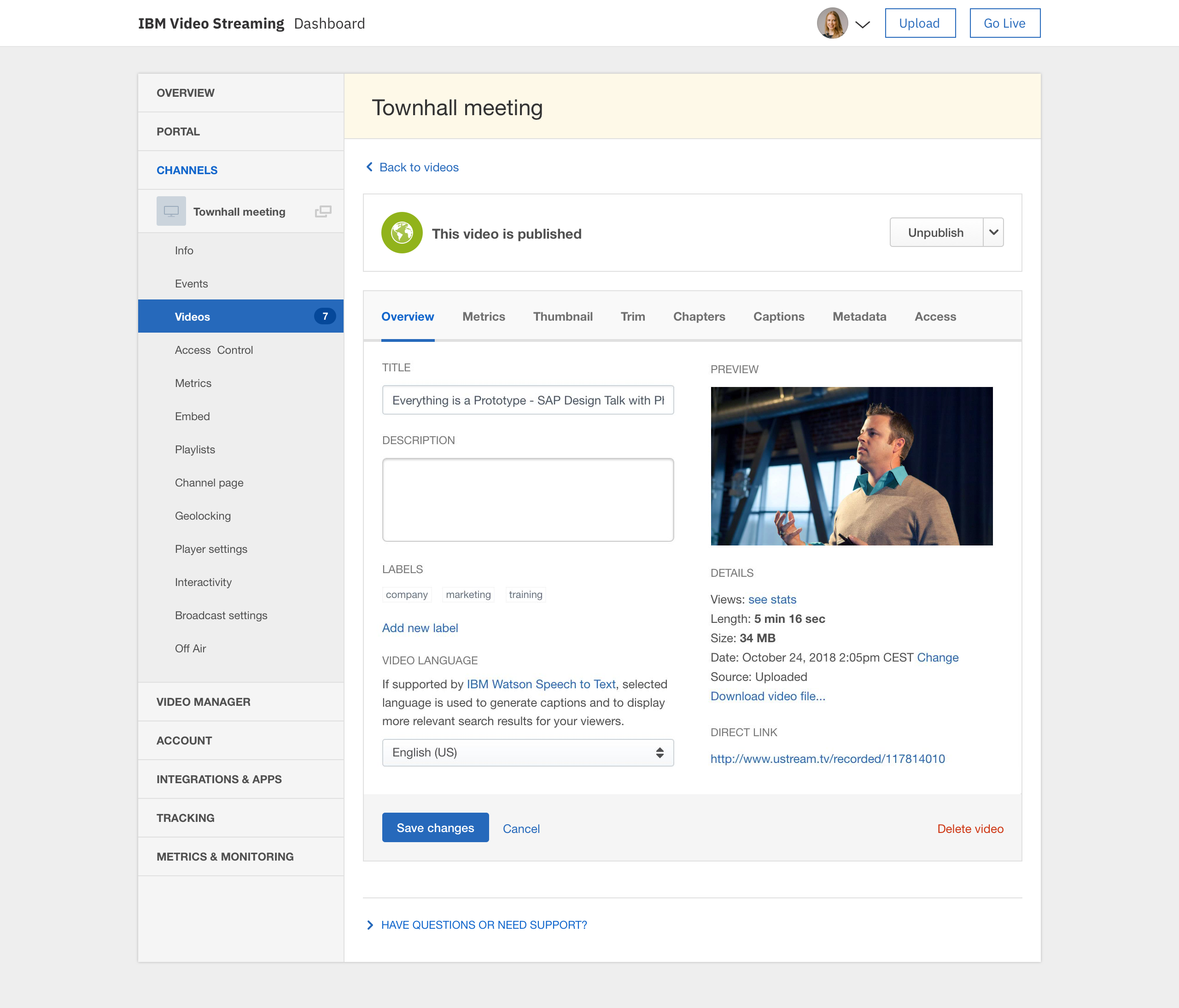
IBM Video Streaming solutions are used to stream virtual events, executive town halls, video marketing product launches, and 24-hour streaming channels. According to IBM, the solution is built for privacy, reliability and scale, to optimize video quality, and powered by IBM Watson AI for video search and automated closed captioning. IBM Enterprise Video Streaming can power security-rich video communications ranging from employee town halls, to…
$137
per month 100 viewer hours
Kaltura
Score8 out of 10
N/A
Kaltura, headquartered in New York, offers enterprise or large scale video storage, streaming, and distribution supporting a variety of purposes such as streaming, enterprise video portal, interactive video and virtual classroom, or podcasting.
N/A
Pricing
IBM Video Streaming
Kaltura
Editions & Modules
Silver
$137
per month 100 viewer hours
Gold
$688
per month 2,000 viewer hours
Platinum
$1380
per month 5,000 viewer hours
No answers on this topic
Offerings
Pricing Offerings
IBM Video Streaming
Kaltura
Free Trial
Yes
No
Free/Freemium Version
No
Yes
Premium Consulting/Integration Services
Yes
No
Entry-level Setup Fee
Optional
No setup fee
Additional Details
Video Streaming edition is available for purchase via credit card online (or via IBM salesperson if needs exceed those outlined in the online plans).
Enterprise Video Streaming edition must be purchased from an IBM salesperson.
Media Productions Engineer in Information Technology at Airbnb (Internet, 1001-5000 employees)
Chose IBM Video Streaming
The main reasons I would recommend Ustream over other competitors are: SSO integration, how accessible/responsive support is, the ease of use for the viewer, the consumption/seat model is easy to understand, server side encoding to multiple bitrates/qualities, ability to …
A de minimis incentive was given to thank the reviewer for their time. The incentive was not used to bias or drive a particular response, nor was the incentive contingent on a positive endorsement. More Info
Kaltura
No answer on this topic
Key User Insights
Would buy again
No answers on this topic
No answers on this topic
Delivers good value for the price
No answers on this topic
No answers on this topic
Happy with the feature set
No answers on this topic
No answers on this topic
Lived up to sales and marketing promises
No answers on this topic
No answers on this topic
Implementation went as expected
No answers on this topic
No answers on this topic
Features
IBM Video Streaming
Kaltura
Video Marketing
Comparison of Video Marketing features of IBM Video Streaming and Kaltura
Feature
IBM Video Streaming
-
Ratings
Kaltura
7.5
5 Ratings
0% above category average
Lead generation
00 Ratings
5.72 Ratings
Video personalization
00 Ratings
10.04 Ratings
eCommerce
00 Ratings
5.72 Ratings
Support for advertisements
00 Ratings
9.02 Ratings
Video SEO
00 Ratings
7.33 Ratings
Integration to Marketing Automation
00 Ratings
7.01 Ratings
Video Platform Integrations
Comparison of Video Platform Integrations features of IBM Video Streaming and Kaltura
Feature
IBM Video Streaming
-
Ratings
Kaltura
7.3
4 Ratings
17% above category average
Integration to Salesforce.com
00 Ratings
5.01 Ratings
Integration to Marketo
00 Ratings
5.01 Ratings
Integration to Eloqua
00 Ratings
9.01 Ratings
Integration to LMS
00 Ratings
10.03 Ratings
Video Security
Comparison of Video Security features of IBM Video Streaming and Kaltura
Feature
IBM Video Streaming
-
Ratings
Kaltura
8.3
7 Ratings
7% below category average
Video access controls
00 Ratings
8.57 Ratings
User management
00 Ratings
8.07 Ratings
Video link sharing
00 Ratings
8.07 Ratings
Internal video
00 Ratings
8.76 Ratings
External video
00 Ratings
8.37 Ratings
Video Player
Comparison of Video Player features of IBM Video Streaming and Kaltura
Feature
IBM Video Streaming
-
Ratings
Kaltura
7.8
6 Ratings
8% below category average
Player customization
00 Ratings
8.35 Ratings
Embedded videos
00 Ratings
8.36 Ratings
Video quality / Bandwidth controls
00 Ratings
8.76 Ratings
Mobile compatibility
00 Ratings
5.76 Ratings
Video Analytics
Comparison of Video Analytics features of IBM Video Streaming and Kaltura
Feature
IBM Video Streaming
-
Ratings
Kaltura
6.4
5 Ratings
20% below category average
A/B testing
00 Ratings
6.02 Ratings
Streaming quality reports
00 Ratings
6.43 Ratings
Per viewer tracking
00 Ratings
6.45 Ratings
Per video tracking
00 Ratings
6.45 Ratings
Video analytics dashboard
00 Ratings
6.75 Ratings
Video Hosting, Management & Storage
Comparison of Video Hosting, Management & Storage features of IBM Video Streaming and Kaltura
Feature
IBM Video Streaming
-
Ratings
Kaltura
8.1
7 Ratings
7% below category average
On-Demand video
00 Ratings
8.05 Ratings
Live streaming
00 Ratings
7.73 Ratings
Impact of streaming on network
00 Ratings
8.33 Ratings
Video upload & format support
00 Ratings
8.37 Ratings
Video library / File management
00 Ratings
8.07 Ratings
Video portal
00 Ratings
8.56 Ratings
Video Engagement
Comparison of Video Engagement features of IBM Video Streaming and Kaltura
Very limited customization features. Permissions are a mess too if you want to have people assigned as chat moderators for events for instance, but dont want them access to the admin panel. The quality of the broadcast and live captions work well, but they charge extra for live captions. For operating a video on demand site, the design of the page is really poor and limited on customization. Been a user for years and seen almost no new innovation on the platform which has been disappointing. The metrics are a mess on the user panels too. They do provide an api link for your external metrics and/or data dumps for using something like tableau, but that features not really something to write home about and a rather basic offering. This is an expensive platform with limited options and an outdated style unfortunately. We have been getting by for our uses but there's nothing really keeping us with IBM if another platform offering came around
Kaltura is an excellent tool IF you have a large library of content. It can be pretty pricey so if you are early in launching an online program you may be better off waiting a few years until you've amassed a large enough catalog to warrant the investment in such a tool. The tool is best purchased by a University or company-wide vs having a single department try to find the budget for it. The unlimited plan pays for itself in most cases if you go this route. Secondly, you must be willing to invest time and resources into on-going training for your faculty and staff, especially for those who wish to create their own media and use the quizzing features.
A de minimis incentive was given to thank the reviewer for their time. The incentive was not used to bias or drive a particular response, nor was the incentive contingent on a positive endorsement. More Info
IBM Video Streaming allows for the integration of interactive elements into video content, such as quizzes, polls, and live Q&A sessions. This can make learning more engaging for young students by making it interactive and fun, thus increasing their attention and participation.
Teachers in a K-5 setting can access and share professional development materials and teaching resources through the platform. This can help them stay updated on the best practices for early childhood education, innovative teaching methods, and subject-specific strategies, ultimately benefiting their students.
IBM Video Streaming provides the capability for teachers to create a library of on-demand educational videos. This is particularly useful for young learners who may need to revisit concepts multiple times to fully understand them. It also supports differentiated learning by allowing students to learn at their own pace.
Young students often benefit from visual aids in their learning process. IBM Video Streaming can deliver high-quality video content that includes animations, demonstrations, and visual explanations of concepts. This can be particularly effective in subjects like science, math, and reading, where visualizations can enhance understanding.
A de minimis incentive was given to thank the reviewer for their time. The incentive was not used to bias or drive a particular response, nor was the incentive contingent on a positive endorsement. TR verified that a representative sample of customers was invited. More Info
Very easy to use interface for uploading videos or capturing a screen recording. There are very few clicks required to get the media up and running. The video conversion process that happens on the back-end is fast and provides videos in device agnostic formats.
Integrates well with other systems, such as our Moodle LMS. This extends the capabilities of the LMS and also allows us to keep video/multimedia content organized in a central location (the KMC).
Kaltura can be connected to various processes within your organization. For example, we have a system in place that allows a video lecture in a classroom to be uploaded to Kaltura in a very easy manner.
User/role management is very important as some people on campus have more privileges to publish content than do others. We have Kaltura connected to our Single Sign-On solution for authentication and we can assign roles to specific people within the Kaltura software.
Occasionally, we experience a form of static that lasts for about 1 to 2 minutes. It appears in the live stream and in the auto-recorded file, but not in the live worship assembly. It occurs roughly 1 in every 4 hours of webcast time. I wish there was a way to trace the source of that recurring static. The diagnostic tools could be more robust.
It would be nice if the chat room allowed a user photo/avatar for each user to personalize that a little more.
I have wished for a way that an admin could use a “laser pointer” on the video window to point out something on the feed that other live viewers could see.
It would be wonderful to have a mini-tutorial for viewers who are not technically savvy that would inform them of how to get to the site and explain how they can use the software. For example, how they can see and type in the chat room, how to maximize the screen and make it smaller. Some of our viewers are in nursing homes or otherwise limited in capability to learn to use this on their own.
A de minimis incentive was given to thank the reviewer for their time. The incentive was not used to bias or drive a particular response, nor was the incentive contingent on a positive endorsement. More Info
A de minimis incentive was given to thank the reviewer for their time. The incentive was not used to bias or drive a particular response, nor was the incentive contingent on a positive endorsement. More Info
Our organization depends heavily on this streaming service. Now that we have the option of allowing our clients to attend meetings virtually, we can never retract that option as so many of our clients love the flexibility. Also, we have no complaints with the service itself. It is reliable and dependable and any issues we have encountered have never been to blame on the service but rather our lack of knowledge of it or needing to update our embed code
A de minimis incentive was given to thank the reviewer for their time. The incentive was not used to bias or drive a particular response, nor was the incentive contingent on a positive endorsement. TR verified that a representative sample of customers was invited. More Info
The choice to renew our subscription does not belong to us, though we are able to provide input. We are aware of competitive products who have matured in the past three years, and we are aware now of alternatives to conventional plugin usage (LTI).
The user interface is pretty straightforward, but simply needs optimization. (Please hire a seasoned UX person to fix it.) However, all of the key features are there and understandable. It's a great platform overall, a bit expensive, and could use some more options for its viewing experience, and a better "smart" embedding window for mobile applications.
A de minimis incentive was given to thank the reviewer for their time. The incentive was not used to bias or drive a particular response, nor was the incentive contingent on a positive endorsement. More Info
Absolutely. We have never had an outage problem or any application errors that I have been privy to. We are duly notified generally in advance of outages or updates
A de minimis incentive was given to thank the reviewer for their time. The incentive was not used to bias or drive a particular response, nor was the incentive contingent on a positive endorsement. TR verified that a representative sample of customers was invited. More Info
As we use it now, we are satisfied with the streaming performance. I cannot speak to integration yet as we have yet to engage in that but have plans to in the future
A de minimis incentive was given to thank the reviewer for their time. The incentive was not used to bias or drive a particular response, nor was the incentive contingent on a positive endorsement. TR verified that a representative sample of customers was invited. More Info
We funded 'white glove' service as our timelines were tight and our needs were well-defined. Tier 1 and Tier 2 support were able to help us get up and running in shorter order than we would have on our own. Documentation on the eCDN product had gaps, increasing the time to resolve and created concerns about success.
A de minimis incentive was given to thank the reviewer for their time. The incentive was not used to bias or drive a particular response, nor was the incentive contingent on a positive endorsement. More Info
The first line support agents seldom are able to diagnose or troubleshoot any problems that we have. These agents simply open support tickets in their system which are escalated to a foreign level 2 support agent which creates at least a day delay between reporting a problem and getting initial feedback. Any back-and-forth questions add at least another day delay.
A de minimis incentive was given to thank the reviewer for their time. The incentive was not used to bias or drive a particular response, nor was the incentive contingent on a positive endorsement. More Info
Ustream is easy to implement. It takes any stream we have thrown its way and distributed it quickly and with quality. When talking to others that are pursuing live stream implementations, I often remind them that the technology used to distribute your live stream is less important than the quality of the content you are distributing. Taking care to use the right camera equipment, the proper encoder, and quality sound gear will result in a high-quality stream that will allow the strength of the Ustream CDN to shine.
A de minimis incentive was given to thank the reviewer for their time. The incentive was not used to bias or drive a particular response, nor was the incentive contingent on a positive endorsement. More Info
Vimeo offers better tools for on-demand like chapters and marketing tools. But their live options are limited to event durations. YouTube can stream for longer durations but IBM 24/7 stream has been much more reliable and easy to use.
A de minimis incentive was given to thank the reviewer for their time. The incentive was not used to bias or drive a particular response, nor was the incentive contingent on a positive endorsement. More Info
Kaltura was the best option given the sheer volume of people we needed to support digitally. Others were better in their own regard, but due to limitations in number of attendees or sessions, Kaltura was the best option
A de minimis incentive was given to thank the reviewer for their time. The incentive was not used to bias or drive a particular response, nor was the incentive contingent on a positive endorsement. More Info
A de minimis incentive was given to thank the reviewer for their time. The incentive was not used to bias or drive a particular response, nor was the incentive contingent on a positive endorsement. More Info
Our ROI is measured by the provision of ministry and satisfaction of our congregation. We are extremely pleased with our USTREAM and feel that it is a valuable asset to our church.
A de minimis incentive was given to thank the reviewer for their time. The incentive was not used to bias or drive a particular response, nor was the incentive contingent on a positive endorsement. TR verified that a representative sample of customers was invited. More Info
Managing video content with the KMC has greatly reduced the amount of hours previously needed to manage.
User issues ie: uploading video, viewing video has been greatly reduced.
Increased user engagement with using video in LMS courses. We currently have 6,929 videos on our system. Last month , 2/1/14, 17,623 videos were viewed at least 75% of the way through.