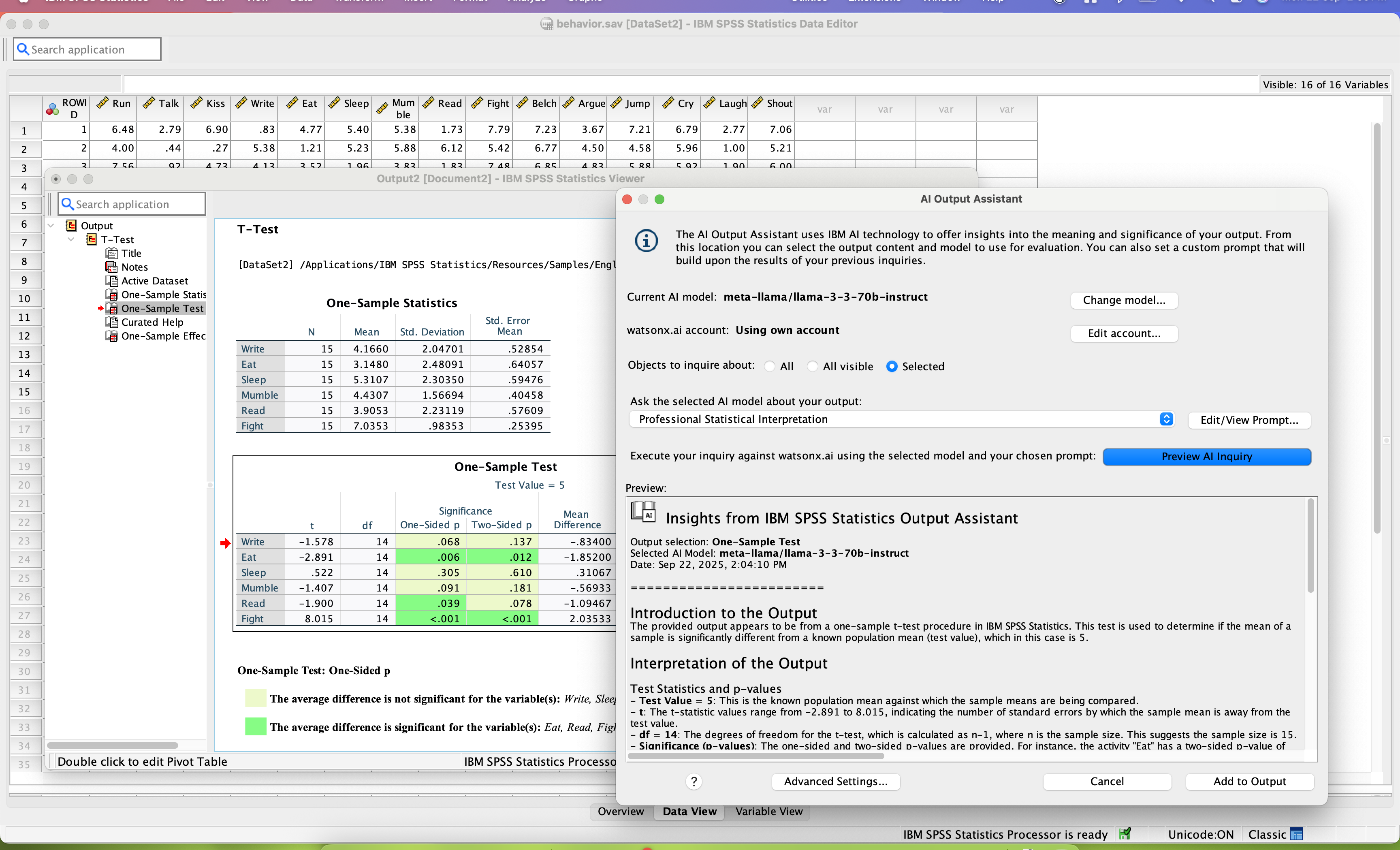
SPSS Statistics is a software package used for statistical analysis. It is now officially named "IBM SPSS Statistics". Companion products in the same family are used for survey authoring and deployment (IBM SPSS Data Collection), data mining (IBM SPSS Modeler), text analytics, and collaboration and deployment (batch and automated scoring services).
$99
per month per user
SAS Enterprise Miner
Score 9.0 out of 10
N/A
SAS Enterprise Miner is a data science and statistical modeling solution enabling the creation of predictive and descriptive models on very large data sources across the organization.
N/A
Pricing
IBM SPSS Statistics
SAS Enterprise Miner
Editions & Modules
Base
USD 3,830
one-time fee per user
Standard
USD 8,440
one-time fee per user
Professional
USD 16,900
one-time fee per user
Premium
USD 25,200
one-time fee per user
Monthly subscription
USD 99
per month per user
Annual subscription
USD 1,188.00
per year per user
No answers on this topic
Offerings
Pricing Offerings
IBM SPSS Statistics
SAS Enterprise Miner
Free Trial
Yes
No
Free/Freemium Version
No
No
Premium Consulting/Integration Services
No
No
Entry-level Setup Fee
No setup fee
No setup fee
Additional Details
—
—
More Pricing Information
Community Pulse
IBM SPSS Statistics
SAS Enterprise Miner
Features
IBM SPSS Statistics
SAS Enterprise Miner
Platform Connectivity
Comparison of Platform Connectivity features of Product A and Product B
IBM SPSS Statistics
-
Ratings
SAS Enterprise Miner
8.8
Ratings
5% above category average
Connect to Multiple Data Sources
00 Ratings
8.10 Ratings
Extend Existing Data Sources
00 Ratings
9.00 Ratings
Automatic Data Format Detection
00 Ratings
9.30 Ratings
MDM Integration
00 Ratings
9.00 Ratings
Data Exploration
Comparison of Data Exploration features of Product A and Product B
IBM SPSS Statistics
-
Ratings
SAS Enterprise Miner
8.1
Ratings
3% below category average
Visualization
00 Ratings
7.10 Ratings
Interactive Data Analysis
00 Ratings
9.10 Ratings
Data Preparation
Comparison of Data Preparation features of Product A and Product B
IBM SPSS Statistics
-
Ratings
SAS Enterprise Miner
8.0
Ratings
2% below category average
Interactive Data Cleaning and Enrichment
00 Ratings
7.80 Ratings
Data Transformations
00 Ratings
8.20 Ratings
Data Encryption
00 Ratings
8.10 Ratings
Built-in Processors
00 Ratings
8.10 Ratings
Platform Data Modeling
Comparison of Platform Data Modeling features of Product A and Product B
IBM SPSS Statistics
-
Ratings
SAS Enterprise Miner
8.8
Ratings
5% above category average
Multiple Model Development Languages and Tools
00 Ratings
7.50 Ratings
Automated Machine Learning
00 Ratings
9.80 Ratings
Single platform for multiple model development
00 Ratings
8.50 Ratings
Self-Service Model Delivery
00 Ratings
9.20 Ratings
Model Deployment
Comparison of Model Deployment features of Product A and Product B
SPSS is well-suited for the following: 1) User Behavior Analysis: SPSS handles large datasets to analyze user behavior data. 2) Customer Satisfaction / Foundational Surveys: SPSS facilitates analysis of quant data from satisfaction surveys, keeping us informed about customer needs and preferences. 3) A/B test analysis: SPSS statistical tools for A/B test analysis, which helps optimize user experience of our products. Scenarios where SPSS are less appropriate: 1) Qualitative Data Analysis: I do not use SPSS for open-ended survey responses/qual data. 2) Live/in-vivo data analysis: SPSS is not ideal for real-time data processing. 3) Complex Data Integration: SPSS isn’t the best fit for complex data integration tasks
SPSS has been around for quite a while and has amassed a large suite of functionality. One of its longest-running features is the ability to automate SPSS via scripting, AKA "syntax." There is a very large community of practice on the internet who can help newbies to quickly scale up their automation abilities with SPSS. And SPSS allows users to save syntax scripting directly from GUI wizards and configuration windows, which can be a real life-saver if one is not an experienced coder.
Many statistics package users are doing scientific research with an eye to publish reproducible results. SPSS allows you to save datasets and syntax scripting in a common format, facilitating attempts by peer reviewers and other researchers to quickly and easily attempt to reproduce your results. It's very portable!
SPSS has both legacy and modern visualization suites baked into the base software, giving users an easily mountable learning curve when it comes to outputting charts and graphs. It's very easy to start with a canned look and feel of an exported chart, and then you can tweak a saved copy to change just about everything, from colors, legends, and axis scaling, to orientation, labels, and grid lines. And when you've got a chart or graph set up the way you like, you can export it as an image file, or create a template syntax to apply to new visualizations going forward.
SPSS makes it easy for even beginner-level users to create statistical coding fields to support multidimensional analysis, ensuring that you never need to destructively modify your dataset.
In closing, SPSS's long and successful tenure ensures that just about any question a new user may have about it can be answered with a modicum of Google-fu. There are even several fully-fledged tutorial websites out there for newbie perusal.
One of the major flaws is that the tool is basically an interface to SAS/STAT code. It generates code in the background and runs it. Because of that, some errors are warning might be a little difficult to understand for users who aren't proficient with SAS code.
R integration is nice but I would like to see the possibility to integrate even more statistical models different than SAS. That would allow for better performance optimization when really required.
The light client is java based and a little heavy on the OS. It would be nice to get a web-based version of the tool instead of the java one.
It's super easy to use for newbies and super powerful for power users! It does EVERYTHING you are usually asked to do analytically. Their Help Desk is PHENOMENAL. And I find the upgrade and renewal price to be a good deal.
SPSS is beginner friendly and user-friendly for beginner analysts and simple statistical tests. It's "click and go" interface does take some learning, but overall this is much easier than other programs I have used and seen. Compared to SAS software, SPSS takes a great deal less familiarizing and it not a matter of learning a coding language like SAS and RStudio.
I have not contacted IBM SPSS for support myself. However, our IT staff has for trying to get SPSS Text Analytics Module to work. The issue was never resolved, but I'm not sure if it was on the IT's end or on SPSS's end
I have contacted SAS twice in the past year and they have been super responsive both times. They solved my problem. I am also registered for an in-person class next month and they called today to tell me that it will be an online-only session. They apologized for the change and registered me for the online version. Super helpful!
Have a plan for managing the yearly upgrade cycle. Most users work in the desktop version, so there needs to be a mechanism for either pushing out new versions of the software or a key manager to deal with updated licensing keys. If you have a lot of users this needs to be planned for in advance.
If you have made it this far, you should have a very good idea of how SPSS stacks up the competition (data processing and analytics tools). Even the free ones, such as r Studio or Stata, are leaps and bounds ahead of SPSS. IBM is resting on a reputation developed nearly 30 years ago and has shown no desire to improve.
For those that are used to the SAS ecosystem, SAS Enterprise Miner is a massive move in the right direction. It makes doing analytics much more enjoyable. It is more user-friendly than Spotfire or Kinesis and seems to produce better results overall. SAS Enterprise Miner seems to be written by analysts for analysts.
I found SPSS easier to use than SAS as it's more intuitive to me.
The learning curve to use SPSS is less compared to SAS.
I used SAS, to a much lesser extent than SPSS. However, it seems that SAS may be more suitable for users who understand programming. With SPSS, users can perform many statistical tests without the need to know programming.
It has a positive ROI to our business, as our sales lead rate increased after we started recommending SAS EM.
Our business operation numbers improved after we introduced SAS EM and started using predictive analytics for our customer retention and customer chain prediction.
The statistical modelling for the risk controls in our financial department helped to reduce the related residual risk.