Instana, an IBM company since the December 2020 acquisition, provides APM services for SOA, microservices, containerized applications and Kubernetes, and cloud native applications, as well as discovery and monitoring for IT assets.
$75
per month per Managed Virtual Server (MVS)
SolarWinds AppOptics
Score 8.1 out of 10
N/A
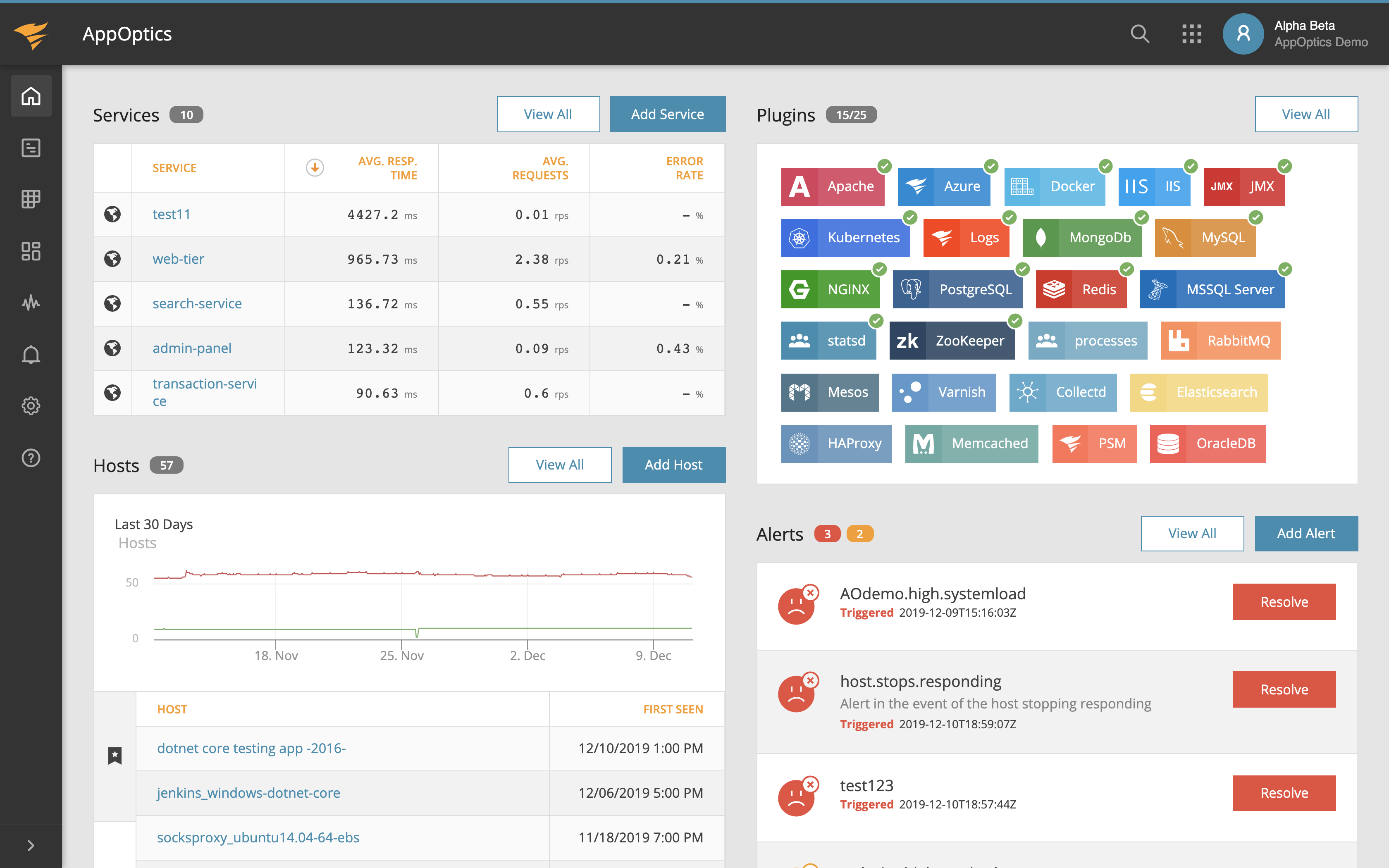
SolarWinds AppOptics (formerly Librato) is an IT infrastructure monitoring service and APM, based on technology acquired by SolarWinds with Librato in 2015 to expand its cloud monitoring portfolio.
N/A
Pricing
IBM Instana
SolarWinds AppOptics
Editions & Modules
Essentials
$18
per month per Managed Virtual Server (MVS)
Standard
$75
per month per Managed Virtual Server (MVS)
Self-Hosted
$93.80
per month per Managed Virtual Server (MVS)
No answers on this topic
Offerings
Pricing Offerings
IBM Instana
SolarWinds AppOptics
Free Trial
Yes
Yes
Free/Freemium Version
No
No
Premium Consulting/Integration Services
No
No
Entry-level Setup Fee
No setup fee
No setup fee
Additional Details
—
—
More Pricing Information
Community Pulse
IBM Instana
SolarWinds AppOptics
Considered Both Products
IBM Instana
No answer on this topic
SolarWinds AppOptics
Verified User
Vice-President
Chose SolarWinds AppOptics
As an early-stage startup, we evaluated the different options on the following parameters: Functionality Monitoring overhead Cost Easy-to-use dashboard AppOptics had most of the features that we needed and offered their services at a reasonable price that made sense for …
With enterprise IT assets in a multitude of ecosystems, cloud infrastructures and sometimes still left stuck in a legacy on prem architecture, IBM Instana makes it easy to get the right data to drive development and / or DevSecOps processes with tangible input from the target environment itself.
AppOptics is good for small to medium-sized organizations with less than 150 servers or less than 40 services to monitor. It performs well for this use case where people need to get an overview of application performance, and 95%ile data is okay. Somewhere every data point and every record is critical; it should be avoided.
Can monitor application(s) and system(s) with very large throughput of transactions by the second ( it gets everything !!!)
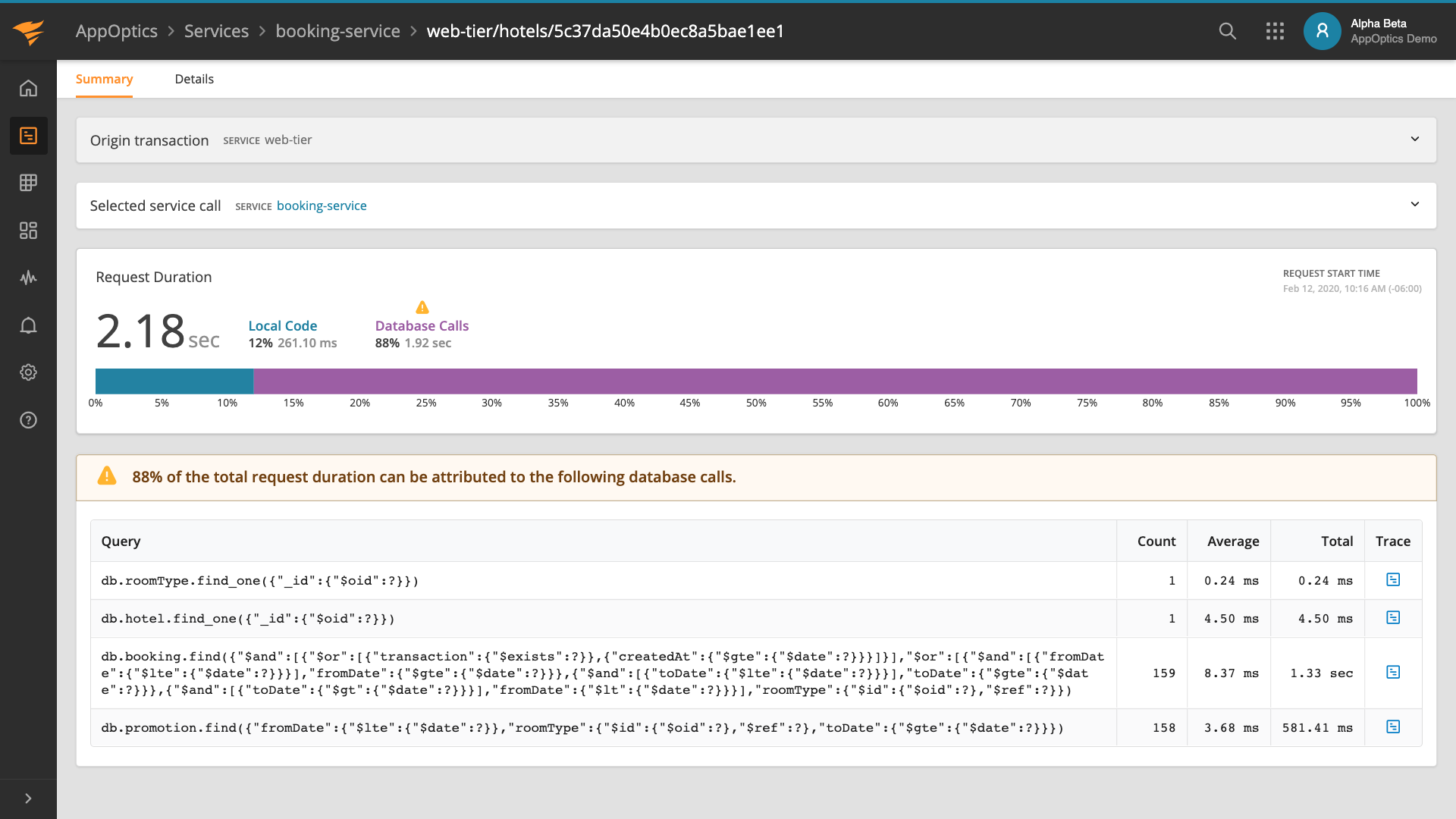
Provide strong drill down for your applications and will tell you where the points of failure of an application's is ( servers , network , Databases , etc you name it )
Very easy to set up and have it up and running when using the SaaS solution. There's an on premise solution which works just as well but requires more effort and preparation from an infrastructure point of view for your teams to implement.
Continuously improve their features and their agents auto-update and keep up. All while not interfering with your applications.
Let's you create your own dashboards and visualizations that can be tailored for different kind of users with the data collected.
Create your own events and smart alerts so you can know on the spot if something is happening or is likely to happen that needs addressing on your applications / systems
It's very difficult to create custom dashboards, only a handful of scenarios can be visualized to dashboards.
Extracting information from Instana to further analysis into excel for example is something that can be improved. Using an API to get data is very limiting.
Open telemetry features which allow to send application data to Instana is not working as documented.
The only thing that I would add is the possibility to display every single query our servers receive to eventually analyze them and query through them. We could also generate nice visualizations from that. Right now I believe we can only see averages.
Instana has been able to fulfill our all requirement and provide out of box solution for multiple component like AWS RDS Monitoring and real time alerting setup on basis of that. it is also easy to integrate with other open-source alerting and monitoring tools which makes it easier to incorporate into our solutions
IBM Instana totally alters our monitoring approach since it increases the stability of the system and simplifies the process of problem solving. And since it helps to lower the degree of alert exhaustion that we experience, it is a total game changer for us.
As far a usability is concerned for AppOptics, it is just as matter of few minutes away even if you start from scratch, as all you need to do is register on the site and you will get the URL and password. And after this all you have to do is follow the instruction, as per the configuration wizard (tool tip) within the console for various technology such as SQL, IIS, .NET
Solarwinds AppOptics is rated as 9 out of 10 and the reason is there are still few areas where AppOptics needs to improve such as Service Now Integration, GCP Cloud Support, Better Dashboard visualization for application transactions flow. Other than these feature everything is there in AppOptics and that's a reason given 9 points out of 10.
As a DevOps engineer, I've explored various Application Performance Monitoring (APM) tools, including New Relic for real-time insights, AppDynamics for code-level visibility, Dynatrace for AI-driven monitoring, Datadog for comprehensive observability, Splunk for log management, Stackify Retrace for error tracking, and Raygun for crash reporting. Each tool offers distinct features, and the choice depends on specific use cases, technology stacks, and organizational needs. Thorough evaluations, considering factors like ease of use, integration capabilities, and scalability, help in selecting the most suitable APM solution for effective application monitoring in a DevOps environment.
What we found positive in AppOptics from others is:
Easy to install and manage.
Various stack support.
Point to point deep-dive metrics and correlation.
Metrics like DB connection, query analysis, latency in API calls, and other connections, response codes for various APIs, etc are the key ones in our case, which AppOptics provides efficiently.