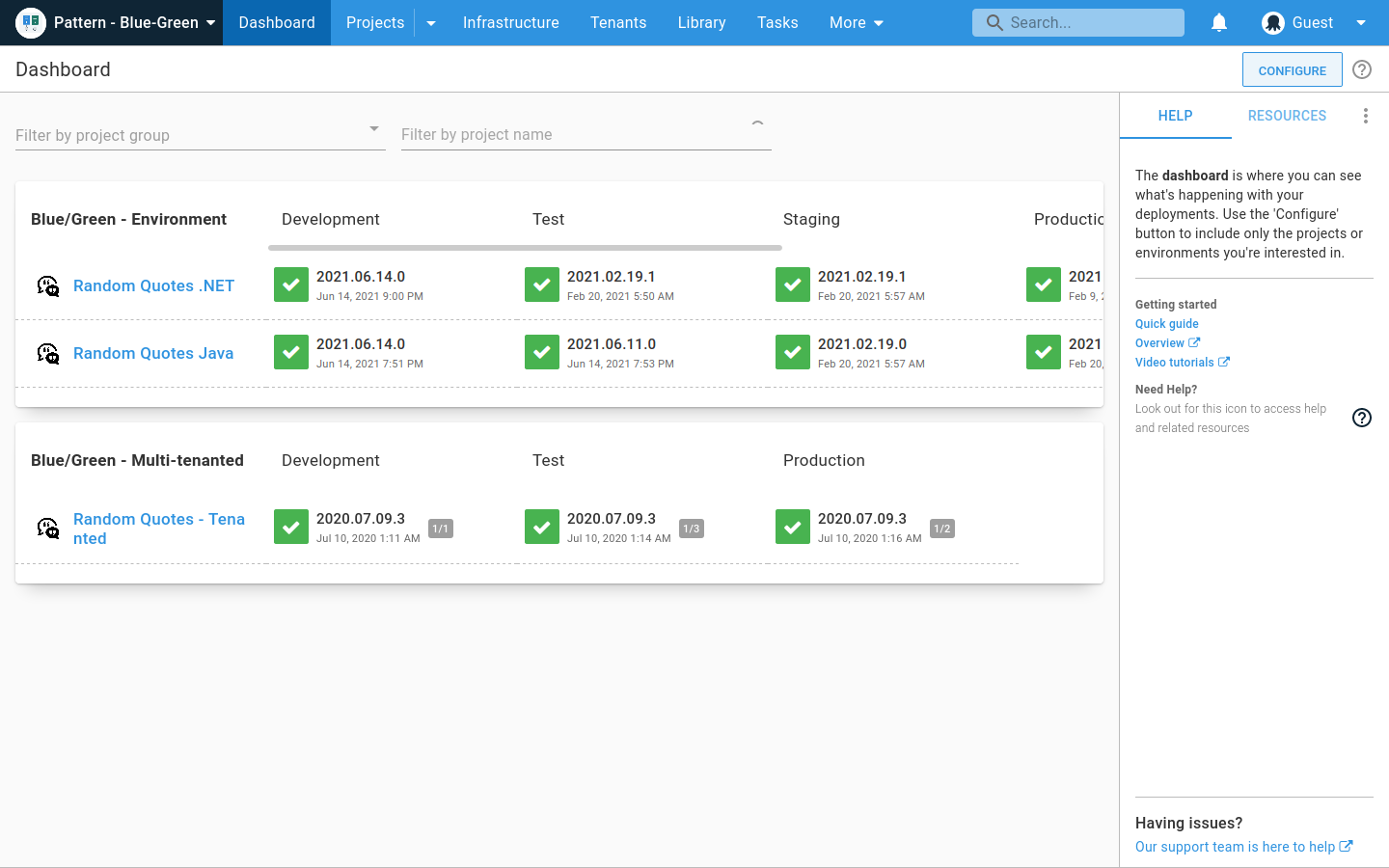
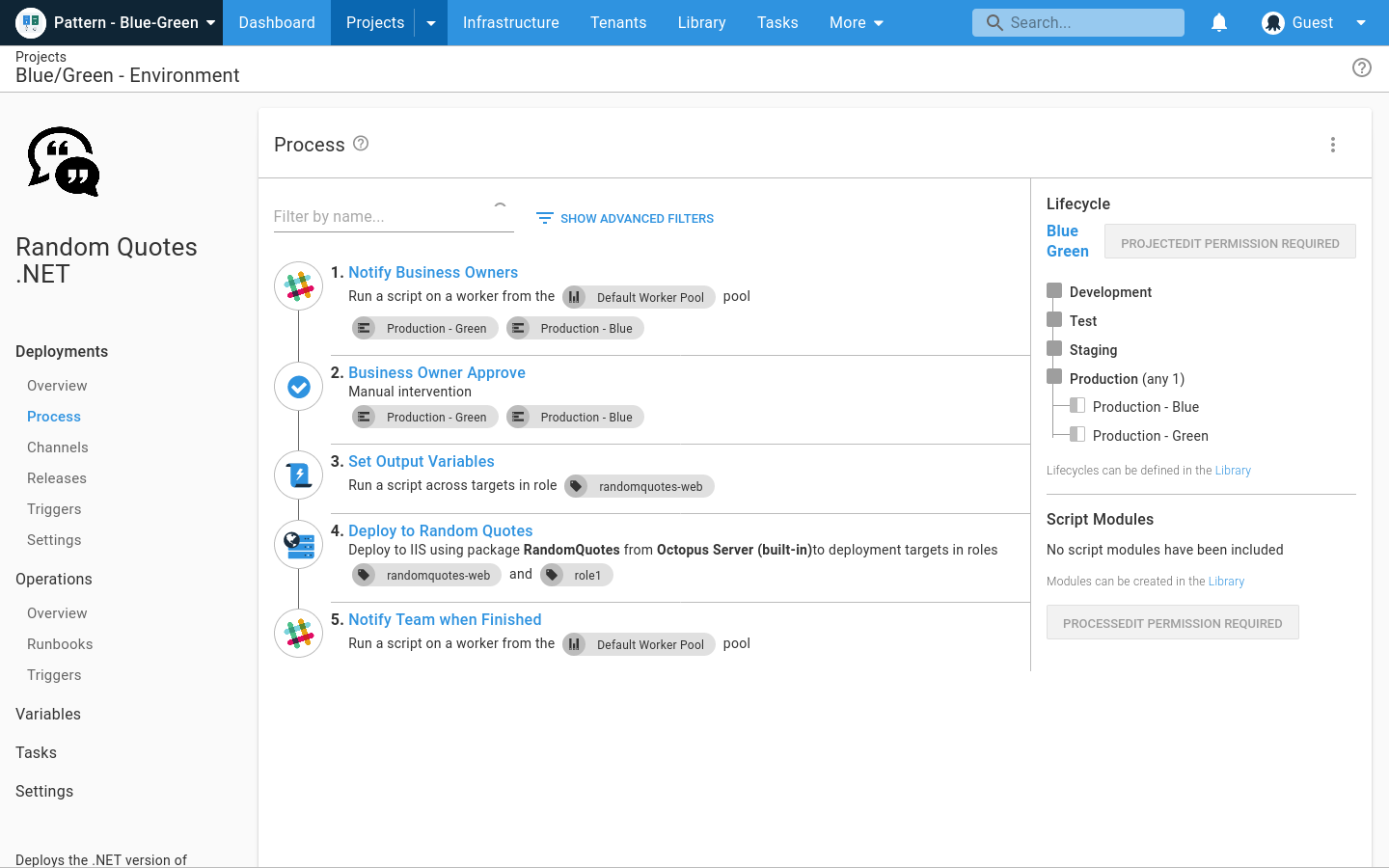
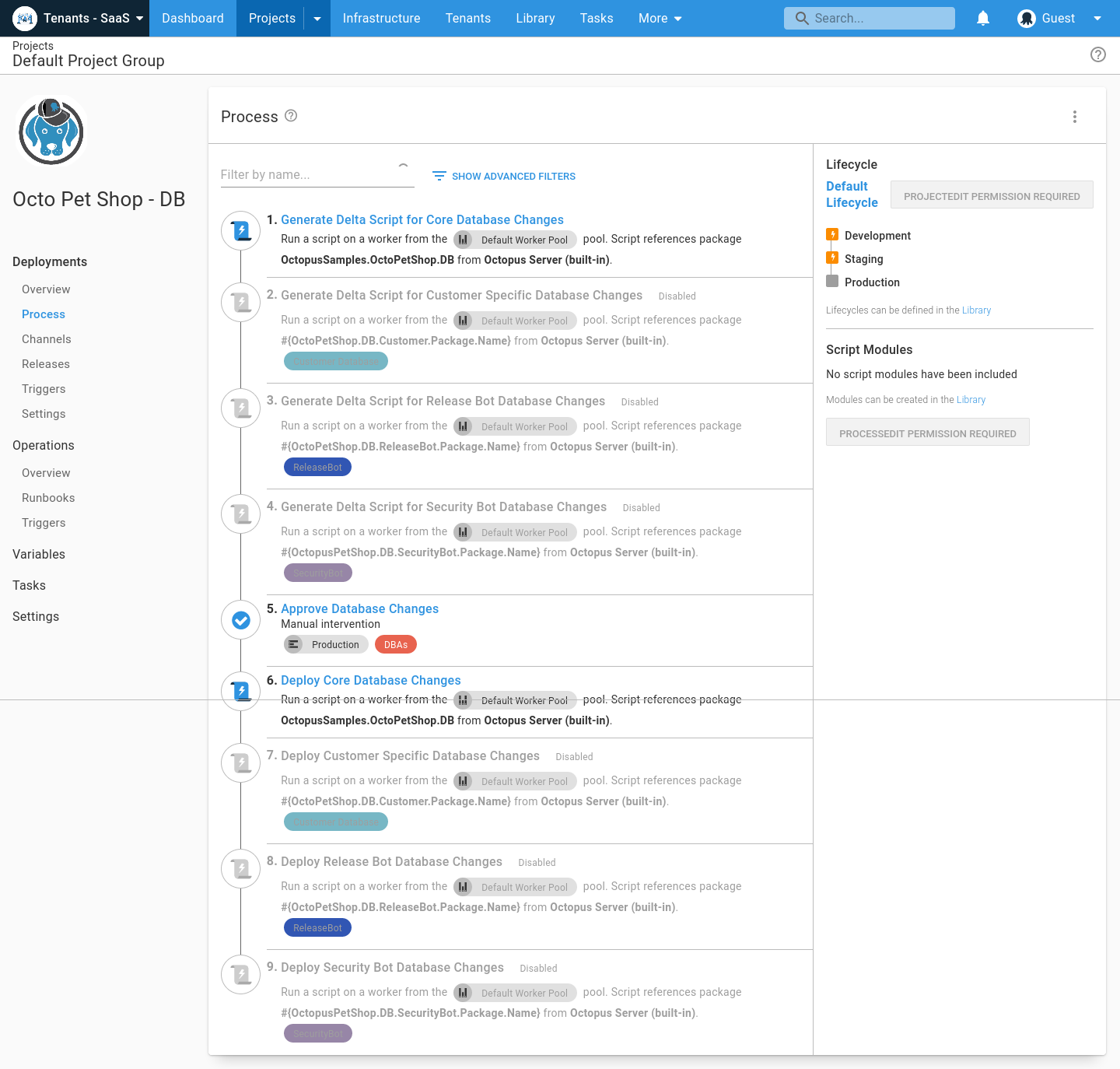
A solution for continuous delivery of any application to any environment, and an application-release solution that infuses automation into the continuous delivery and continuous deployment (CI/CD) process and provides robust visibility, traceability and auditing capabilities.
N/A
Octopus Deploy
Score10 out of 10
Mid-Size Companies (51-1,000 employees)
Australian company Octopus Deploy offers their eponymous automated deployment and release management software that integrates with the user's preferred CI server and adds deployment & ops automation capabilities. Octopus Deploy enables developers, release managers, and operations folks to bring all automation into a single place. The vendor states that by reusing configuration variables, environment definition, API keys, connection strings, permissions, service principals, and automation logic,…
$12
per month
Pricing
IBM DevOps Deploy
Octopus Deploy
Editions & Modules
No answers on this topic
Cloud
Free 30 day trial
unlimited targets/users/projects
Server
Free 30 day trial
unlimited targets/users/projects
Enterprise
Starting at $18 per month
Enterprise
Starting at $18 per month
Server
Starting at $12 per month
Cloud
Starting at $12 per month
Offerings
Pricing Offerings
IBM DevOps Deploy
Octopus Deploy
Free Trial
No
Yes
Free/Freemium Version
No
Yes
Premium Consulting/Integration Services
No
Yes
Entry-level Setup Fee
No setup fee
Optional
Additional Details
—
Octopus Server edition is available as a 30 day free trial on our unlimited tier for any scenario, including production, and commercial use. After the trial period ends you can keep your working configuration and upgrade to a paid license and continue deploying uninterrupted.
Octopus Cloud is an alternative that is hosted by us, and is also available as a 30 day unlimited trial. No credit card is needed to create a Octopus Cloud trial instance. You can convert the Cloud trial to a paid instance at any time during or after the trial period, and keep all of your instance configuration.
Octopus also offers an Enterprise tier which offers advanced features for teams at scale including, advanced high availability, insights & DORA metrics, ServiceNow & Jira Service Management integration, unlimited instances, 24/7 support & service credits, and a Customer Success Manager.
Volume discounts are available above 500 targets, and temporary bursting for certain scenarios is supported.
Sr. Integration Developer / DevOps Engineer in Information Technology at NRECA (Non-Profit Organization Management, 51-200 employees)
Chose Octopus Deploy
We looked at IBM UrbanCode Deploy and Release and Microsoft VSTS while looking for Application Release Automation tools. While VSTS doesn't work with cross-platform technologies IBM UrbanCode Deploy commands a premium price for the features it offers. Also, it needs UrbanCode …
A de minimis incentive was given to thank the reviewer for their time. The incentive was not used to bias or drive a particular response, nor was the incentive contingent on a positive endorsement. More Info
IBM UrbanCode Deploy is excellent for code deployments such as Java, .Net, C++, etc. It can also deploy and run SQLs reasonably well. Where it lacks is the ability for executables, Jars, WARs, EARs, etc.
A de minimis incentive was given to thank the reviewer for their time. The incentive was not used to bias or drive a particular response, nor was the incentive contingent on a positive endorsement. More Info
Octopus Deploy is a well though [the] solution to the deployment orchestration problem. It is a reliable and robust solution that is relatively simple to understand. [Its] UI is friendly and easy to use, The support and documentation [are] excellent and the product seems to fit into any organization’s process very well and with less effort than other products in this space. I actually find it a pleasure to work with [every day] and I am glad to have it as an integral part of our process.
A de minimis incentive was given to thank the reviewer for their time. The incentive was not used to bias or drive a particular response, nor was the incentive contingent on a positive endorsement. More Info
A de minimis incentive was given to thank the reviewer for their time. The incentive was not used to bias or drive a particular response, nor was the incentive contingent on a positive endorsement. More Info
A de minimis incentive was given to thank the reviewer for their time. The incentive was not used to bias or drive a particular response, nor was the incentive contingent on a positive endorsement. More Info
IBM UrbanCode Deploy does code deployments easy enough, but configurations or ex deployments are a little more complicated. I work on packaged systems, so most of the code I get is form a vendor that I have to deploy.
IBM UebanCode Deploy integration into the mainframe world would be ideal. My company uses Mainframe and OpenSystems technologies, and many times there are dependencies between the deployments.
A de minimis incentive was given to thank the reviewer for their time. The incentive was not used to bias or drive a particular response, nor was the incentive contingent on a positive endorsement. More Info
UI is very fluffy and padded. It looks pretty but it could benefit from a more compact, information-focused design
Deployment process options are not always laid out in an intuitive manner. Choosing which steps to exclude, which environments or targets to deploy to, etc., is not immediately clear
Lack of useful reports and metrics for tracking active deployments and historical data
A de minimis incentive was given to thank the reviewer for their time. The incentive was not used to bias or drive a particular response, nor was the incentive contingent on a positive endorsement. More Info
A de minimis incentive was given to thank the reviewer for their time. The incentive was not used to bias or drive a particular response, nor was the incentive contingent on a positive endorsement. More Info
It's challenging to get a working knowledge of the product without having someone show you the ropes. Linking components with applications and applications with resource trees and resource trees with application deploys is not intuitive. However, once past that learning curve, the possibilities open up, and things become easier to understand and allow for further granularity.
A de minimis incentive was given to thank the reviewer for their time. The incentive was not used to bias or drive a particular response, nor was the incentive contingent on a positive endorsement. More Info
Octopus Deploy has greatly helped us to improve our reliability and frequency of our deployments and given us the confidence to deploy much more often, with a direct benefit to customers. Cross-platform support and release to Cloud require more focus on the product side.
A de minimis incentive was given to thank the reviewer for their time. The incentive was not used to bias or drive a particular response, nor was the incentive contingent on a positive endorsement. More Info
Octopus Deploy is a software that runs very effectively, is easy to use, does not require such a high learning curve, provides the necessary tools to carry out the functions it offers, making it a very flexible software, it also allows that can be configured according to the needs of the user and provides integrations with other very advantageous tools since they are carried out in a very favorable way.
A de minimis incentive was given to thank the reviewer for their time. The incentive was not used to bias or drive a particular response, nor was the incentive contingent on a positive endorsement. More Info
A de minimis incentive was given to thank the reviewer for their time. The incentive was not used to bias or drive a particular response, nor was the incentive contingent on a positive endorsement. More Info
Octopus Deploy support has always been there for us, even when using the free tier, we get responsive hands-on help. We haven't needed to use that level of support since the documentation is clearly written, and help is readily available within the interface itself. Using Octopus Deploy is a truly joyful experience.
A de minimis incentive was given to thank the reviewer for their time. The incentive was not used to bias or drive a particular response, nor was the incentive contingent on a positive endorsement. More Info
There aren't really any competitors in the land of ASP.NET. Deployment is too ad-hoc. Other tools exist that have massive downsides, like Web Deploy. Most aren't even supported anymore. You could argue that containers (Docker) are a competitor, but containers cannot be used for everything and solve a somewhat different problem. Octopus Deploy is even able to help with containers. To us, Octopus Deploy was really the only really polished solution.
A de minimis incentive was given to thank the reviewer for their time. The incentive was not used to bias or drive a particular response, nor was the incentive contingent on a positive endorsement. More Info
A de minimis incentive was given to thank the reviewer for their time. The incentive was not used to bias or drive a particular response, nor was the incentive contingent on a positive endorsement. More Info
A de minimis incentive was given to thank the reviewer for their time. The incentive was not used to bias or drive a particular response, nor was the incentive contingent on a positive endorsement. More Info
While not an inexpensive product, it has proven to be a good value. I don't have firm ROI numbers but our PROD deployment quality has improved, and we now measure deployment times in "person-minutes" rather than "person-hours".
Our defect rate due to missed configuration items has been significantly reduced.
Octopus has enhanced our ability to enforce SDLC separation-of-duties.
A de minimis incentive was given to thank the reviewer for their time. The incentive was not used to bias or drive a particular response, nor was the incentive contingent on a positive endorsement. More Info