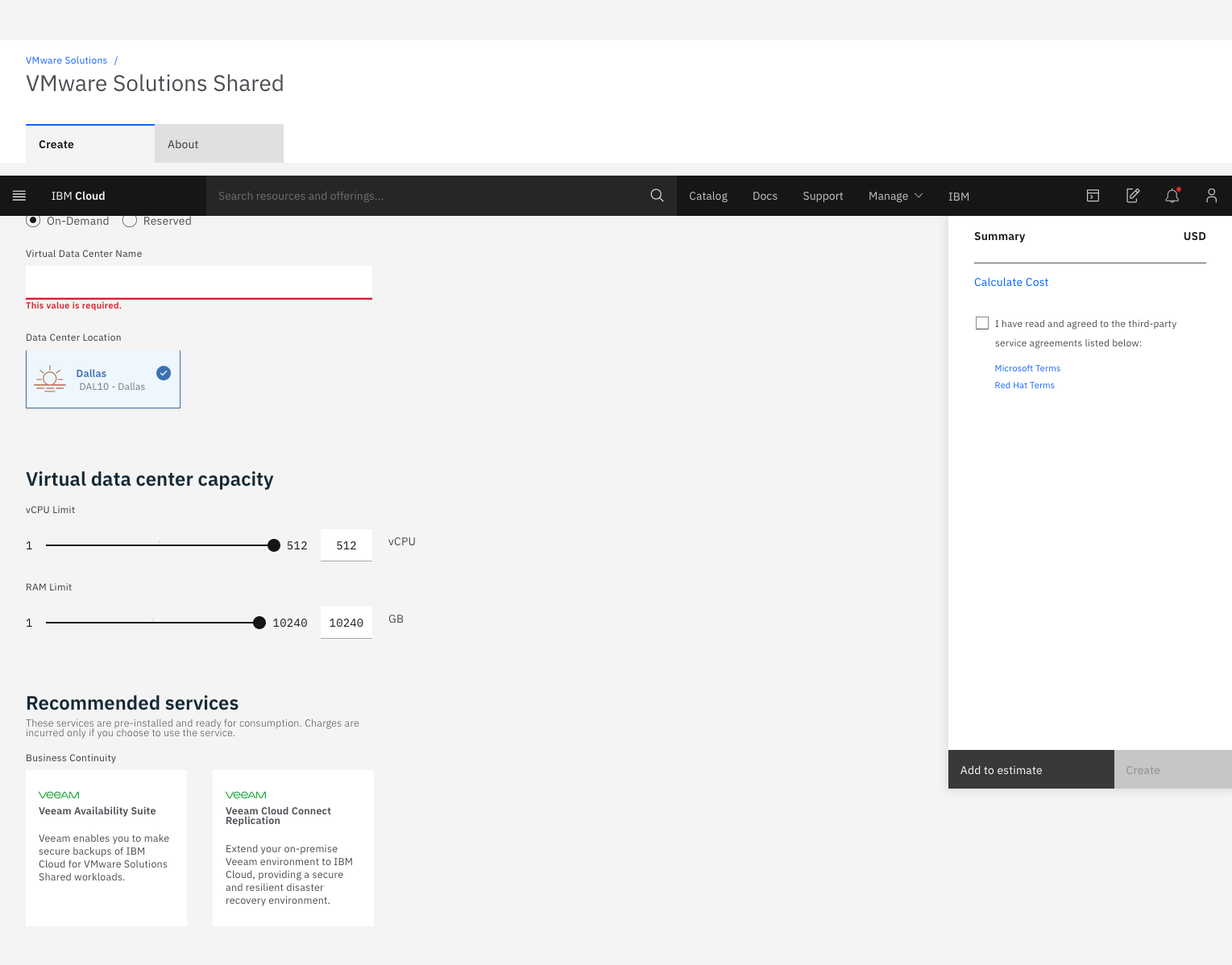
IBM Cloud for VMware
Solutions is designed to make cloud adoption easier, allowing the user to optimize the
value of existing on-premises infrastructure, while leveraging the
same tools, technologies and skills in the cloud. The solution provides rapid scalability,
deployment in 35+ global data centers and access to disaster
recovery, backup, security and compliance solutions from an array of ecosystem
partners. To address varying workload needs, IBM Cloud…
$0
IBM Cloud Object Storage Cross-Regional Smart Tier 1 GB (hourly)
Microsoft Azure
Score 8.5 out of 10
N/A
Microsoft Azure is a cloud computing platform and infrastructure for building, deploying, and managing applications and services through a global network of Microsoft-managed datacenters.
$29
per month
Pricing
IBM Cloud for VMware Solutions
Microsoft Azure
Editions & Modules
Add-on
$0
IBM Cloud Object Storage Cross-Regional Smart Tier 1 GB (hourly)
On-demand
$0
0.25 IOPs 1 GB
Reserved (monthly or 730 hours)
$0
0.25 IOPs 1 GB (Per gigabyte of storage (hourly))
Add-on
$0
IBM Cloud Block Storage 1 GB (hourly)
On-demand
$0.01
Per vCPU (hourly)
On-demand
$0.09
Per gigabyte of network and bandwidth egress (monthly)
Reserved (monthly or 730 hours)
$0.09
Per gigabyte of network and bandwidth egress (monthly)
Reserved (monthly or 730 hours)
$12.80
Microsoft license (monthly) per 1 vCPU²
Add-on
$13
Veeam backup license
Developer
$29
per month
Standard
$100
per month
Professional Direct
$1000
per month
Basic
Free
per month
Offerings
Pricing Offerings
IBM Cloud for VMware Solutions
Microsoft Azure
Free Trial
No
Yes
Free/Freemium Version
Yes
Yes
Premium Consulting/Integration Services
No
No
Entry-level Setup Fee
Optional
No setup fee
Additional Details
—
The free tier lets users have access to a variety of services free for 12 months with limited usage after making an Azure account.
More Pricing Information
Community Pulse
IBM Cloud for VMware Solutions
Microsoft Azure
Features
IBM Cloud for VMware Solutions
Microsoft Azure
Server Virtualization
Comparison of Server Virtualization features of Product A and Product B
IBM Cloud for VMware Solutions
7.7
Ratings
6% below category average
Microsoft Azure
-
Ratings
Virtual machine automated provisioning
5.30 Ratings
00 Ratings
Management console
8.00 Ratings
00 Ratings
Live virtual machine backup
8.90 Ratings
00 Ratings
Live virtual machine migration
8.00 Ratings
00 Ratings
Hypervisor-level security
8.00 Ratings
00 Ratings
Infrastructure-as-a-Service (IaaS)
Comparison of Infrastructure-as-a-Service (IaaS) features of Product A and Product B
VMware Cloud Foundation for Disaster Recovery environment, when the client needs to deploy a pay-as-you-go service or if they need to migrate SAP workloads, you can use VMware Cloud Foundation for Classic and VPC. We are the unique SAP-Certified VMware cloud service provider.
Actually, migrating to Microsoft Azure is a good solution for almost any situation, especially when all components of your network are ready to become cloud-based. The only drawback I personally encounter frequently is that older software packages cannot always be easily picked up and moved to Microsoft Azure in an optimal manner.
Azure simply provides end to end life cycle. Starting from the development to automated deployment, you will find [a] bunch of options. Custom hook-points allow [integration] on-premise resources as well.
Excellent documentation around all the services make it really easy for any novice. Overall support by [the] community and Azure Technical team is exceptional.
BOT Services, Computer Vision services, ML frameworks provide excellent results as compare to similar services provided by other giants in the same space.
Azure data services provide excellent support to ingest data from different sources, ETL, and consumption of data for BI purpose.
In our experience, Azure Kubernetes Survice was difficult to set up, which is why we used Kubernetes on top of VMs.
Azure REST API is a bit difficult to use, which made it difficult for us to automate our interactions with Azure.
Azure's Web UI does a good job of showing metrics on individual VMs, but it would be great if there was a way to show certain metrics from multiple VMs on one dashboard. For example, hard drive usage on our database VMs.
We have been very satisfied with Windows Azure and now a lot of our business depends on it as more teams are now deploying their applications into Azure. Our next step is to have our Infrastructure team move their resources to Azure. It will take awhile for that to happen but we are positive that it will.
Everything is very clearly laid out. Being familiar with vSphere already, it was a quick transition over to the IBM environment. This allowed us to spend less time on the implementation phase and move quickly to actually utilizing the system on a day to day basis. Also, the performance is very good. No lagginess to the website like our previous on-prem environment.
Microsoft Azure's overall usability has been better than expected. Often times vendors promise the world, only to leave you with a run-down town. Not the case with our experience. From an implementation perspective, all went perfect, and from the user-facing experience we have had no technical issues, just some learning curve issues that are more about "why" than "how"
Overall, just a great experience here. No one in my opinion gets a perfect 10/10 rating (no one is ever perfect), so 9/10 is probably as good as it gets! From initial planning to post implementation support, the IBM Cloud and professional services has been there for my group as much as we have needed them. Great job!
Support is easy with all the knowledge base articles available for free on the web. Plus, if you have a preferred status you can leverage their concierge support to get rapid response. Sometimes they’ll bounce you around a lot to get you to the right person, but they are quite responsive (especially when you are paying for the service). Many of the older Microsoft skills are also transferable from old-school on-prem to Azure-based virtual interfaces.
IBM professional services helped us plan and implement the project with great success. They guided the project from planning, scoping, pre-implementation, testing, roll-out, then production and post-production support. We were very impressed with their knowledge of VMware and really appreciated their desire to make our project a success. I would highly recommend them!
As I have mentioned before the issue with my Oracle Mismatch Version issues that have put a delay on moving one of my platforms will justify my 7 rating.
We chose VMware over Azure App Service because of the way that it was at that point natural and still offered similar cloud capacities that Azure would have acquired us. This permitted us to continue to utilize a similar interface and not need to relearn everything beginning to end with another item.
I feel that Microsoft Azure typically outperforms Google Cloud Platform in hybrid cloud capabilities, integration aspects, and, primarily, security compliance features. Azure offered superior integration with Microsoft's enterprise software ecosystem, and it's second to none in my opinion. This made it the natural choice for most, especially if heavily invested in Windows, Office 365, or Active Directory deployments. We chose Azure over GCP because we simply needed Windows workload support as a strong driver, more access to global regions, and let's not forget that most tech teams in an organization are Microsoft Certified, which makes skillset transfer from on-prem to cloud a minimal learning curve over shifting to a different provider.
Times and growth went into it. By balancing on-premises maintenance with continuous cloud improvements, we’ve budgeted and planned endlessly increased capacity.
In today’s world of cyber-crime, clients can put even more faith in what they’ve heard. We built an innovative single-sign-on hub for all users. Also, other business platforms use Azure application gateways, reducing worker switching time and increasing productivity.
Its step can automate to improve the investment. In addition, we can integrate our organization’s credentials into an authorization for other systems.