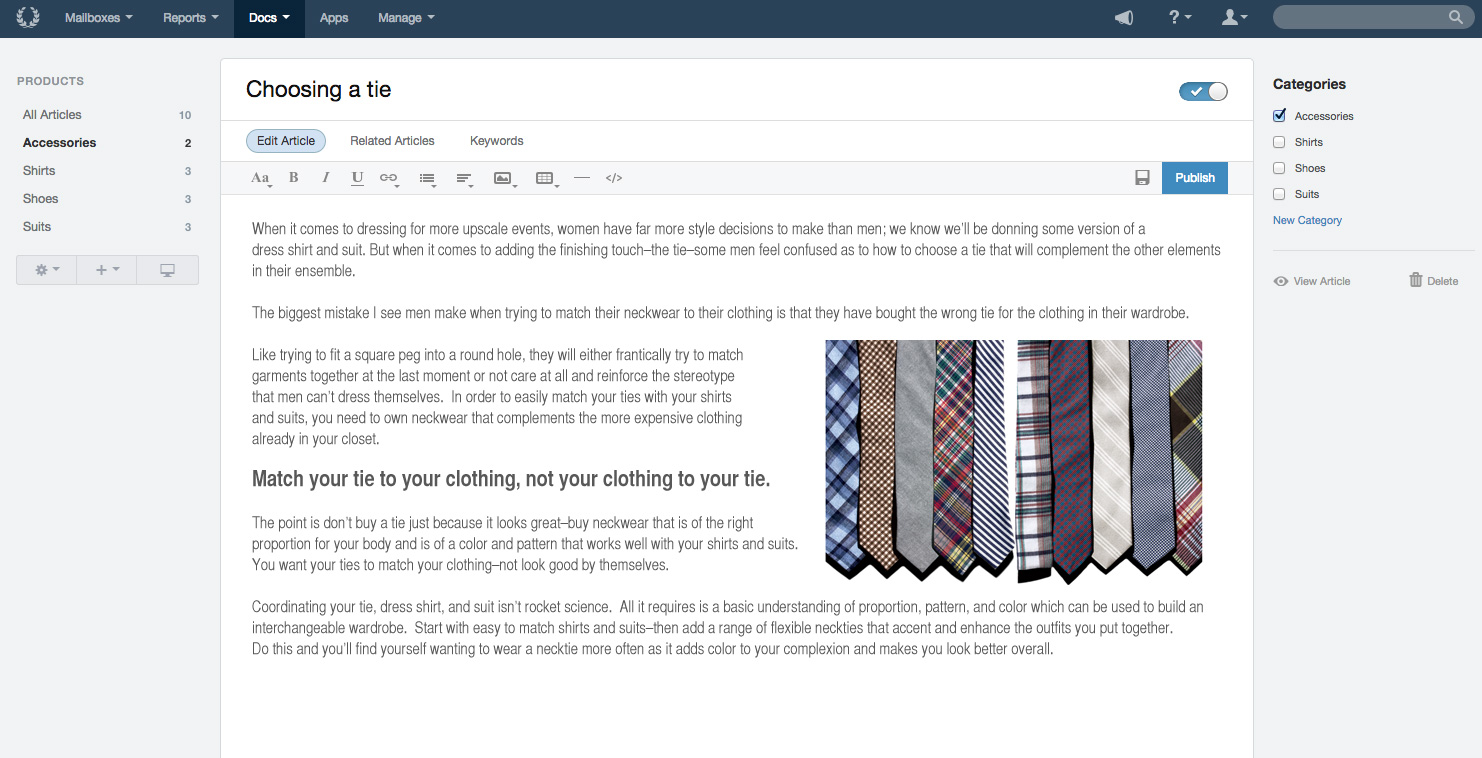
Help Scout is help desk software. The vendor’s value proposition is that that their solution reduces time spent on training users because Help Scout is simple to use and set up and scales like any enterprise product. This solution includes multiple mailboxes to support as many email addresses as needed in order to work collaboratively across teams, and manage several products or brands from one account. Reports on conversation trends, team performance, productivity, and customer happiness are…
$30
per month starts with 100 contacts
Oracle Service
Score 5.1 out of 10
N/A
Oracle Service is the help desk and customer experience management platform from Oracle. The technology was developed and supported by RightNow Technologies as RightNow CX for cloud-based call center automation, until that company's acquisition by Oracle in 2011 for about $1.5 billion.
N/A
Pricing
Help Scout
Oracle Service
Editions & Modules
Standard
$30
per month starts with 100 contacts
Plus
$90
per month starts with 200 contacts
Company
Contact sales team
No answers on this topic
Offerings
Pricing Offerings
Help Scout
Oracle Service
Free Trial
Yes
No
Free/Freemium Version
Yes
No
Premium Consulting/Integration Services
No
No
Entry-level Setup Fee
No setup fee
No setup fee
Additional Details
—
—
More Pricing Information
Community Pulse
Help Scout
Oracle Service
Features
Help Scout
Oracle Service
Incident and problem management
Comparison of Incident and problem management features of Product A and Product B
Help Scout
8.8
Ratings
9% above category average
Oracle Service
7.5
Ratings
7% below category average
Organize and prioritize service tickets
9.00 Ratings
7.00 Ratings
Subscription-based notifications
10.00 Ratings
7.00 Ratings
Ticket creation and submission
8.10 Ratings
9.00 Ratings
Ticket response
8.10 Ratings
8.00 Ratings
Expert directory
00 Ratings
7.50 Ratings
ITSM collaboration and documentation
00 Ratings
6.70 Ratings
Self Help Community
Comparison of Self Help Community features of Product A and Product B
Help Scout
8.5
Ratings
8% above category average
Oracle Service
7.3
Ratings
7% below category average
External knowledge base
9.00 Ratings
6.80 Ratings
Internal knowledge base
8.00 Ratings
7.70 Ratings
Multi-Channel Help
Comparison of Multi-Channel Help features of Product A and Product B
Small businesses that want a conversational type of customer support experience. Nothing wrong with support tickets, but it does make you feel like a number. Also, we needed to get up and running quickly so the "inbox" feel of the dashboard was already familiar with the team so they could adopt the new software quickly.
Oracle Right (Oracle Service Cloud) was an important evolution in the group's ombudsman channel management processes. We brought the Oracle Service Cloud to digitize the processes for capturing and managing the group's ombudsman channel, no longer operating manually (MS Excel).
Oracle Service Cloud (Right Now) brought about an important evolution in the management processes of the group's ombudsman channel, where activities that were performed manually, repetitively and with risk of errors, are now operated by the Right Now platform itself, whether by API, or by automation of the tool.
Extremely simple to use and understand as a user - treats communications like human beings and provides a much more personal feel to communication (as opposed to making people feel like numbers).
The email newsletter.
They are super responsive. They are pretty rad and transparent: if something goes wrong on their end they are not afraid of admitting fault. Which leads me to trust them because I can believe them. I know that tells you very little about the product, but as leadership, that's something that I really need
Help Scout does exactly what it needs to (facilitate organized, efficient conversations between customers and support people) without getting in the way.
Oracle Service cloud handles incident management extremely well. It can accept requests from multiple channels. That includes email, website, phone, chat, SMS & some social.
Oracle Service cloud provides a knowledge base that can be used by customers or by agents. It can move consumers to self service for most issues. It also has good feedback from customers and agents so that the knowledge can continue to be updated to push people to more self service.
Oracle has a good consumer portal that can be used as a website or typically is used in conjunction with a main website as a contact center or help center site. This allows the contact center to manage both the knowledge and the request and the interactions with the customers.
Oracle Service cloud is built to provide a turn key solution for CRM/Contact center with some minor configuration. But it also has the ability to be highly customized to meet any companies needs. Much of that work can be done via the configuration options already in the system. It also have a full set of SOAP and Rest APIs for integrating to other systems.
This is only an occasional, user problem; when searching for specific records, at times we receive an error that the maximum size has been exceeded and therefore does not yield any results. This is particularly frustrating when trying to search for a specific street address across several years.
We are receiving feedback from the organizational level that they may want us to transition to a different solution to provide consistency across the company.
I give this rating to RightNow because I believe that it's a strong CRM (I know RightNow doesn't like this term) product with virtually limitless possibilities. I like how flexible RightNow is, allowing businesses to fully customize it for their needs. I also like that it's cloud based and doesn't require additional local installation and management.
Help Scout is a great solution for support teams. There are many articles and webinars to help you learn how to use Help Scout. There are also many features to help make your workflows easier and more efficient. I would readily recommend Help Scout to any small or medium-growing support teams.
The learning curve is fairly steep; but for something that has this much capability, it's nearly impossible to make it "easy". The layout and organization are at least reasonably intuitive. The hardest part-- the "weakest link"-- is the portal development (where you can build help centers and other end-user pages.) The capabilities there are significant, but the learning curve for that part is especially steep and it takes a fair amount of expertise to be able to update it.
We use a lot of tabs and fields on our incident workspace, which should slow the system down, but it's still quite fast, and we continue to optimize whatever is possible.
Technicians seem to be assessed based solely on how quickly they close the issues. I've had to reopen requests multiple times because they didn't actually solve my problem. Also, when the issue has even a moderate amount of complexity, the technicians often instruct me to "open another SR" to handle the other issue. I'm the customer, I shouldn't have to follow their processes, they should handle that for me. But even when I create the new SR, it seems like their right hand isn't talking to their left - they aren't reading back to the previous issue for context. So I get bounced around a lot, and I have to tell them how to do their job
Most of our training was given while doing user acceptance testing, and getting the system approved by the market. When ever we were in doubt, our implementer helped us along. Later on we started exploring by our selves.
Work with a RightNow expert during the implementation. Explain features that would you like to have. Often, somebody who really knows the system can show you what you need to do to achieve the desired results. Where a RightNow support engineer or a consultant might say "the system can't do that," a RightNow application engineer will listen to what you need, and often come up with an alternate path to achieve it
This is tricky because there's helpdesk apps and chat apps (now Help Scout offers both). We first used just an email inbox (of course not scalable but we were very small), then we turned to Freshdesk, which was painful to use. It had some cool features but in general it was ugly, slow, using the interface was very non-intuitive and the prioritization was hard. I have to say this was more than a year ago, so probably they have changed, but anyway. Zendesk is very expensive considering the features are almost the same AND the chat app needs to be paid separately. As chat we used Tawk.to, it was functional but metrics were not that good and it was buggy at times. Comparing Help Scout with their competitors, at least for us, made it a no-brainer to hire them. The price was very attractive considering the amount of features, the great support and the quality of the app. I don't regret my decision at all because Help Scout, unlike other helpdesk companies, tries to have their app "smart" and not a big, corporate thing piled with features. It does what it needs, it's easy to use and helps you achieve your goals regarding support for your customers.
TCS' customers who also selected Oracle Service Cloud over Salesforce Service Cloud and GE's ServiceMax in the Mfg. vertical in which I work, did so because of the robust ability of Oracle Service Cloud and its APIs to integrate with other value-add solutions for manufacturers such as IoT applications, Big Data Analytics, and Field Service applications.
We are able to retain our customer base due to the outstanding customer service our Customer Experience department provides. Without an organized tool like Help Scout, this would not be possible. We pride ourselves in quick response times to customers and are able to do so by effectively routing tickets to the right agents.