Notes from HCL (formerly from IBM, acquired by HCL in late 2018) is a collaboration platform based on the Lotus platform.
N/A
Zimbra
Score7 out of 10
N/A
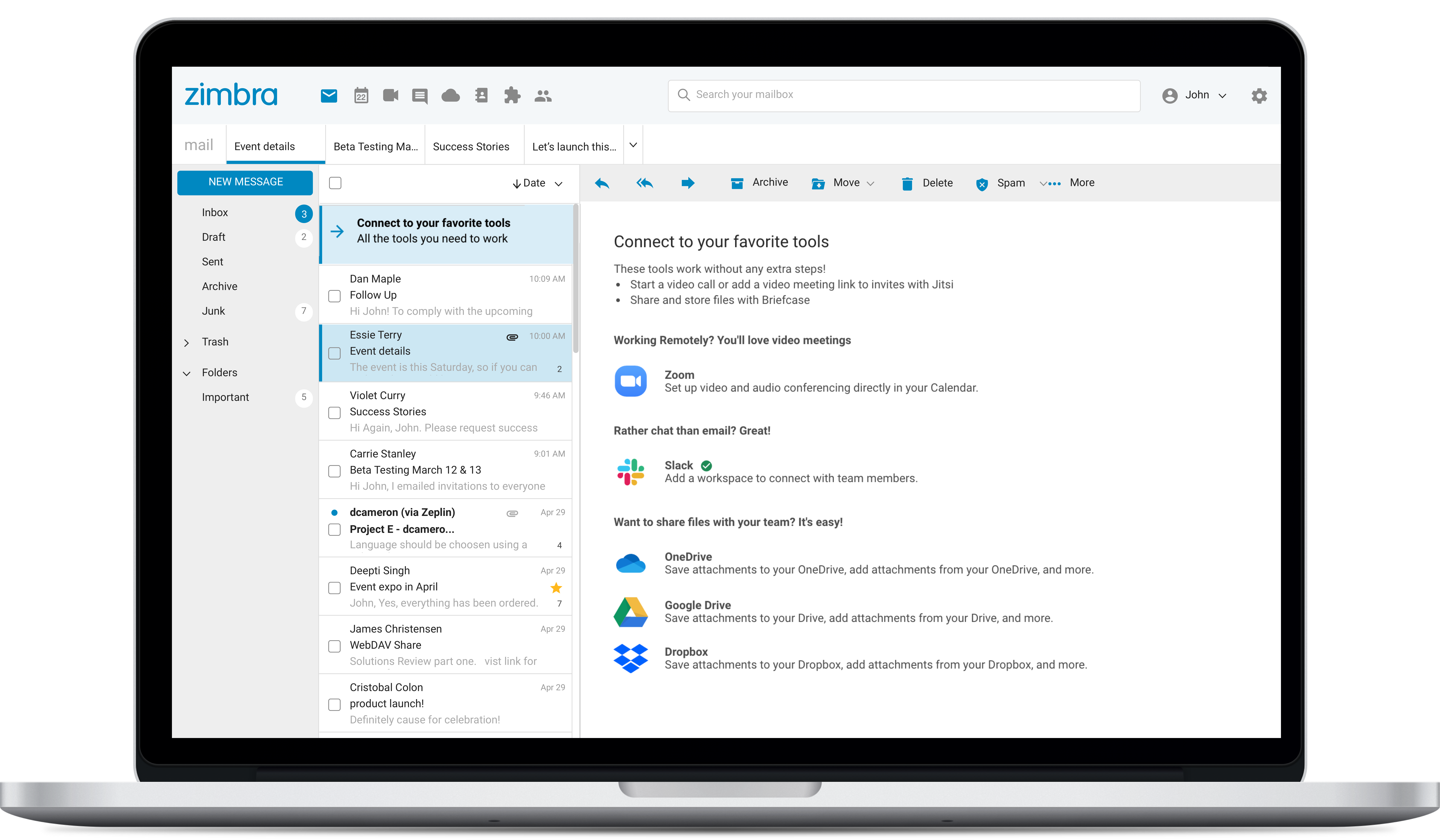
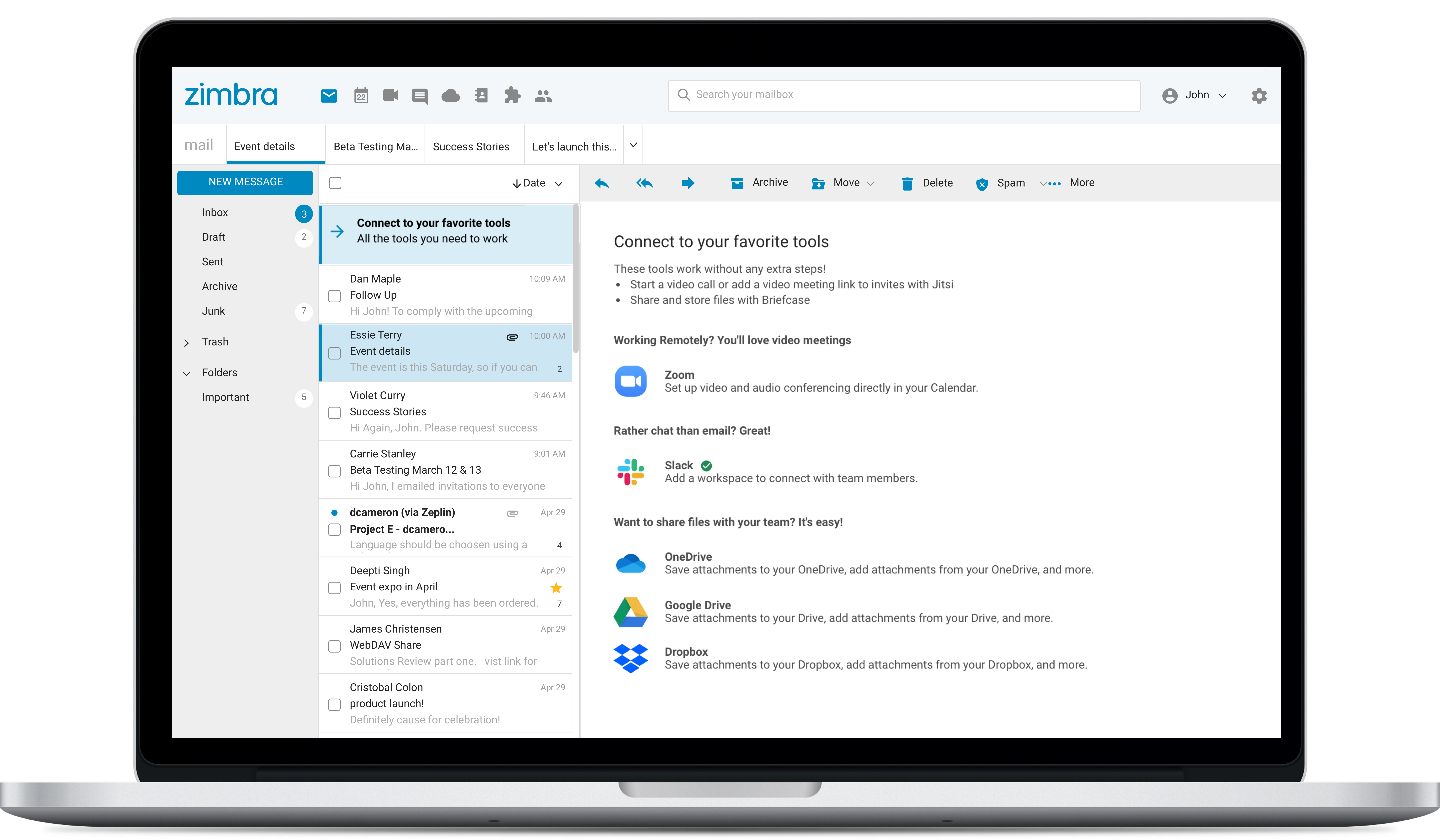
Zimbra is an email and collaboration platform and productivity suite that includes contacts, calendar, tasks, chat and file sharing, plus videoconferencing, document editing, and file storage.
N/A
Pricing
HCL Notes
Zimbra
Editions & Modules
No answers on this topic
No answers on this topic
Offerings
Pricing Offerings
HCL Notes
Zimbra
Free Trial
No
Yes
Free/Freemium Version
No
No
Premium Consulting/Integration Services
No
No
Entry-level Setup Fee
No setup fee
No setup fee
Additional Details
—
—
More Pricing Information
Features
HCL Notes
Zimbra
Project Management
Comparison of Project Management features of HCL Notes and Zimbra by Synacor
Feature
HCL Notes
6.9
10 Ratings
11% below category average
Zimbra by Synacor
9.0
6 Ratings
16% above category average
Task Management
7.09 Ratings
9.86 Ratings
Gantt Charts
6.03 Ratings
8.13 Ratings
Scheduling
8.09 Ratings
9.85 Ratings
Workflow Automation
5.06 Ratings
7.23 Ratings
Mobile Access
8.010 Ratings
9.76 Ratings
Search
6.09 Ratings
9.86 Ratings
Visual planning tools
8.03 Ratings
8.53 Ratings
Communication
Comparison of Communication features of HCL Notes and Zimbra by Synacor
Feature
HCL Notes
9.2
10 Ratings
15% above category average
Zimbra by Synacor
6.6
9 Ratings
18% below category average
Chat
6.010 Ratings
7.07 Ratings
Notifications
9.010 Ratings
5.18 Ratings
Discussions
9.57 Ratings
2.07 Ratings
Surveys
9.14 Ratings
7.72 Ratings
Internal knowledgebase
10.06 Ratings
7.73 Ratings
Integrates with GoToMeeting
10.03 Ratings
7.63 Ratings
Integrates with Gmail and Google Hangouts
10.02 Ratings
8.04 Ratings
Integrates with Outlook
10.05 Ratings
7.53 Ratings
File Sharing & Management
Comparison of File Sharing & Management features of HCL Notes and Zimbra by Synacor
I often work with teams from other country and regions, hence HCL Notes is a very useful platform for internal company management operations. It standardized organisational work standards in most of the offices worldwide. HCL Notes also enables chat with other team around the world that I find very helpful when initiating conversation or just want to have a quick update rather than sending emails and waiting for replies. However, HCL Notes is not very efficient in web browsing and user still need to use other internet service providers.
A de minimis incentive was given to thank the reviewer for their time. The incentive was not used to bias or drive a particular response, nor was the incentive contingent on a positive endorsement. More Info
Zimbra is great for an email system for a medium or large organization with appropriate IT staffing. The system is easy to use for end-users, and has a fantastic web interface. Unfortunately, it is overly complex, when considering staffing requirements and price, when compared with Office 365 or Google Apps for smaller organizations. For other education customers, it is hard to compete with Microsoft and Google providing their services for "Free" now though
A de minimis incentive was given to thank the reviewer for their time. The incentive was not used to bias or drive a particular response, nor was the incentive contingent on a positive endorsement. More Info
A de minimis incentive was given to thank the reviewer for their time. The incentive was not used to bias or drive a particular response, nor was the incentive contingent on a positive endorsement. More Info
Notes' backwards compatibility sometimes gets in the way. Menus are cluttered with extraneous, outdated options and features that modern users will never use, and Preferences are often difficult to navigate for those coming from Gmail or Outlook. We have greatly simplified this via Policies, but users still find it daunting to go through all the options that are available.
The IBM Notes client for Windows & Mac is essentially the Eclipse Java development platform...so it is HUGE. Performance initially was very slow but IBM has done a good job of speeding things up. As IBM moves more toward cloud-delivered applications, this will not be as much of a problem.
Notes and Domino can be complex to manage for administrators who are more accustomed to ActiveDirectory, Group Policy, etc. Editing a notes.ini file to add a feature, or working with XML files by hand to create a SmartUpgrade kit can be daunting to those coming from more modern administrative roles.
Some users claim to "hate" Notes mail. While I have heard this less and less over the past 10 years, we have had 3rd party software offer plugins to Outlook and it's rare to see any for Notes.
The client update process should be automated more. I would like to see the Notes client update quietly and quickly more like an Adobe software update. If an update fails it should automatically try again without prompting the user over and over.
Notes multiple language spell checking is a downloaded add-on Java-based resource that has to be deployed in a convoluted way that is difficult for users to grasp. Therefore any foreign language spell check updates must be done individually per Notes client by IT, which is unfortunate. I would prefer to see that be a "live download" update option for users to get directly from IBM (don't make me download it and put it on my network).
Zimbra's mobile application leaves much to be desired; it is its weakest point.
This forces the use of third-party applications on smartphones, which only offer a more or less complete integration with the ActiveSync protocol.
Zimbra allows for an on-premise scenario, which is not for everyone, especially considering that the trend nowadays is to outsource email; in any case, it also offers this alternative.
The cost of Zimbra as a SaaS solution comes too close to that of more widely adopted competing options.
Zimbra lacks a robust integrated chat system, which its competitors offer.
A de minimis incentive was given to thank the reviewer for their time. The incentive was not used to bias or drive a particular response, nor was the incentive contingent on a positive endorsement. More Info
I've been in IT business and as a Programmer/Developer for 20+ years with too many programming languages experiences/back ground (C/C++/Visual Basic/Basic Program/Unix/COBOL/Java). Also with 18+ years with Lotus Notes/IBM Domino, I am still and always think Lotus Notes is the best RAD platform available!. When the time where resource is very limited and the expectation is very high and the turn around is too short, IBM Domino/Notes is the platform to use and it's the only choice available.
Easy to use for the user, most of the apps we developed, there is not much need for user training. Most of the times, we just do a demo to the users group and they can pick up from there.
The web usability of the solution is adequate, with all functions integrated into a single interface. However, it is important to note that in the desktop environment, it lacks its own application and relies on ActiveSync synchronization with reference solutions like Outlook or Thunderbird. Some features, such as the briefcase, will be excluded. The same happens on smartphones.It is also common for competing solutions to include integrated chat or video call tools, which Zimbra lacks. These shortcomings are among the most frequently requested by users.
A de minimis incentive was given to thank the reviewer for their time. The incentive was not used to bias or drive a particular response, nor was the incentive contingent on a positive endorsement. More Info
I've been using the production for a very long time and very happy with it. Also, all the online resources and forums for notes is very friendly and easy/quick for getting help. I found out that compared to Microsoft or Oracle or any other platforms, IBM Notes online forum is the best I have seen.
Implementation is easy and smooth if the requirement is well gathered/documented. Notes is a RAD platform, all projects in Notes is simple in the implementation step.
Overall, we were satisfied with the implementation. We perhaps should have spent more time consulting with Zimbra or others regarding best practices but as we got to know the system better we were able to make changes relatively easily after the fact.
A de minimis incentive was given to thank the reviewer for their time. The incentive was not used to bias or drive a particular response, nor was the incentive contingent on a positive endorsement. More Info
Outlook has been considered for years as a replacement platform. Pricing and support staff made it prohibitive. Our long-time use of Microsoft Office productivity suite naturally led us to consider the adoption of Office365. A recent investigation told us that Azure Cloud services propel an O365 solution to the forefront. Early adopters in international divisions have paved the way for Azure and O365.
A de minimis incentive was given to thank the reviewer for their time. The incentive was not used to bias or drive a particular response, nor was the incentive contingent on a positive endorsement. More Info
Zimbra is a significantly cheaper option than one of the Microsoft solutions, such as Exchange. It is able to run in a free environment, as it is in the case of Linux. It offers the advantages of a powerful mail manager, such as indexed searches and the integration of contacts and notes, all in one platform. It is constantly updated and the operation of its connection in mobile equipment is remarkable and very efficient. Additionally, it is able to easily integrate with Outlook solutions with its connector, which brings all the benefits of Zimbra to the user under the interface known as "mail manager." So far, I have been using Zimbra for several years and I have not missed my previous work platforms.
A de minimis incentive was given to thank the reviewer for their time. The incentive was not used to bias or drive a particular response, nor was the incentive contingent on a positive endorsement. More Info
Over the years, we have lost countless hours of productivity from the thousands of crashes we have experienced.
One benefit of IBM Notes is that it is very simple to train a new user on. Many people prefer and are familiar with Google tools, but those that use IBM Notes have very little trouble acclimating themselves.
A de minimis incentive was given to thank the reviewer for their time. The incentive was not used to bias or drive a particular response, nor was the incentive contingent on a positive endorsement. More Info
Zimbra is a cheaper email service than other similar platforms and in my point of view offers better features, that's why the company migrated services to this platform several years ago and without a doubt, it has been the best investment.
Zimbra has a more user-friendly interface for employees, this has improved response times to external customers of the company.
The implementation of Zimbra in the company motivated the IT engineering department to make improvements in open source to adapt it to the needs of the company.
A de minimis incentive was given to thank the reviewer for their time. The incentive was not used to bias or drive a particular response, nor was the incentive contingent on a positive endorsement. More Info