Connections from HCL Technologies (formerly from IBM, acquired by HCL in 2018) is a collaboration tool and employee digital workspace with key features like social analytics, blogs, document management, and a social network.
N/A
Jostle
Score 8.0 out of 10
N/A
Jostle is intranet software for collaboration. Jostle is designed to make it easier to inform and connect employees to get work done. Users can share news, align teams, recognize contributions and invite participation from others. According to the vendor, Jostle can help improve employee engagement; Jostle reports engagement rates 5X higher than both traditional employee portals and social intranets. Company leaders can use Jostle to communicate plans, reinforce culture, and celebrate successes.…
IBM Connections is possibly most suited for larger organizations where bigger teams are able to have more people to share with. Also, it may be less appropriate when there is so much security that it would hinder the anytime, anywhere access capabilities and prevent users from being able to enjoy sharing content with each other.
As one of the great intranet software, Jostle has always helped me in staying connected with the team members from different departments. The app makes me feel so much at ease because I know what is happening in all the departments and if everything is going in the right direction or not. My recommendation is that this software is very appropriate for growing businesses where people are not aware of their surroundings and their colleagues' work status. Jostle will send them notifications on emails whenever they need to be updated regarding any specific thing that is why I highly recommend this application.
Search in connections is incredibly poor. It's commonly joked that once data goes into Connections, you never find it again, unless you have a direct link. This alone kills usability for Connections.
Embedded content in wiki pages in connections is poorly implemented. While the content displays, you can't interact with it, or edit it reasonably, and it's really slow to load.
The "social" features in Connections are pretty lame, and no self-respecting user spends any time trying to build their profile. It's just disappointing.
Jostle has many advantages but there are certain disadvantages that need to be catered to in order to make the entire experience smooth and good. I think that the dashboard is not well designed. I feel like I have to go through a lot of navigation panels to find the right information. It takes too much time sometimes.
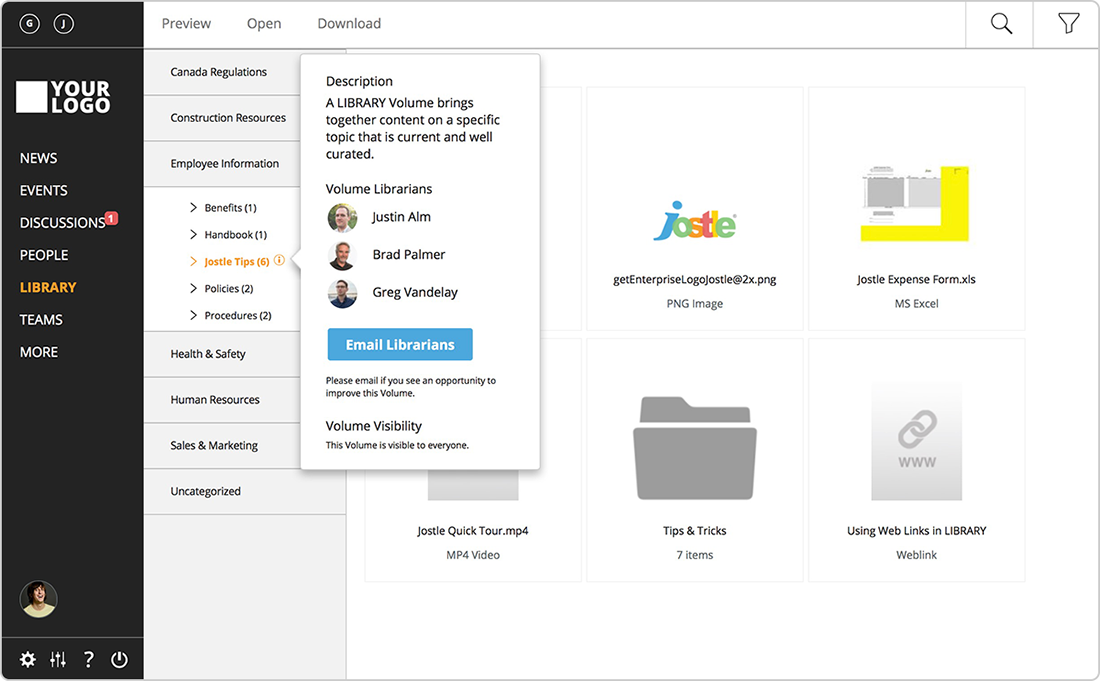
Another con in my opinion is that the library of Jostle needs a lot of customization and a lot of features have to be added to easily make other things accessible.
Connections has continued to more than meet our needs from a collaboration point of view and we are currently working on integration with our IBM Websphere portal platform to provide an integrated collaboration solution. This scenario will provide our users the best both products have to offer in a single interface.
Connections combines all the most useful abilities from various social networks. This makes it useful of course, but it also reduces user adoption time initially by allowing users to get comfortable with basic features. Once they are comfortable, it's easy for users to start exploring. They find new people in the organization to contact, new sources of information, etc. Before you know it, about half of the users are contributing back in some form -- and all with little or no training needed by IT.
It's a wonderful product that can be used from a computer or from the ease of an app on your phone. I love that my team can have access to Job Aids from their phones while working out in the field. I have not personally had any issues while using Jostle and I highly recommend it for your business.
Once Connections was installed, patched, etc. it was ALWAYS up. We only had to bring it down for OS updates to the servers. That seems to be typical of anything that runs on WebSphere; it's bulletproof and could probably run for months and years if the underlying OS didn't require constant patching.
IBM Connections web UI, mobile app (data sync to / from the device), and file transfer speeds were almost always very fast. It was rare for a slow-down of any kind, even when doing searches.
IBM Support has ALWAYS been quick to respond, regardless of the product. Even first level techs seldom provide "canned" responses and they really try to help. If they can't help, they don't wallow around but engage the right person immediately. It's very rare that the first level tech needs to escalate, and even more rare when they do escalate and the next person engaged cannot solve it. We have been more than satisfied with IBM support's quick and professional responses to our issues.
Try to understand you will never find a product which suites all your end user for 100%. IBM Connections is the best of all breeds but if you go look on each functionality on its own there are better example out there. But as IBM COnnections delivers it all in just one platform makes it the best example about integration of different functionality into one platform.
IBM Connections offers a complete package of tools that can be useful but it doesn't integrate well with other services. Competitors like Yammer offer slightly fewer features but are cheaper and much easier to maintain. If we were making a decision today we probably would choose a combination of Yammer, Slack, Microsoft Teams, and other Microsoft or Google Tools.
Our company used to have a Wall of Wow but it was mostly to just congratulate team members on milestones. Jostle allows you to connect with others members on your team and throughout your company as well as being able to post important bulletins, ensure access to quick links, and the ability to have Job Aids and resources available in the Library.
Scaling UP is never an issue with IBM's core technologies like WebSphere, DB2, etc. as long as you have or can find the technical resources to implement it. Where IBM seems to fail is scaling DOWN for smaller organizations. Connections 5.0 on-premises would have required us to create 7 servers -- yes, they would be virtualized, but still that's 7 OS licenses, 40 virtual CPU cores, 80GB RAM, and a few TB of hard disk space. All to replace Quick which runs on 1 server with 1 OS license, 4 cores, 8GB RAM and 600GB of disk. Granted, there are major differences in capabilities between the two, but how do you get a CFO understand why features like a mobile app, file sync, and social sharing require 10x the back-end resources?
Another main feature that I like the most is their Activity Feed feature, it helps our employees to stay connected with each other easily without any restriction of location.
The search bar is helping to manage the breeze easily. I have been very much impressed by their support staff.