Connections from HCL Technologies (formerly from IBM, acquired by HCL in 2018) is a collaboration tool and employee digital workspace with key features like social analytics, blogs, document management, and a social network.
N/A
Jive
Score8.7 out of 10
N/A
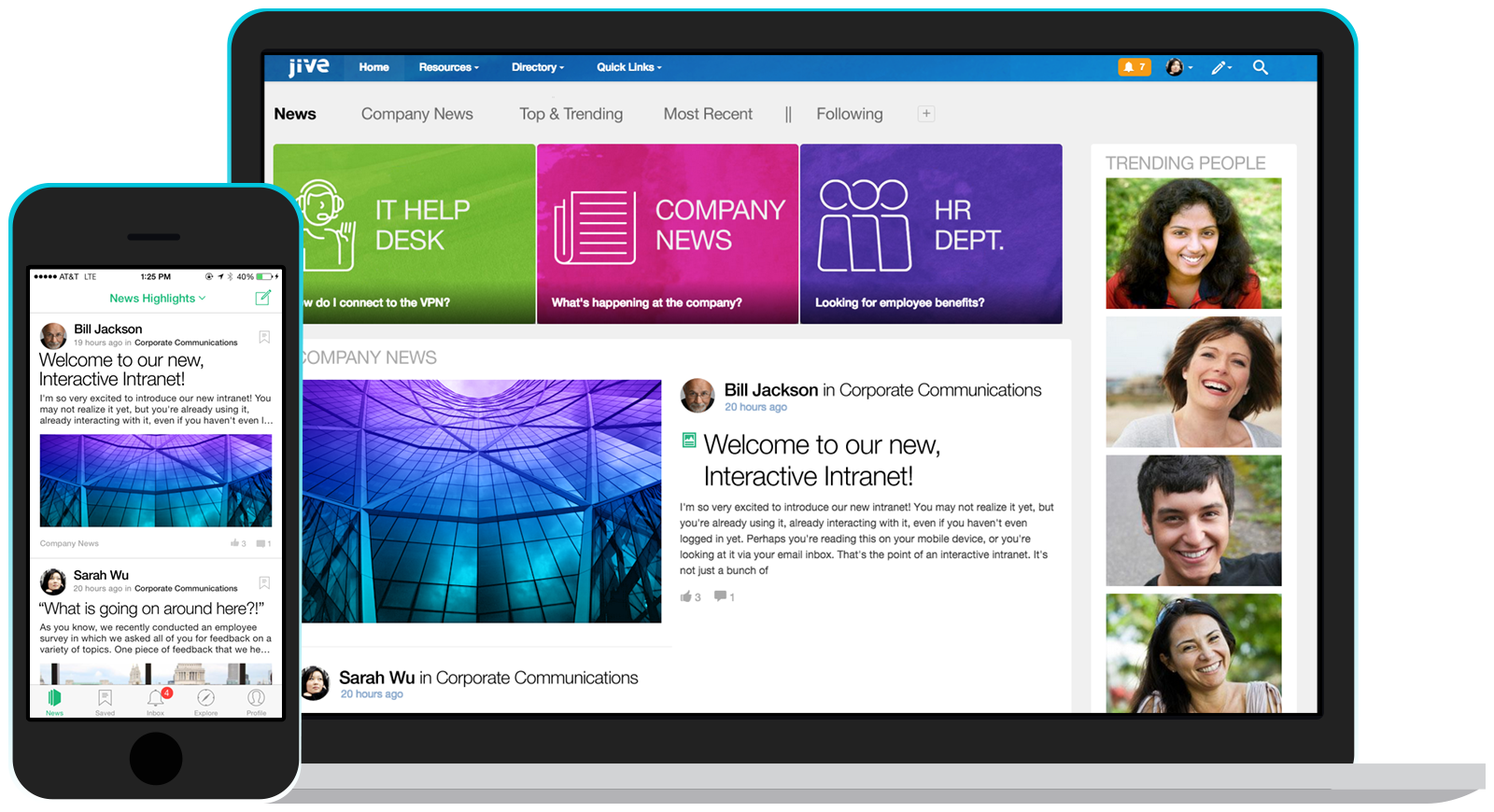
Jive Software, part of the Aurea family of customer experience solutions, provides the gateway to an organization's most important assets – its knowledge and people. Jive's interactive intranet solution promises to connect people, information and ideas to help businesses outpace their competitors. The vendor says the product has more than 30 million users worldwide across every industry, and is consistently recognized as a leader by top analyst firms.
IBM Connections is well suited for larger organizations that need an internal social networking tool and are willing to deal with IBM and the complexity of the software. It is less appropriate for smaller organizations and those who don't want to deal with the complexity, or IBM's awful customer service and prices.
A de minimis incentive was given to thank the reviewer for their time. The incentive was not used to bias or drive a particular response, nor was the incentive contingent on a positive endorsement. More Info
It's definitely worth considering Jive for the type of application we've developed i.e. a central shared repository for all employees to host and discuss information. I can't say I have ever used a superior tool, but they may exist. I'm just not sure I would want to use it exclusively for file hosting, though. It does integrate with various other tools, so perhaps it would be fine if used in conjunction with another tool for that purpose.
A de minimis incentive was given to thank the reviewer for their time. The incentive was not used to bias or drive a particular response, nor was the incentive contingent on a positive endorsement. TR verified that a representative sample of customers was invited. More Info
The plugin for MS Office/Explorer has made saving and sharing working documents extremely convenient for me and my close colleagues
The newsfeed feature conveniently aggregates updates from the communities/people you follow. It's nice not to have to jump from community to community to see what's going on in the organization
The various apps can be used for several purposes. A little creativity goes a long way when establishing what type of information the apps can be useful for communicating
A de minimis incentive was given to thank the reviewer for their time. The incentive was not used to bias or drive a particular response, nor was the incentive contingent on a positive endorsement. More Info
Presence of Russian language (localization can be independently established)
You can configure several information tapes with different themes. One for work, the second for communication
A newly-arrived network user immediately receives a prepared block for beginners. After completing several game tasks, the user will receive the basics of using Jive.
There is a template for each scenario. There is even a template for planning R&D, and there are more than twenty of them.
Integrates with MS Office, Google Drive, Google Docs
There are all platforms (even Winphone and blackberry)
A de minimis incentive was given to thank the reviewer for their time. The incentive was not used to bias or drive a particular response, nor was the incentive contingent on a positive endorsement. More Info
The lack of a note-taking tool became a bigger and bigger issue as time went on. Our pilot users felt Connections was a natural place to take and share meeting notes – including photos, drawings, recorded audio, etc. – and were always frustrated that there was no easy, organized way to do that. We tried using a Blog, Wiki, etc. but nothing really resonated as a good solution for this.
The Wiki tool is weak, providing rigid structure but with few options. A Community can only have a single Wiki, for instance. Wikis are weak in the mobile app as well; they’re not even easy to navigate. Users ended up ignoring Wikis completely despite our efforts to get them to convert documents like guidelines, policies, procedures, handbooks, etc. into Wiki form.
The Windows Explorer plug-in was useful but required a lot of manual intervention to setup. For instance, once a user joins a Community in Connections, the Community also has to be manually added to the Explorer plug-in so the user can find, open and edit files with it. We felt this process should be much more automated.
Tagging is only relevant in the web UI and, to a lesser extent, in the mobile app. However, in the Windows Explorer plug-in, Tags are not usable at all making it difficult to find things that were easy to find in the web UI.
IBM Docs was not included in the on-premises deployment; it was an additional license so we did not test it. Documents, mainly Microsoft Office files, are still the single most common way our user community creates, shares, edits and presents information. That proved to be a major gap for our users, and slowed user adoption considerably. We considered testing it, but IBM Docs would only work for about half of our users so we found ourselves wondering if we really wanted to support two document editing platforms. IBM Docs also offers no way to work offline as far as we could tell. This also meant we would need to keep licensing Microsoft Office which is not cheap.
Consulting costs are high because the back-end environment is complex. Installing, administrating and even patching Connections is a fairly complex process. We needed to hire consultants to install our test environment and any major upgrades would’ve required additional consulting fees. Any 3rd party add-ons we looked at were highly technical in nature meaning…you guessed it, more consulting costs.
Administrating IBM Connections requires editing XML files in a specific, secure way that is typically done in a console. I love consoles as much as the next admin, but when you only use a console once every 2 months it means looking up all the documentation and re-educating yourself. A single change could take me 2 hours to implement. 3rd party admin dashboards do exist, at an additional cost, but IBM really should provide a much easier way to manage the environment.
The lack of in-person or online training courses, materials, videos, etc. really discouraged a lot of users. The only decent training we could find (marketing videos aside) was a single video series on Lynda.com which, of course, was an additional cost. In the end that video didn’t really help our users much beyond introductory concepts.
IBM includes reporting, but it’s a massive Cognos system requiring some serious hardware and Cognos expertise. We had neither, and would have ultimately opted for a 3rd party add-on for reporting and statistics.
An often overlooked concern is eDiscovery. Our contracted eDiscovery service extensively works with various ECMs, but had no idea how they would handle Connections data. The cloud version of Connections offers an add-on for eDiscovery, but as far as we could tell IBM offered nothing for on-premises deployments.
A de minimis incentive was given to thank the reviewer for their time. The incentive was not used to bias or drive a particular response, nor was the incentive contingent on a positive endorsement. More Info
Connections has continued to more than meet our needs from a collaboration point of view and we are currently working on integration with our IBM Websphere portal platform to provide an integrated collaboration solution. This scenario will provide our users the best both products have to offer in a single interface.
A de minimis incentive was given to thank the reviewer for their time. The incentive was not used to bias or drive a particular response, nor was the incentive contingent on a positive endorsement. More Info
There are always external factors that can impact this decision but currently, the Jive platform is maintaining its lead in the market place in this area. If the innovation in this space by Jive continues, then this number will remain high. Integration with other systems and adaptability to changes in the market or in client needs will also make this decision hard to predict more then 6 months into the future
Connections combines all the most useful abilities from various social networks. This makes it useful of course, but it also reduces user adoption time initially by allowing users to get comfortable with basic features. Once they are comfortable, it's easy for users to start exploring. They find new people in the organization to contact, new sources of information, etc. Before you know it, about half of the users are contributing back in some form -- and all with little or no training needed by IT.
A de minimis incentive was given to thank the reviewer for their time. The incentive was not used to bias or drive a particular response, nor was the incentive contingent on a positive endorsement. More Info
It was harder to use that expected. The admin needs to be code savvy to truly customize the system. And users need to trained on the system and the setup. Trainings and monitoring need to continue to enforce use.
Once Connections was installed, patched, etc. it was ALWAYS up. We only had to bring it down for OS updates to the servers. That seems to be typical of anything that runs on WebSphere; it's bulletproof and could probably run for months and years if the underlying OS didn't require constant patching.
A de minimis incentive was given to thank the reviewer for their time. The incentive was not used to bias or drive a particular response, nor was the incentive contingent on a positive endorsement. More Info
Uptime was OK. But there was one day that the system crashed for a whole day. Our company was unable to operate. And all the plugins to word/excel froze causing those systems to freeze.
Jive posted a statement to the media saying all customers were up, but we were not.
IBM Connections web UI, mobile app (data sync to / from the device), and file transfer speeds were almost always very fast. It was rare for a slow-down of any kind, even when doing searches.
A de minimis incentive was given to thank the reviewer for their time. The incentive was not used to bias or drive a particular response, nor was the incentive contingent on a positive endorsement. More Info
IBM Support has ALWAYS been quick to respond, regardless of the product. Even first level techs seldom provide "canned" responses and they really try to help. If they can't help, they don't wallow around but engage the right person immediately. It's very rare that the first level tech needs to escalate, and even more rare when they do escalate and the next person engaged cannot solve it. We have been more than satisfied with IBM support's quick and professional responses to our issues.
A de minimis incentive was given to thank the reviewer for their time. The incentive was not used to bias or drive a particular response, nor was the incentive contingent on a positive endorsement. More Info
They did an OK job when I needed them. Except for the one day the system went down. Jive pointed the finger at the hosting company, and the hosting company pointed the finger at Jive. No reliable information came to us.
Jive online training is there. It is OK/average. I feel some other companies are doing better. It is not a piece that is required to have a successfully implementation, but it could be useful to improve it
Try to understand you will never find a product which suites all your end user for 100%. IBM Connections is the best of all breeds but if you go look on each functionality on its own there are better example out there. But as IBM COnnections delivers it all in just one platform makes it the best example about integration of different functionality into one platform.
From the few times that I have used MS SharePoint, I can say that it doesn't seem to hold a candle to the robust features of IBM Connections. The out-of-the-box capabilities of IBM Connections are amazing and are more easy to access and use than what I've seen with MS SharePoint.
A de minimis incentive was given to thank the reviewer for their time. The incentive was not used to bias or drive a particular response, nor was the incentive contingent on a positive endorsement. More Info
We had a Google phone number set up before and Jive was a lot better option than that. It is more consistent and can be configured much easier and with more advanced settings. Additionally, based on the pricing as well as working with the rep on our account, it was a perfect option for us
A de minimis incentive was given to thank the reviewer for their time. The incentive was not used to bias or drive a particular response, nor was the incentive contingent on a positive endorsement. More Info
Scaling UP is never an issue with IBM's core technologies like WebSphere, DB2, etc. as long as you have or can find the technical resources to implement it. Where IBM seems to fail is scaling DOWN for smaller organizations. Connections 5.0 on-premises would have required us to create 7 servers -- yes, they would be virtualized, but still that's 7 OS licenses, 40 virtual CPU cores, 80GB RAM, and a few TB of hard disk space. All to replace Quick which runs on 1 server with 1 OS license, 4 cores, 8GB RAM and 600GB of disk. Granted, there are major differences in capabilities between the two, but how do you get a CFO understand why features like a mobile app, file sync, and social sharing require 10x the back-end resources?
A de minimis incentive was given to thank the reviewer for their time. The incentive was not used to bias or drive a particular response, nor was the incentive contingent on a positive endorsement. More Info
A de minimis incentive was given to thank the reviewer for their time. The incentive was not used to bias or drive a particular response, nor was the incentive contingent on a positive endorsement. More Info
reduce amount of files/documents scattered & lost across shared drives
increased discovery, awareness and interaction of historically more separated individuals & team functions across the organisation
from an IT perspective, we've benefited from improved IT operations (e.g. troubleshooting info shared and easily searched/found with all team members - such that even junior team members can solve technical problems outside of business hours, lessening the burden for standby/call-in for more senior team members)
A de minimis incentive was given to thank the reviewer for their time. The incentive was not used to bias or drive a particular response, nor was the incentive contingent on a positive endorsement. More Info