Google Kubernetes Engine supplies containerized application management powered by Kubernetes which includes Google Cloud services including load balancing, automatic scaling and upgrade, and other Google Cloud services.
$0.04
vCPU-hr Autopilot Mode
OCI
Score9 out of 10
N/A
Oracle Cloud Infrastructure (OCI) is Oracles's infrastructure-as-a-service (IaaS) platform which combines the utility of public cloud with the granular control, security, and predictability of on-premises infrastructure.
N/A
Pricing
Google Kubernetes Engine
OCI
Editions & Modules
Autopilot Mode - 3 year commitment price (USD)
$0
GKE Autopilot Ephemeral Storage Price GB-hr
Autopilot Mode - 1 year commitment price (USD)
$0.0000438
GKE Autopilot Ephemeral Storage Price GB-hr
Autopilot Mode - Regular Price
$0.0000548
GKE Autopilot Ephemeral Storage Price GB-hr
Autopilot Mode - Spot Price
$0.0000548
GKE Autopilot Ephemeral Storage Price GB-hr
Autopilot Mode - Spot Price
$0.0014767
GKE Autopilot Pod Memory Price GB-hr
Autopilot Mode - 3 year commitment price (USD)
$0
GKE Autopilot Pod Memory Price GB-hr
Autopilot Mode - 1 year commitment price (USD)
$0.0039380
GKE Autopilot Pod Memory Price GB-hr
Autopilot Mode - Regular Price
$0.0049225
GKE Autopilot Price GB-hr
Autopilot Mode - Spot Price
$0.0133
GKE Autopilot vCPU Price vCPU-hr
Autopilot Mode - 3 year commitment price (USD)
$0.02
GKE Autopilot vCPU Price vCPU-hr
Autopilot Mode - 1 year commitment price (USD)
$0.0356000
GKE Autopilot vCPU Price vCPU-hr
Autopilot Mode - Regular Price
$0.0445
vCPU Price vCPU-hr
Standard Mode
$0.10
per hour
Cluster Management
$0.10
per cluster per hour
Cluster Management
$74.40 monthly credit
per month per hour
Standard Mode - Free Version
Free
per hour
No answers on this topic
Offerings
Pricing Offerings
Google Kubernetes Engine
OCI
Free Trial
Yes
Yes
Free/Freemium Version
Yes
Yes
Premium Consulting/Integration Services
No
Yes
Entry-level Setup Fee
No setup fee
Optional
Additional Details
—
—
More Pricing Information
Community Pulse
Google Kubernetes Engine
OCI
Considered Both Products
Google
Verified User
Chose Google Kubernetes Engine
Our organization went with Google's Kubernetes Engine because we are already significantly invested in the Google Cloud Platform. In our evaluation of Amazon's Elastic Kubernetes Service we were turned off by recent concerns about Amazon becoming overly dominant in the cloud …
A de minimis incentive was given to thank the reviewer for their time. The incentive was not used to bias or drive a particular response, nor was the incentive contingent on a positive endorsement. More Info
Senior software engineer in Information Technology at Manhattan (Logistics & Supply Chain, 501-1000 employees)
Chose OCI
Main benefit was costing compared to other services and we use Oracle as a database so with Oracle Cloud Infrastructure we can fully utilize the Oracle Cloud Infrastructure database which helped a lot for our products to handle major load that is one big plus because we had pay …
A de minimis incentive was given to thank the reviewer for their time. The incentive was not used to bias or drive a particular response, nor was the incentive contingent on a positive endorsement. More Info
Consultant in Information Technology at Atgen Software Solutions LLP (Computer Software, 11-50 employees)
Chose OCI
- Performance was big reason for choosing Oracle Cloud infrastructure over AWS Ec2 and Azure VMware Solutions.- Oracle Database as application design was another reason for choosing Oracle Cloud infrastructure over AWS Ec2 and Azure VMware Solutions.
A de minimis incentive was given to thank the reviewer for their time. The incentive was not used to bias or drive a particular response, nor was the incentive contingent on a positive endorsement. TR verified that a representative sample of customers was invited. More Info
If your application is complex, if it's planet-scale, or if you need autoscaling, then Kubernetes is best suited. If your application is straightforward, you can opt for App Engine or Cloud Run. In many cases, you can prefer to run the cloud on GKE. But once you deploy on Kubernetes, you get the flexibility to try different things. But if you don't seek flexibility, it's not an option for you.
A de minimis incentive was given to thank the reviewer for their time. The incentive was not used to bias or drive a particular response, nor was the incentive contingent on a positive endorsement. More Info
As per our usage Oracle Cloud Infrastructure for almost 6 years hosting 500 + customers I can say its well suited application for any small scale to larger scale application as it can handle that capacity and provide more reliable cloud service only if you need any messaging service like pub/sub or sqs better to consider other services.
A de minimis incentive was given to thank the reviewer for their time. The incentive was not used to bias or drive a particular response, nor was the incentive contingent on a positive endorsement. More Info
Engine upgrade rollout strategy - well documented and configurable
Integration with other Google Cloud services like the Compute Engine, SaaS databases, and some cloud networking like Cloud Armor
Graphical interface for a lot of operations - either for a quick peek/overview or actual work done by administrators and/or developers (via the Google Cloud Console, for example)
A de minimis incentive was given to thank the reviewer for their time. The incentive was not used to bias or drive a particular response, nor was the incentive contingent on a positive endorsement. More Info
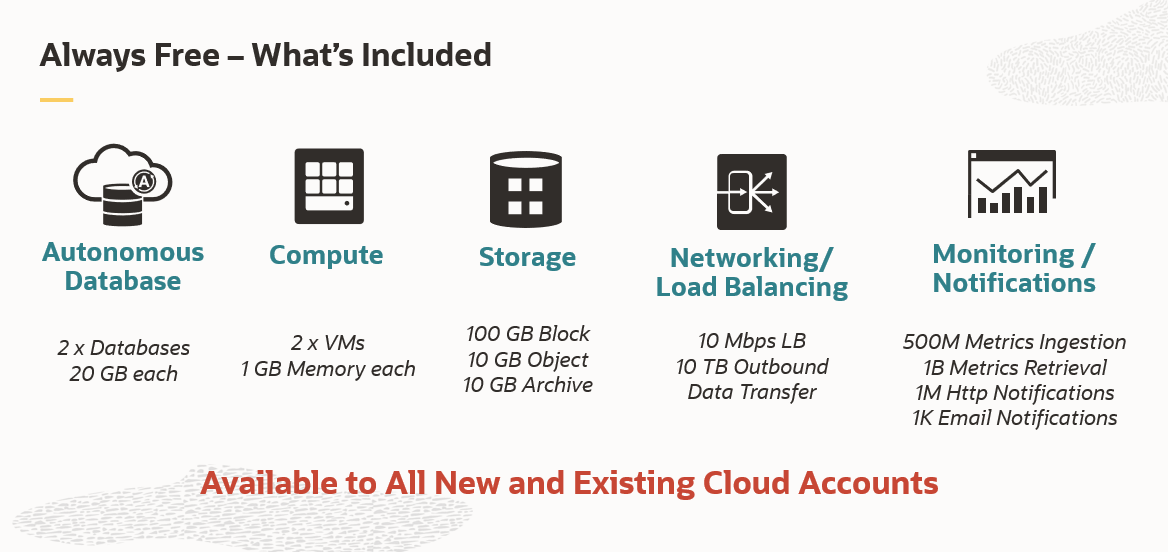
Oracle Cloud Infrastructure has a generous free tier, moreso than other hyperscalers, with an always-free tier that guarantees certain products are always free
Oracle Cloud Infrastructure allows you to size VMs with differing combinations of CPU and RAM, which is contrary to other hyperscalers that have specific pre-defined combinations only
A de minimis incentive was given to thank the reviewer for their time. The incentive was not used to bias or drive a particular response, nor was the incentive contingent on a positive endorsement. More Info
A de minimis incentive was given to thank the reviewer for their time. The incentive was not used to bias or drive a particular response, nor was the incentive contingent on a positive endorsement. More Info
Navigating the UI takes lots of getting used to. It reminds me of older GCP (just to get used to where everything is).
Permission for different things always seemed to be more difficult than it really needed to be. Once you got them set up you were good but updating anything or creating new permissions for just about anything took longer than I thought it should.
Based on how the buttons were laid out, it was pretty easy to delete all of your DNS records, and backing them up was not as intuitive as I'd like with the UI, but it was easy to do using a script.
A de minimis incentive was given to thank the reviewer for their time. The incentive was not used to bias or drive a particular response, nor was the incentive contingent on a positive endorsement. More Info
Reliability: Very dependable and stable OCI services have been for the business operations.Performance: The speed and efficiency of OCI in meeting their computing and storage needs.Scalability: The ease and effectiveness of scaling resources up or down to accommodate changing demands.Security: The robustness and effectiveness of OCI's security features in protecting their data and applications.
A de minimis incentive was given to thank the reviewer for their time. The incentive was not used to bias or drive a particular response, nor was the incentive contingent on a positive endorsement. More Info
A de minimis incentive was given to thank the reviewer for their time. The incentive was not used to bias or drive a particular response, nor was the incentive contingent on a positive endorsement. More Info
The services & products in Oracle Cloud Infrastructure needs more improvement to beat other Cloud service providers. The price is good & Security processes are good. We are requiring to put more effort in supporting this Oracle Cloud Infrastructure than other Cloud service providers. Probably better ways are there but is not super easy to find or not super available
Yeah sometimes we had to face unplanned outages due to underlying infrastructure issues, so not every time,e but once in a while we face issues with availability. But the good thing is we have redundancy with DR setup and multi region so we can manage.
A de minimis incentive was given to thank the reviewer for their time. The incentive was not used to bias or drive a particular response, nor was the incentive contingent on a positive endorsement. More Info
From the start, I was surprised by response times and image quality accessing windows VMs with RDP. GCP, Azure and -many offerings in AWS- don't perform this speed. Also, that's evident in the quality of Infrastructure Management Team, because I just received one warning regarding a region failure, what confirms that's a mature platform.
A de minimis incentive was given to thank the reviewer for their time. The incentive was not used to bias or drive a particular response, nor was the incentive contingent on a positive endorsement. More Info
Very good Kubernetes distribution with a reasonable total price. Integration with storage and load balancer for ingress and services speed up every process deployment.
A de minimis incentive was given to thank the reviewer for their time. The incentive was not used to bias or drive a particular response, nor was the incentive contingent on a positive endorsement. More Info
Overall it is amazing, there is always room for improvement. We have weekly updates that tend to slow the program used more and more. We had to change some reports within Oracle because the others wouldn’t load. This is tied to our payroll and the delays are causing many time constraint issues and panic. We have to create a new report when one breaks. Otherwise awesome!
A de minimis incentive was given to thank the reviewer for their time. The incentive was not used to bias or drive a particular response, nor was the incentive contingent on a positive endorsement. More Info
A de minimis incentive was given to thank the reviewer for their time. The incentive was not used to bias or drive a particular response, nor was the incentive contingent on a positive endorsement. More Info
A de minimis incentive was given to thank the reviewer for their time. The incentive was not used to bias or drive a particular response, nor was the incentive contingent on a positive endorsement. More Info
A de minimis incentive was given to thank the reviewer for their time. The incentive was not used to bias or drive a particular response, nor was the incentive contingent on a positive endorsement. More Info
GKE spins up new nodes a LOT faster than AKS. GKE's auto scaler runs a lot smoother than AKS. GKE has a lot more Kubernetes features baked in natively.
A de minimis incentive was given to thank the reviewer for their time. The incentive was not used to bias or drive a particular response, nor was the incentive contingent on a positive endorsement. More Info
We used Microsoft Azure and Docker earlier and faced some difficulties like Microsoft Azure and Docker. Occasionally, the generation of large images can delay deployment. It is also necessary for me to admit that Microsoft Azure and Docker have a somewhat steep learning curve. Proper paperwork needs to be there. Docker has issues with performance on a number of platforms. On the other hand, OCI is easy to deploy and easy to understand.
A de minimis incentive was given to thank the reviewer for their time. The incentive was not used to bias or drive a particular response, nor was the incentive contingent on a positive endorsement. More Info
was not part of initial purchase team. Anyways, i think unit pricing and billing frequency is good compared to other Cloud service providers, when it comes to Cloud Capital expenditure & Operational expenditure. Would be more interested in exploring more options where customers can get more cost relaxations on trying out new cloud services in Oracle Cloud Infrastructure for example a new App or a feature
We have hosted around 500 + customers on this cloud so till day not faced any major issues, so we can use it for any kind of products and it can hold the load and easily scale based on need.
A de minimis incentive was given to thank the reviewer for their time. The incentive was not used to bias or drive a particular response, nor was the incentive contingent on a positive endorsement. More Info
When issues came up, we reached out to some folks at GCP and they seemed to be very prompt and attentive to our needs. They were always willing to help and provide additional details or recommendations or links to resources. This kind of support is very helpful as it allows us to navigate GKE with more confidence.
A de minimis incentive was given to thank the reviewer for their time. The incentive was not used to bias or drive a particular response, nor was the incentive contingent on a positive endorsement. More Info
Services & Infra wise is ok to use & host applications & services. Security wise also good for a Cloud service provider. It is a interesting area to explore & using it for day to day needs can be further improvised in future probably. Modern day Services like AI and Machine learning could be improved
A de minimis incentive was given to thank the reviewer for their time. The incentive was not used to bias or drive a particular response, nor was the incentive contingent on a positive endorsement. More Info
A de minimis incentive was given to thank the reviewer for their time. The incentive was not used to bias or drive a particular response, nor was the incentive contingent on a positive endorsement. TR verified that a representative sample of customers was invited. More Info