Google Analytics is perhaps the best-known web analytics product and, as a free product, it has massive adoption. Although it lacks some enterprise-level features compared to its competitors in the space, the launch of the paid Google Analytics Premium edition seems likely to close the gap.
$150,000
per year
Moz Pro
Score 7.8 out of 10
N/A
MozPro , from Moz in Seattle, Washington, is an SEO platforms for tracking the performance of all inbound marketing efforts comprehensively. It reveals how content is being shared through social channels and how that drives traffic to a website, and features a broad toolset for search engine optimization: rank tracking, link opportunites, site audit via Moz Analytics, prospective keyword analysis and content grading, as well as a crawl test to find broken or poorly designed site elements.
Moz…
$99
per month
Pricing
Google Analytics
Moz Pro
Editions & Modules
Google Analytics 360
150,000
per year
Google Analytics
Free
Standard
$99
per month
Medium
$179
per month
Large
$299
per month
Premium
$599
per month
Offerings
Pricing Offerings
Google Analytics
Moz Pro
Free Trial
No
Yes
Free/Freemium Version
Yes
No
Premium Consulting/Integration Services
No
No
Entry-level Setup Fee
No setup fee
No setup fee
Additional Details
—
Discount available for annual billing.
More Pricing Information
Community Pulse
Google Analytics
Moz Pro
Features
Google Analytics
Moz Pro
Web Analytics
Comparison of Web Analytics features of Product A and Product B
Google Analytics
8.2
Ratings
2% above category average
Moz Pro
-
Ratings
Lead Conversion Tracking
7.50 Ratings
00 Ratings
Bounce Rate Measurement
8.50 Ratings
00 Ratings
Device and Browser Reporting
8.50 Ratings
00 Ratings
Pageview Tracking
8.00 Ratings
00 Ratings
Event Tracking
7.00 Ratings
00 Ratings
Reporting in real-time
10.00 Ratings
00 Ratings
Referral Source Tracking
8.00 Ratings
00 Ratings
Customizable Dashboards
8.50 Ratings
00 Ratings
SEO
Comparison of SEO features of Product A and Product B
Google Analytics
-
Ratings
Moz Pro
7.3
Ratings
6% below category average
Keyword analysis
00 Ratings
8.10 Ratings
Backlink management
00 Ratings
7.00 Ratings
SERP ranking tracking
00 Ratings
7.10 Ratings
Page grader
00 Ratings
8.10 Ratings
Competitive analysis
00 Ratings
8.00 Ratings
Site audit / diagnostics
00 Ratings
7.00 Ratings
Site recommendations
00 Ratings
7.00 Ratings
Task management
00 Ratings
6.00 Ratings
SEO Channels
Comparison of SEO Channels features of Product A and Product B
Google Analytics
-
Ratings
Moz Pro
5.9
Ratings
25% below category average
Local SEO
00 Ratings
5.30 Ratings
Social SEO
00 Ratings
5.30 Ratings
Mobile SEO
00 Ratings
6.20 Ratings
Global SEO
00 Ratings
6.80 Ratings
SEO Platform & Account Management
Comparison of SEO Platform & Account Management features of Product A and Product B
Honesty, there is no reason that a company wouldn’t want to implement Google Analytics. The regular version is completely free, is very easy to configure, and provides immense volumes of website data. There are also tangible benefits to the other Google tools it can connect to, and it integrates with any BI/data platform that you might use. The only time I’d advise not using standard Google Analytics is if you’ve purchased Google Analytics 360.
Moz Pro is best if you are an absolute beginner with SEO and need tools that are easy to use. It is designed more so for the blogger and not necessarily for the SEO professional. If I were them I would totally market that angle better. It just makes sense.
Keyword rank tracking is on-point. You can easily tag on competitors and get ranks for them as well, which rules.
Moz has a great section for links—I especially use the Discovered and Lost reporting, which lists new domains linking to your site, and domains that dropped out, plus a DA for each. Clients eat this stuff up.
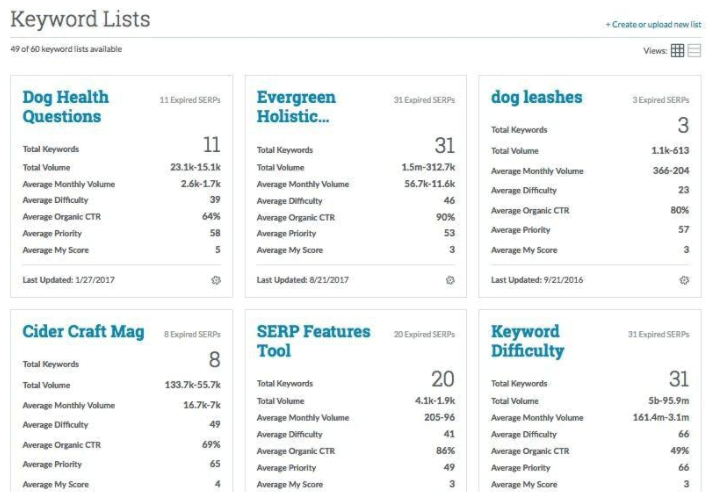
SERP Features is great as well—this is another thing that clients are thrilled to see: examples of keywords where fun SERP features appear. It's sort of a little thing, but the ease which Moz makes it available is great—the optics on this kind of thing to clients is outstanding.
While raw data is nice to have, I do wish there was an easier way to provide reports from Google Analytics directly. Something that could answer questions straight-forward for people.
I would appreciate "helpful hints" or a cheat sheet of some sort, so when quickly searching for something such as time on a certain page, I can find it quickly.
Industry specific jargons and mentions would be helpful
Error tracking is very misleading
Duplicate pages marking each page even when it’s not duplicate. In other words this algorithm is too sensitive. Provide ability or control to user to set the sensitivity of the duplicate page check
Having used Google Analytics for the last 9 years, I have no intention of discontinuing my service. Google Analytics is a fantastic product that provides me with almost everything I could wish for. The positives in this product outweigh any negatives that you might find. I can not think of a single reason to not immediately start using Google Analytics for your business.
We've been paying monthly for Moz for at least four years. We rely heavily on it for our daily work, and would need to re-engineer many of our processes if we were to cancel our subscription. I suspect we'll continue to use Moz as long as we are in business (assuming they maintain their quality).
Google Analytics provides a wealth of data, down to minute levels. That is it's greatest detriment: find the right information when you need it can be a cumbersome task. You are able to create shortcuts, however, so it can mitigate some of this problem. Google is continually refining Analytics, so I do not doubt there will be improvements
it's easy to use once you get the hang of it and most people with any sort of background in using online tools and analytics systems can figure it out. it's just not as intuitive as it could be like google webmaster tools or Adobe (Site Catalyst)
We all know Google is at top when it comes to availability. We have never faced any such instances where I can suggest otherwise. All you need is a Google account, a device and internet connection to use this super powerful tool for reporting and visualising your site data, traffic, events, etc. that too in real time.
This has been a catalyst for improving our site's traffic handling capabilities. We were able to identify exit% from our sites through it and we used recommendations to handle and implement the same in our sites. We have been increasing the usage of Google Analytics in our sites and never had any performance related issues if we used Analytics
The Google reps respond very quickly. However, sometimes they can overly call you to set up an apportionment. I'm very proficient and sometimes when I talk to reps, they give beginner tutorials and insights that are a waste of time. I wish Google would understand my level of expertise and assign me to a rep (long-term) that doesn't have to walk me through the basics.
I have not had a ton of interaction with the support team. Mostly asking questions where I cannot find the answer or where the data did not quite make sense. I always use their easy to access chat feature to talk to support. They are very responsive and very well informed and can usually solve my issue with just one chat session.
love the product and training they provide for businesses of all sizes. The following list of links will help you get started with Google Analytics from setup to understanding what data is being presented by Google Analytics.
Make sure to put the tracking code on every page. Ideally this would be part of a template or "include" so you can update the code on all pages (or at least within pages of the same category) at once.
I have not used Adobe Analytics as much, but I know they offer something called customer journey analytics, which we are evaluating now. I have used Semrush, and I find them much better than Google Analytics. I feel a fairly nontechnical person could learn Semrush in about a month. They also offer features like competitive analysis (on content, keywords, traffic, etc.), which is very useful. If you have to choose one among Semrush and Google Analytics, I would say go for Semrush.
gShift has better customer service and consulting to get your SEO strategy off the group, but is limited in its scope and depth of analytics. Ahrefs, Semrush, and Moz are very comparable in their approaches, just with different levels of focus on keyword tracking, backlinks, competitor analysis, and site audits.
Google Analytics is currently handling the reporting and tracking of near about 80 sites in our project. And I am not talking about the sites from different projects. They may have way more accounts than that. Never ever felt a performance issue from Google's end while generating or customising reports or tracking custom events or creating custom dimensions
Here I can easily find competitor's ranking keywords and their backlinks. It also gives you another exciting feature where you can compare two domains at the same time.
The thing that I don't like about this software is, that sometimes your page can take too much time for crawling.