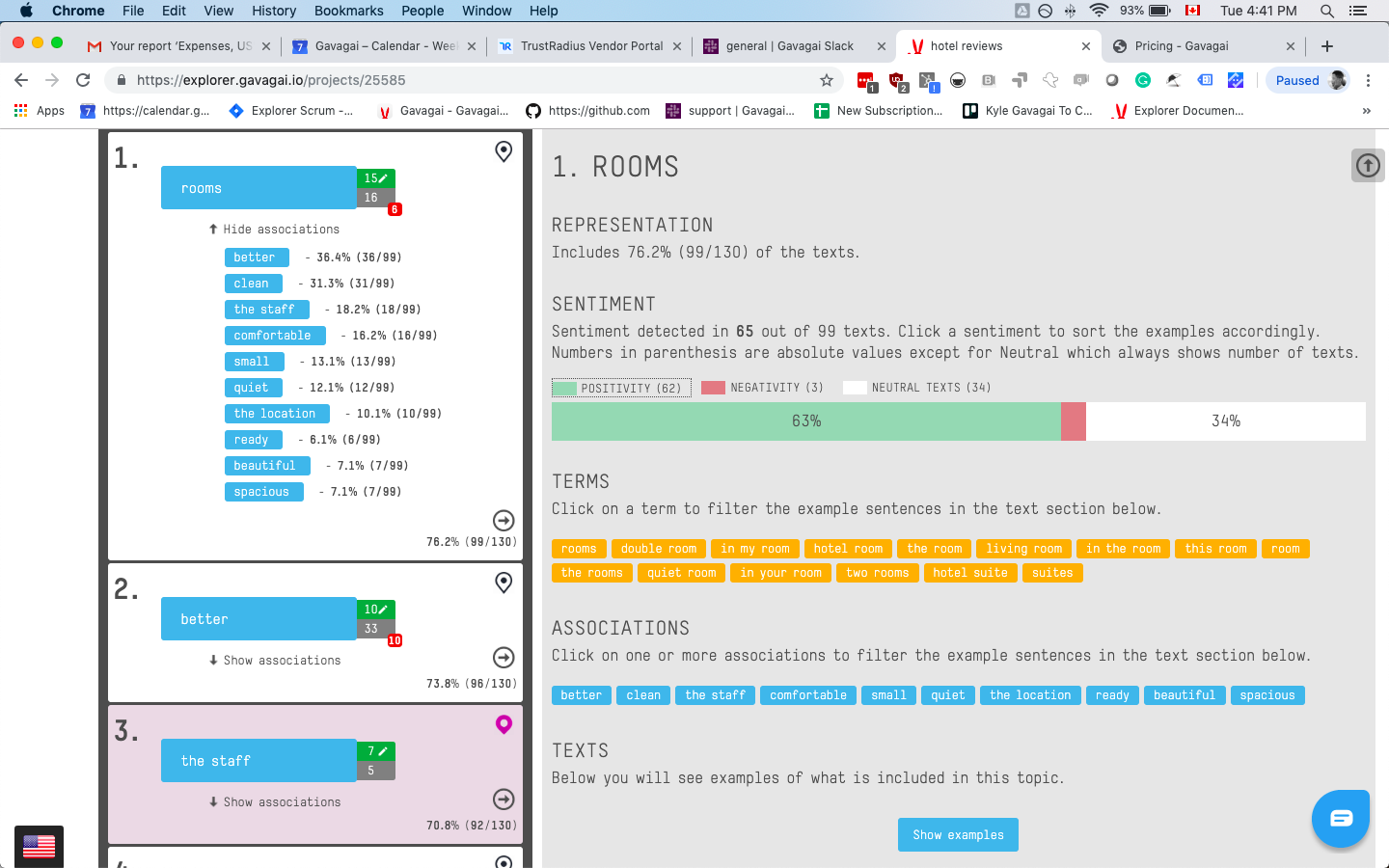
Gavagai Explorer is a text analysis tool for companies that want to keep track of what their customers think – regardless of which language they speak. Explorer analyzes texts in 47 languages. The texts get automatically analyzed and the results are presented in interactive and share-able Dashboards. Gavagai understands meaning The majority of the text data it analyzes comes from sources such as surveys, reviews, emails, chat conversations, and social…
$3,000
Time used to Set Up
TensorFlow
Score 8.1 out of 10
N/A
TensorFlow is an open-source machine learning software library for numerical computation using data flow graphs. It was originally developed by Google.
N/A
Pricing
Gavagai
TensorFlow
Editions & Modules
Small - 3 project slots -1200 credits
€ 120 per month - More or extra credits can be purchased
Number of Texts Analyzing, number of seats, number of projects
Medium - 10 project slots - 1200 credits
€ 400 per month - More or extra credits can be purchased
Number of Texts Analyzing, number of seats, number of projects
Large - 50 project slots - 1200 credits
€ 2,000 per month - More or extra credits can be purchased
Number of Texts Analyzing, number of seats, number of projects
The Entire Web Application
$3000.00
Time used to Set Up
Enterprise
quote: https://www.gavagai.io/request-quote/
Number of Texts Analyzing, number of seats, number of projects
No answers on this topic
Offerings
Pricing Offerings
Gavagai
TensorFlow
Free Trial
Yes
No
Free/Freemium Version
No
No
Premium Consulting/Integration Services
No
No
Entry-level Setup Fee
Optional
No setup fee
Additional Details
Buy extra credits at any time
Bought credits never expire
Gavagai is well suited for a B2C business that receives a lot of customer feedback in a form of open-ended text. It makes life easier for the customer experience team to efficiently identify the strengths and areas of improvement for the business. It saves a lot of time and also the hassle of analysing text data manually. It is not just a word cloud tool that shows you the words with the most number of mentions. Gavagai directs you towards actionability.
Whenever the problem has the demand for a neural networks based solution, Tensorflow (TF) is a great fit.
The tf.dataset API makes it really simple to create complex data pipelines in a few lines of code.
tf.estimators API abstracts all the complex computation graph creation logic making it very simple to get started.
Eager execution makes it simple to develop a TF graph as debugging the code would be like any other imperative Python program.
TF abstracts all the complexities of scaling it to multiple machines. It has various code and data distribution algorithms ready to use.
Projects like TensorBoard make monitoring the training process really easy. It also gives the ability to view embeddings without any extra code. Their What-If is extremely useful for poking and understanding a black box model. It also has tools to visualize data to quickly check for anomalies.
TF Autograph aims to covert any normal Python code into a distributed program which is quite handy to scale an existing code base.
Data pipeline implementation is quite good, loading large amounts of data and pre-process it in an efficient way is no more issue for us
It supports all major DL algorithms and network layouts such as ConvNets, RNN, LSTMs, Word2Vec, and even the latest transformer architecture
The abstraction for the device is perfectly done and its support seamlessly for multiple GPU and even TPU will bring a lot of performance gain for enterprise scoped solution while still keep the flexibility
The TensorBoard is amazing. I haven't seen a similar thing in other frameworks on the market. It allows us to quickly understand and debug the model with the info visualization which makes understanding much better
A very supportive community, which is the key for sharing the ideas and find the quick and best solutions
It would be much better if they could provide good documentation and easy ways to understand concepts.
It is difficult to understand the concept behind for example, Tensor Graph, which takes a lot of time.
As you have to write everything, it is time consuming to write the implementation of whole neural network. It would be better if they can provide some wrapper library to make things easier.
Community support for TensorFlow is great. There's a huge community that truly loves the platform and there are many examples of development in TensorFlow. Often, when a new good technique is published, there will be a TensorFlow implementation not long after. This makes it quick to ally the latest techniques from academia straight to production-grade systems. Tooling around TensorFlow is also good. TensorBoard has been such a useful tool, I can't imagine how hard it would be to debug a deep neural network gone wrong without TensorBoard.
I didn't evaluate many options while choosing Gavagai, I had explored a few local vendors whose capabilities were either incomplete or were not up to the mark. Their customer support was also quite poor. Also, the tool was debugged enough which led to frequent crashing. Alchmer although is not a direct competitor to Gavagai, since it's more of a customer feedback tool with additional capabilities of text analytics. I found Alchemer to be extremely expensive. Zonka on the other hand was quite welcoming to feedback from me and promised to develop additional capabilities for my specific requirements although the plan didn't go through due to internal reasons.
Can't seem to choose any deep learning platform in the above, so I'll list it here: 1. Apache MXNet: this has been used for one of our main algorithms for search as an end-to-end pipeline. We chose this because of the Scala bindings, which makes it easier to integrate with out JVM backend. MXNet seems comparable to TensorFlow, although community support is not as good as TensorFlow, and there are issues with memory leaks that are being worked on. TensorFlow in general is easier to use, but MXNet isn't too far behind. 2. Keras: still a favorite. Often I use this when paired with TensorFlow. TensorFlow 2.0 will make it even easier. 3. PyTorch: only used it a little, so it's hard to provide a good opinion. 4. DL4J: used it initially in an early days project because it has good JVM support. Harder to used not because of poor API design, but because community support is lacking and features don't come out as fast as TensorFlow.
Positive Impact- As I mentioned before its open source. Very easy to learn for average programmer/ developer. We were able to design a POC model for understanding the patient appointment cancellation snd reasons behind it in 3 week time frame.
Negative Impact- If you are using tensor flow for small project it works fine. If you are trying to build a model for face recognition it will be hard to program and train the system. It needs data to be processed before hand cannot learn on the go.