Securely connects distributed apps and services across public cloud, on-premises, and edge environments. Utilizing Infrastructure as Code, App Connect provisions resources and maintain uniform policies across multiple sites.
N/A
Splunk Observability Cloud
Score 9.0 out of 10
N/A
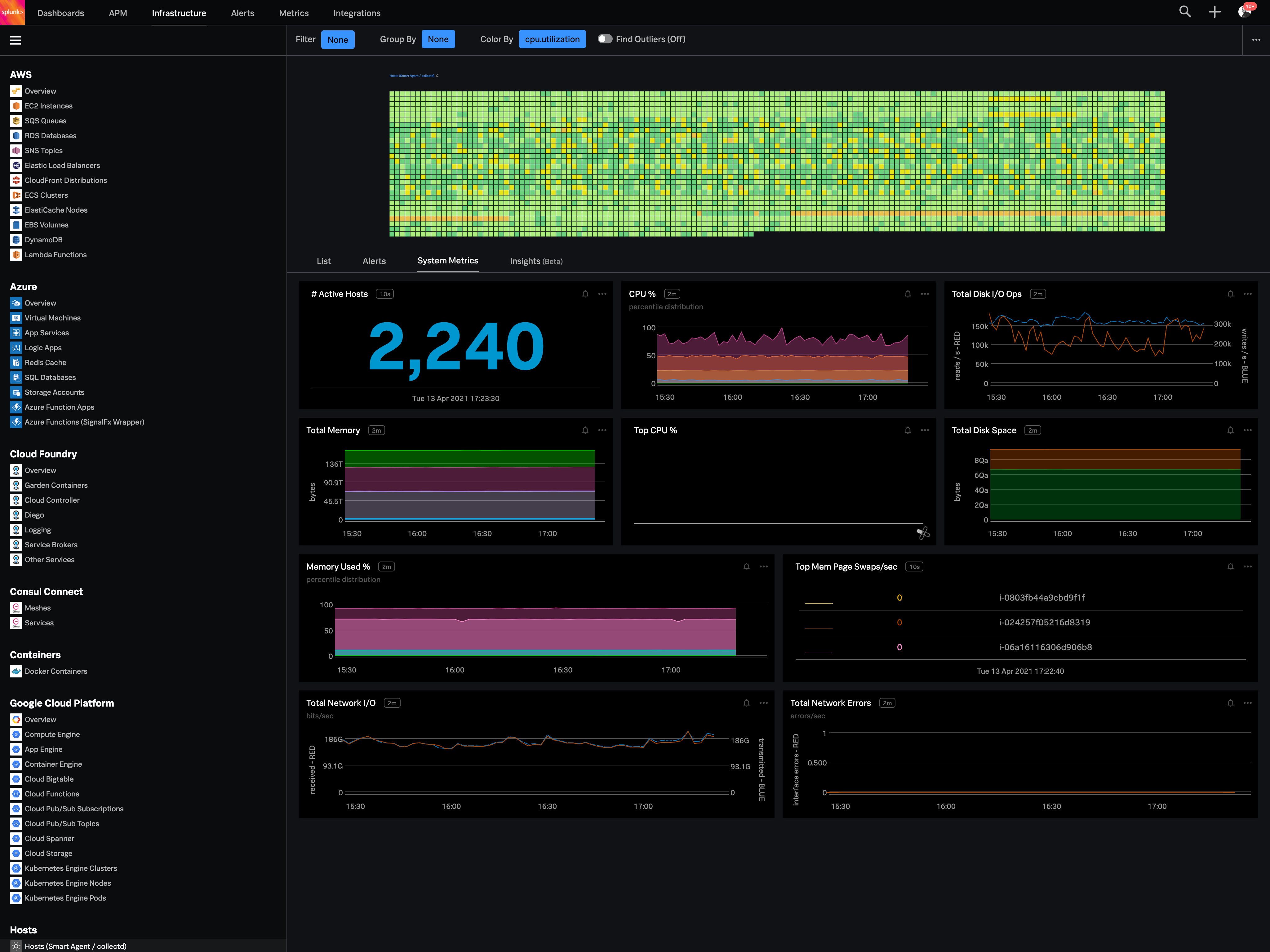
Splunk Observability Cloud aims to enable operational agility and better customer experience through real-time AI-driven streaming analytics allowing accurate alerts in seconds. It is designed to shorten MTTD and MTTR by providing real-time visibility into cloud infrastructure and services.
I thought F5 Distributed Cloud App Connect worked great to bridge the gap between our gcp environment and on prem. We were lacking in cloud funtionality for native load balancers but XC really connected the dots. We would most likely need a hybrid environment until the irules functionality improves for a few of our apps but most could be migrated over the XC.
The query language is relatively easy and flexible when looking into an application's problems. These queries can then be used for alerts, reports, and dashboards. I believe Splunk is a platform that can help a system grow into its proactive application management, using incidents to add insights as needed without trying to work out every scenario in advance.
Ease of use - standing up a new site took very little time, less then an hour.
Connecting the dots - the ease at standing up a load balancer and advertising it on CEs was simple and straight forward. Once you get familiar with the field layout it's very comparable to BIG-IP
The first one is its Kubernetes container monitoring.
I really like this features because as we know how much K8s is vast and to manually monitor each part of the Kubernetes it takes so much time but Splunk Observability Cloud makes it easier. And even once we integrate K8s with Splunk Observability Cloud it gives us some prebuilt dashboards which gives holistic view of our Cluster and its nodes, pods, etc.
The dashbaord feature of Splunk Observability Cloud, it gives us full flexibility to customize our dashboard with a wide range of predefined chart types.
Now it also supports OTEL, which is a plus point for observability. As now everyone is moving towards Otel and in current market there are only few tools who supports OTEL based integrations, Splunk Observability Cloud is one out of them.
More of a unified experience as Gartner released their latest sort of sassy trends. A lot of consumers are looking at a more unified experience and that's the sort of compilation of both management and data planes into a single things like single UI, easier management experience for the corporations.
An indicator for errors on the navigations pane so that we don't have to go through each tab.
As we go more and more cloud maybe you guys can implement a pay-as-you-use strategy so that small companies using it not frequently can also afford it.
That's it can't think of any and it wont let me skip to next question. Thanks
At this point it has become too focal to our operations. An entire department could collapse if we dropped it now or in the near future. My experiences as mentioned in the previous questions tell of its gravity
Good: Stable system with low error rate Easy to use for simple use cases Bad: UI is not very clear for complex usage Mobile view (when logged in from phone) is bad No library for .net
When there is an issue, it’s a win if one can easily identify the root cause. To do the same, it should allow the user to dig deep with multiple data points and compare the data and identify the anomaly. In this use case, it’s good to drive from Splunk 011y.
From what we have been able to test load/responsiveness is quick and when we've tested out reporting and troubleshooting modules they have pulled the correct information in quick timeframes. We haven't been able to test out any software integration with Splunk of other software on our system since we are still in early POC stages but from what we've been told we should be able to implement that in our environment
-F5 Distributed Cloud App Connect provides more granular security policies with features like DOS, WAF etc and others lack -F5 Distributed Cloud App Connect provides high performance global network and other rely on public internet and impact is latency and it gives F5 Distributed Cloud App Connect a better user experience
We initially chose Splunk Observability Cloud because it promised full-stack visibility and tighter integration. The other tools didn't offer this as part of the core package. Their analytics and real-time dashboards looked strong during the demo but it turned out to a lot heavier and more complex than expected. If I had to decide again, I’d probably go with something more streamlined and easier to manage.