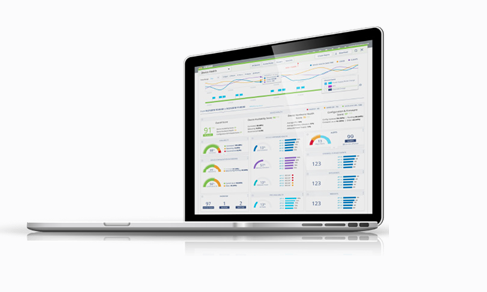
ExtremeCloud IQ provides unified management driven by Machine Learning (ML). It features configuration workflows, realtime and historical monitoring, comprehensive troubleshooting, and integrated network applications. Designed to take full advantage of Extreme’s end-to- end networking solutions, it delivers unified, full-stack management of access points, switches, and SD-WAN.
N/A
TeamCity
Score 7.4 out of 10
N/A
TeamCity is a continuous integration server from Czeck company JetBrains.
N/A
Pricing
ExtremeCloud IQ
TeamCity
Editions & Modules
No answers on this topic
No answers on this topic
Offerings
Pricing Offerings
ExtremeCloud IQ
TeamCity
Free Trial
No
No
Free/Freemium Version
No
No
Premium Consulting/Integration Services
No
No
Entry-level Setup Fee
No setup fee
No setup fee
Additional Details
—
—
More Pricing Information
Community Pulse
ExtremeCloud IQ
TeamCity
Features
ExtremeCloud IQ
TeamCity
Configuration Management
Comparison of Configuration Management features of Product A and Product B
In complex environments where redundancy is required or a high density of client devices is in use. It is helpful to small enterprises with limited IT staff, as once the auto-provisioning is set up with AP templates, it means APs can be installed by non-IT staff. Licensing can be complex due to all the models, but the ability for co-term licenses to end on the same expiry is essential.
TeamCity is well suited for an organization using continuous integration, meaning you release code to production often, and an agile project management system. There are free versions available for small teams and enterprise versions available for large teams with many different builds. TeamCity is probably overkill for basic e-commerce or blog website builds that do not require much development after the initial launch
GTAC support is excellent; they understand the issue and do not hesitate to help in detail.
The layout is very intuitive and easy to use, especially the templating of switch port types. It makes it simple to use context-based names so the purpose of the port can be understood.
The auto channel selection now works very well, including the SDR dual 5GHz mode.
Fully customizable build process. Each step of the build process can be parameterized and customized to address specific needs of particular applications. This allowed us to easily convert from a custom VM-based environment to our current Docker-based environment.
Manages large numbers of build agents seamlessly. This allows us to run multiple builds on many different applications in a most efficient manner.
Build steps can be managed in an arbitrary manner, allowing some parts of the process to proceed in parallel while restricting others to depend on completion of all relevant steps.
Licensing as a whole is a nightmare. If you have a device RMA'd - you have to email their licensing team to have the device license transferred to your new hardware. Licensing renewals are also a pain, as oftentimes they don't have the licenses correctly tied to each device you own. Definitely the biggest issue I have with ExtremeCloud IQ Networks
Hardware is tied to you once you purchase it, so there is no resale market/secondary market for the devices you purchase - should you try to sell them when they're end of life within your organization
Being a web platform, it is very easily accessible. The user interface is very simple, intuitive, and visually well-designed. The learning to use it was very quick and can be done even without specific user manuals. Access to the analytics and troubleshooting tools is also extremely intuitive and very well-crafted.
TeamCity runs really well, even when sharing a small instance with other applications. The user interface adequately conveys important information without being overly bloated, and it is snappy. There isn't any significant overhead to build agents or unit test runners that we have measured.
Jenkins relies on being open source as the primary driver for its success. This low cost is a huge factor for many companies, both small and large. The professional, free tier of TeamCity offers a huge amount of growth before ever needing to pay anything. I personally also find the user experience of TeamCity to be much better, both from a look and feel, as well as from an out-of-the-box feature set perspective. The big selling feature of ADO is its native integration with Azure. TeamCity integrates very well with out-of-the-box .NET support and greatly simplifies our use of another diverse tooling outside of the Microsoft ecosystem.
TeamCity was a key contributor to our organization's adoption of Agile.
TeamCity made it possible to KILL "It works on my laptop" conversations with Developers. If it does not compile in TeamCity - the project is not deployable. TeamCity's easy to use interface made it possible to quickly adopt a "Deploy Only from TeamCity" policy, further ensuring TeamCity Builds were the gold-standard for well-configured source code.