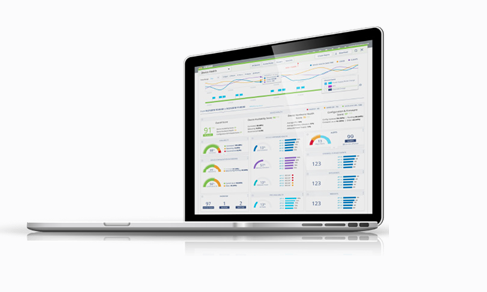
ExtremeCloud IQ provides unified management driven by Machine Learning (ML). It features configuration workflows, realtime and historical monitoring, comprehensive troubleshooting, and integrated network applications. Designed to take full advantage of Extreme’s end-to- end networking solutions, it delivers unified, full-stack management of access points, switches, and SD-WAN.
N/A
Salt
Score6.2 out of 10
N/A
Built on Python, Salt is an event-driven automation tool and framework to deploy, configure, and manage complex IT systems. Salt is used to automate common infrastructure administration tasks and ensure that all the components of infrastructure are operating in a consistent desired state.
N/A
Pricing
ExtremeCloud IQ
Salt
Editions & Modules
No answers on this topic
No answers on this topic
Offerings
Pricing Offerings
ExtremeCloud IQ
Salt
Free Trial
No
No
Free/Freemium Version
No
No
Premium Consulting/Integration Services
No
No
Entry-level Setup Fee
No setup fee
No setup fee
Additional Details
—
—
More Pricing Information
Features
ExtremeCloud IQ
Salt
Configuration Management
Comparison of Configuration Management features of ExtremeCloud IQ and Salt Project
ExtremeCloud IQ is definitely best suited for a mid/large-scale business. The tools provided for what you pay for would be mostly unnecessary for a small business - the pricing also would not condone the purchase for a small business. That said, we are more of a mid-sized district, and being able to manage this system with 120 APs deployed across 10 locations has been great. I'm the only person that purchases, configures, deploys and manages everything with ExtremeCloud IQ - and it doesn't take too much time to be able to do so. I'm certainly a fan of the product!
A de minimis incentive was given to thank the reviewer for their time. The incentive was not used to bias or drive a particular response, nor was the incentive contingent on a positive endorsement. TR verified that a representative sample of customers was invited. More Info
SaltStack is a very well architected toolset and framework for reliably managing distributed systems' complexity at varied scale. If the diversity of kind or number of assets is low, or the dependencies are bounded and simple, it might be overkill. Realization that you need SaltStack might come in the form of other tools, scripts, or jobs whose code has become difficult, unreliable, or unmaintainable. Rather than a native from-scratch SaltStack design, be aware that SaltStack can be added on to tools like Docker or Chef and optionally factor those tools out or other tools into the mix.
A de minimis incentive was given to thank the reviewer for their time. The incentive was not used to bias or drive a particular response, nor was the incentive contingent on a positive endorsement. More Info
GTAC support is excellent; they understand the issue and do not hesitate to help in detail.
The layout is very intuitive and easy to use, especially the templating of switch port types. It makes it simple to use context-based names so the purpose of the port can be understood.
The auto channel selection now works very well, including the SDR dual 5GHz mode.
A de minimis incentive was given to thank the reviewer for their time. The incentive was not used to bias or drive a particular response, nor was the incentive contingent on a positive endorsement. More Info
Targeting is easy and yet extremely granular - I can target machines by name, role, operating system, init system, distro, regex, or any combination of the above.
Abstraction of OS, package manager and package details is far advanced beyond any other CRM I have seen. The ability to set one configuration for a package across multiple distros, and have it apply correctly no matter the distrospecific naming convention or package installation procedure, is amazing.
Abstraction of environments is similarly valuable - I can set a firewall rule to allow ssh from "management", and have that be defined as a specific IP range per dev, test, and prod.
A de minimis incentive was given to thank the reviewer for their time. The incentive was not used to bias or drive a particular response, nor was the incentive contingent on a positive endorsement. More Info
A de minimis incentive was given to thank the reviewer for their time. The incentive was not used to bias or drive a particular response, nor was the incentive contingent on a positive endorsement. More Info
A de minimis incentive was given to thank the reviewer for their time. The incentive was not used to bias or drive a particular response, nor was the incentive contingent on a positive endorsement. More Info
Being a web platform, it is very easily accessible. The user interface is very simple, intuitive, and visually well-designed. The learning to use it was very quick and can be done even without specific user manuals. Access to the analytics and troubleshooting tools is also extremely intuitive and very well-crafted.
A de minimis incentive was given to thank the reviewer for their time. The incentive was not used to bias or drive a particular response, nor was the incentive contingent on a positive endorsement. TR verified that a representative sample of customers was invited. More Info
We haven't had to spend a lot of time talking to support, and we've only had one issue, which, when dealing with other vendors is actually not that bad of an experience.
A de minimis incentive was given to thank the reviewer for their time. The incentive was not used to bias or drive a particular response, nor was the incentive contingent on a positive endorsement. TR verified that a representative sample of customers was invited. More Info
We moved to SaltStack from Puppet about 3 years ago. Puppet just has too much of a learning curve and we inherited it from an old IT regime. We wanted something we could start fresh with. Our team has never looked back. SaltStack is so much easier for us to use and maintain.
A de minimis incentive was given to thank the reviewer for their time. The incentive was not used to bias or drive a particular response, nor was the incentive contingent on a positive endorsement. More Info
A de minimis incentive was given to thank the reviewer for their time. The incentive was not used to bias or drive a particular response, nor was the incentive contingent on a positive endorsement. More Info
We manage two complex highly available self-healing (all infrastructure and systems) environments using SaltStack. Only one person is needed to run SaltStack. That is a HUGE return on investment.
Building tooling on top of SaltStack has allowed us to share administrative abilities by role - e.g. employee X can deploy software Y. No need to call a sysadmin and etc.
Recovery from problems, or time to stand-up new systems is now counted in minutes (usually under eight) rather than hours. This is a strategic advantage for rolling out new services.
A de minimis incentive was given to thank the reviewer for their time. The incentive was not used to bias or drive a particular response, nor was the incentive contingent on a positive endorsement. More Info