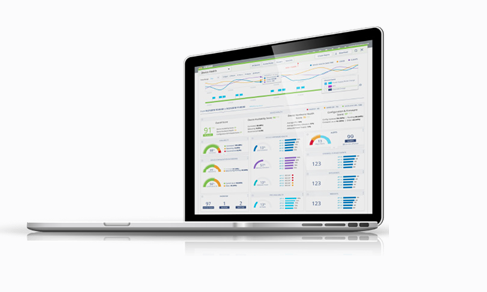
ExtremeCloud IQ provides unified management driven by Machine Learning (ML). It features configuration workflows, realtime and historical monitoring, comprehensive troubleshooting, and integrated network applications. Designed to take full advantage of Extreme’s end-to- end networking solutions, it delivers unified, full-stack management of access points, switches, and SD-WAN.
N/A
Progress Chef
Score6.5 out of 10
N/A
Chef IT infrastructure automation suites were developed by Chef Software in Seattle and acquired by Progress Software in September 2020. The Chef Enterprise Automation Stack is an integrated suite of automation technologies presented as a solution for delivering change quickly, repeatedly, and securely over every application's lifecycle. The Chef Effortless Infrastructure Suit is an integrated suite of automation technologies to codify infrastructure, security, and compliance, as well as…
ExtremeCloud IQ is definitely best suited for a mid/large-scale business. The tools provided for what you pay for would be mostly unnecessary for a small business - the pricing also would not condone the purchase for a small business. That said, we are more of a mid-sized district, and being able to manage this system with 120 APs deployed across 10 locations has been great. I'm the only person that purchases, configures, deploys and manages everything with ExtremeCloud IQ - and it doesn't take too much time to be able to do so. I'm certainly a fan of the product!
A de minimis incentive was given to thank the reviewer for their time. The incentive was not used to bias or drive a particular response, nor was the incentive contingent on a positive endorsement. TR verified that a representative sample of customers was invited. More Info
Chef is a fantastic tool for automating software deployments that aren't able to be containerized. It's more developer-oriented than its other competitors and thus allows you to do more with it. The Chef Infra Server software is rock-solid and has been extremely stable in our experience. I would definitely recommend its use if you're looking for an automation framework. And it also offers InSpec which is a very good tool for testing your infrastructure to ensure it deployed as intended.
A de minimis incentive was given to thank the reviewer for their time. The incentive was not used to bias or drive a particular response, nor was the incentive contingent on a positive endorsement. More Info
GTAC support is excellent; they understand the issue and do not hesitate to help in detail.
The layout is very intuitive and easy to use, especially the templating of switch port types. It makes it simple to use context-based names so the purpose of the port can be understood.
The auto channel selection now works very well, including the SDR dual 5GHz mode.
A de minimis incentive was given to thank the reviewer for their time. The incentive was not used to bias or drive a particular response, nor was the incentive contingent on a positive endorsement. More Info
A de minimis incentive was given to thank the reviewer for their time. The incentive was not used to bias or drive a particular response, nor was the incentive contingent on a positive endorsement. More Info
A de minimis incentive was given to thank the reviewer for their time. The incentive was not used to bias or drive a particular response, nor was the incentive contingent on a positive endorsement. More Info
Chef could do a better job with integration with other DevOps tools. Our company relies on Jenkins and Ansible, which took some development and convincing for plug-ins to be created/available.
It would be nice if kitchen didn't only have a vagrant/virtual-box prerequisite. Our company one day stop allowing virtual-box to run without special privileges, and that caused a lot of issues for people trying to do kitchen tests.
Chef could use more practice materials for the advanced certification badges. There was not a lot of guidance in what to study or examples of certain topics.
A de minimis incentive was given to thank the reviewer for their time. The incentive was not used to bias or drive a particular response, nor was the incentive contingent on a positive endorsement. More Info
Being a web platform, it is very easily accessible. The user interface is very simple, intuitive, and visually well-designed. The learning to use it was very quick and can be done even without specific user manuals. Access to the analytics and troubleshooting tools is also extremely intuitive and very well-crafted.
A de minimis incentive was given to thank the reviewer for their time. The incentive was not used to bias or drive a particular response, nor was the incentive contingent on a positive endorsement. TR verified that a representative sample of customers was invited. More Info
The suite of tools is very powerful. The ability to create custom modules allows for unlimited potential for managing all aspects of a system. However, there is pretty significant learning curve with the toolset. It currently takes approx 3-4 months for new engineers to feel comfortable with our implementation
A de minimis incentive was given to thank the reviewer for their time. The incentive was not used to bias or drive a particular response, nor was the incentive contingent on a positive endorsement. More Info
It loads quick enough for basically all our systems. Because we have this for local dev environments, speed isn't really a big issue here. Yes, depending on the system, sometimes it does take a relatively long time, but it's not an issue for me. One thing that is annoying is that if I want to make a small change to a cookbook and re-run the Chef client, I can't just make the change in the cache and run it. I have to do the whole process of updating the server.
A de minimis incentive was given to thank the reviewer for their time. The incentive was not used to bias or drive a particular response, nor was the incentive contingent on a positive endorsement. More Info
Support for Chef is easily available for fee or through the open source community as most the issues you will face will have been addressed through the Chef developer community forums. The documentation for Chef is moderate to great and easily readable.
A de minimis incentive was given to thank the reviewer for their time. The incentive was not used to bias or drive a particular response, nor was the incentive contingent on a positive endorsement. More Info
A de minimis incentive was given to thank the reviewer for their time. The incentive was not used to bias or drive a particular response, nor was the incentive contingent on a positive endorsement. TR verified that a representative sample of customers was invited. More Info
We considered the three leading competitors in the field: Chef, Puppet and Ansible. Ansible is a very strong competitor and has a nice degree of flexibility in that it does not require a client install. Instead the configuration is delivered by SSH which is very simple. Puppet seems like it has fallen off the pace of the competition and lacked the strong community offered by Chef. We chose Chef because of the strong support by the company and the dynamic and deep community support.
A de minimis incentive was given to thank the reviewer for their time. The incentive was not used to bias or drive a particular response, nor was the incentive contingent on a positive endorsement. More Info
A de minimis incentive was given to thank the reviewer for their time. The incentive was not used to bias or drive a particular response, nor was the incentive contingent on a positive endorsement. More Info
The entire professional services team was great to work with. The curriculum was tailored to our specific use cases. The group we worked with were very responsive, listened to our feedback, was very easy to schedule and accommodate. I cannot say enough good things about our professional services experience
A de minimis incentive was given to thank the reviewer for their time. The incentive was not used to bias or drive a particular response, nor was the incentive contingent on a positive endorsement. More Info
A de minimis incentive was given to thank the reviewer for their time. The incentive was not used to bias or drive a particular response, nor was the incentive contingent on a positive endorsement. More Info
Chef is a good tool for baselining servers. It will be a good ROI when there are huge number of servers. For less number of servers maintaining a master will be an over head.
One good ROI will be that the Operations Team also gets into agile and DevOps methodologies. Operational teams can start writing scripts/automations to keep their infra more stable and their application stack more reliable.
Implementation of Chef eliminates the manual mode of doing things and everyone aligns to automation mind set. It helps in change of culture.
A de minimis incentive was given to thank the reviewer for their time. The incentive was not used to bias or drive a particular response, nor was the incentive contingent on a positive endorsement. More Info