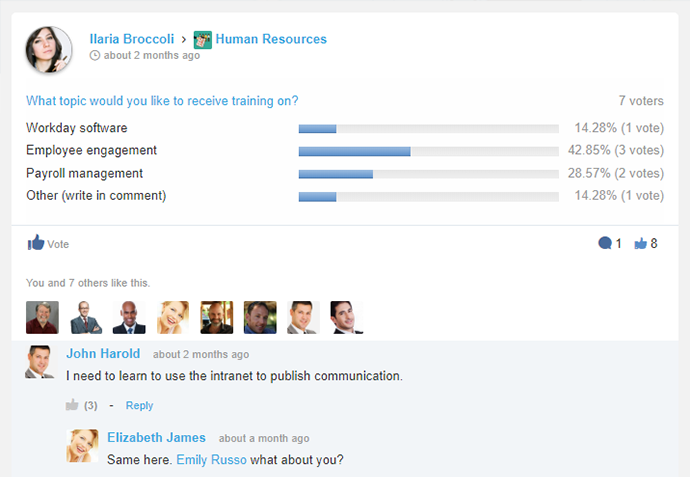
eXo Platform is an open-source, social-collaboration software designed for enterprises. Some key features include: Enterprise Social Network, Enterprise Content Management and Social Collaboration.
$0
engaged user/month
HCL Connections
Score9 out of 10
N/A
Connections from HCL Technologies (formerly from IBM, acquired by HCL in 2018) is a collaboration tool and employee digital workspace with key features like social analytics, blogs, document management, and a social network.
N/A
Pricing
eXo Platform
HCL Connections
Editions & Modules
Community
$0
engaged user/month
Social Intranet
$3
per month per user
Digital Workplace Cloud
$5
per month per user
Digital Workplace On-Premise
$5
per month per user
Enterprise Unlimited
9$
engaged user/month
No answers on this topic
Offerings
Pricing Offerings
eXo Platform
HCL Connections
Free Trial
Yes
No
Free/Freemium Version
Yes
No
Premium Consulting/Integration Services
Yes
No
Entry-level Setup Fee
No setup fee
No setup fee
Additional Details
—
—
More Pricing Information
Features
eXo Platform
HCL Connections
Project Management
Comparison of Project Management features of eXo Platform and HCL Connections
Feature
eXo Platform
9.2
5 Ratings
18% above category average
HCL Connections
-
Ratings
Task Management
10.05 Ratings
00 Ratings
Gantt Charts
8.02 Ratings
00 Ratings
Scheduling
10.04 Ratings
00 Ratings
Workflow Automation
8.33 Ratings
00 Ratings
Mobile Access
10.05 Ratings
00 Ratings
Search
10.05 Ratings
00 Ratings
Visual planning tools
8.03 Ratings
00 Ratings
Communication
Comparison of Communication features of eXo Platform and HCL Connections
Feature
eXo Platform
9.5
4 Ratings
18% above category average
HCL Connections
-
Ratings
Chat
10.04 Ratings
00 Ratings
Notifications
10.04 Ratings
00 Ratings
Discussions
10.04 Ratings
00 Ratings
Surveys
7.13 Ratings
00 Ratings
Internal knowledgebase
10.04 Ratings
00 Ratings
Integrates with GoToMeeting
9.01 Ratings
00 Ratings
Integrates with Gmail and Google Hangouts
10.02 Ratings
00 Ratings
Integrates with Outlook
10.03 Ratings
00 Ratings
File Sharing & Management
Comparison of File Sharing & Management features of eXo Platform and HCL Connections
It is especially suitable for working together remotely or from disconnected locations, allowing them to access collaborative work and tools to facilitate communication. Internal and cloud options also seem to offer a flexible adoption roadmap. It addresses the problems of efficient collaboration and effective communication between employees, particularly with regard to working and completing projects
A de minimis incentive was given to thank the reviewer for their time. The incentive was not used to bias or drive a particular response, nor was the incentive contingent on a positive endorsement. More Info
IBM Connections is well suited for larger organizations that need an internal social networking tool and are willing to deal with IBM and the complexity of the software. It is less appropriate for smaller organizations and those who don't want to deal with the complexity, or IBM's awful customer service and prices.
A de minimis incentive was given to thank the reviewer for their time. The incentive was not used to bias or drive a particular response, nor was the incentive contingent on a positive endorsement. More Info
I personally love the user-friendly interface. Often you find software which is difficult to learn, and not utilized as often as it should be because of this. With eXo Platform, the interface is easy to understand, and is not particularly challenging to new users and non-tech savvy individuals.
It allows you to get work done, without feeling like using the platform is part of the actual work. It feels more like a natural system you would use in your leisure time to connect with friends and family, rather than a social intranet designed to facilitate employee communication and help you meet project deadlines.
The cloud platform allows users to easily share information and files, and collaborate on project work. Another benefit to this is it makes mobile collaboration possible.
The plugin for MS Office/Explorer has made saving and sharing working documents extremely convenient for me and my close colleagues
The newsfeed feature conveniently aggregates updates from the communities/people you follow. It's nice not to have to jump from community to community to see what's going on in the organization
The various apps can be used for several purposes. A little creativity goes a long way when establishing what type of information the apps can be useful for communicating
A de minimis incentive was given to thank the reviewer for their time. The incentive was not used to bias or drive a particular response, nor was the incentive contingent on a positive endorsement. More Info
As the platform appears to be packed with features and functionality it may be a bit daunting at first to get used to it.
The initial adoption in a corporate setting would involve a number of questions, such as integration with other applications, data migration and security and the optimum adoption road map in order to maximise the benefit from the platform.
The lack of a note-taking tool became a bigger and bigger issue as time went on. Our pilot users felt Connections was a natural place to take and share meeting notes – including photos, drawings, recorded audio, etc. – and were always frustrated that there was no easy, organized way to do that. We tried using a Blog, Wiki, etc. but nothing really resonated as a good solution for this.
The Wiki tool is weak, providing rigid structure but with few options. A Community can only have a single Wiki, for instance. Wikis are weak in the mobile app as well; they’re not even easy to navigate. Users ended up ignoring Wikis completely despite our efforts to get them to convert documents like guidelines, policies, procedures, handbooks, etc. into Wiki form.
The Windows Explorer plug-in was useful but required a lot of manual intervention to setup. For instance, once a user joins a Community in Connections, the Community also has to be manually added to the Explorer plug-in so the user can find, open and edit files with it. We felt this process should be much more automated.
Tagging is only relevant in the web UI and, to a lesser extent, in the mobile app. However, in the Windows Explorer plug-in, Tags are not usable at all making it difficult to find things that were easy to find in the web UI.
IBM Docs was not included in the on-premises deployment; it was an additional license so we did not test it. Documents, mainly Microsoft Office files, are still the single most common way our user community creates, shares, edits and presents information. That proved to be a major gap for our users, and slowed user adoption considerably. We considered testing it, but IBM Docs would only work for about half of our users so we found ourselves wondering if we really wanted to support two document editing platforms. IBM Docs also offers no way to work offline as far as we could tell. This also meant we would need to keep licensing Microsoft Office which is not cheap.
Consulting costs are high because the back-end environment is complex. Installing, administrating and even patching Connections is a fairly complex process. We needed to hire consultants to install our test environment and any major upgrades would’ve required additional consulting fees. Any 3rd party add-ons we looked at were highly technical in nature meaning…you guessed it, more consulting costs.
Administrating IBM Connections requires editing XML files in a specific, secure way that is typically done in a console. I love consoles as much as the next admin, but when you only use a console once every 2 months it means looking up all the documentation and re-educating yourself. A single change could take me 2 hours to implement. 3rd party admin dashboards do exist, at an additional cost, but IBM really should provide a much easier way to manage the environment.
The lack of in-person or online training courses, materials, videos, etc. really discouraged a lot of users. The only decent training we could find (marketing videos aside) was a single video series on Lynda.com which, of course, was an additional cost. In the end that video didn’t really help our users much beyond introductory concepts.
IBM includes reporting, but it’s a massive Cognos system requiring some serious hardware and Cognos expertise. We had neither, and would have ultimately opted for a 3rd party add-on for reporting and statistics.
An often overlooked concern is eDiscovery. Our contracted eDiscovery service extensively works with various ECMs, but had no idea how they would handle Connections data. The cloud version of Connections offers an add-on for eDiscovery, but as far as we could tell IBM offered nothing for on-premises deployments.
A de minimis incentive was given to thank the reviewer for their time. The incentive was not used to bias or drive a particular response, nor was the incentive contingent on a positive endorsement. More Info
Connections has continued to more than meet our needs from a collaboration point of view and we are currently working on integration with our IBM Websphere portal platform to provide an integrated collaboration solution. This scenario will provide our users the best both products have to offer in a single interface.
A de minimis incentive was given to thank the reviewer for their time. The incentive was not used to bias or drive a particular response, nor was the incentive contingent on a positive endorsement. More Info
This platform has a pleasant user interface, is very easy to use, and offers a lot of useful accessories and add-ons. At first it can be a little intimidating, but it doesn't take long to get used to it. It is considerably reliable and safe. Facilitates connection and collaboration with coworkers. It provides tools that allow you to capture, organize and act according to the internal knowledge of your team.
A de minimis incentive was given to thank the reviewer for their time. The incentive was not used to bias or drive a particular response, nor was the incentive contingent on a positive endorsement. More Info
Connections combines all the most useful abilities from various social networks. This makes it useful of course, but it also reduces user adoption time initially by allowing users to get comfortable with basic features. Once they are comfortable, it's easy for users to start exploring. They find new people in the organization to contact, new sources of information, etc. Before you know it, about half of the users are contributing back in some form -- and all with little or no training needed by IT.
A de minimis incentive was given to thank the reviewer for their time. The incentive was not used to bias or drive a particular response, nor was the incentive contingent on a positive endorsement. More Info
Once Connections was installed, patched, etc. it was ALWAYS up. We only had to bring it down for OS updates to the servers. That seems to be typical of anything that runs on WebSphere; it's bulletproof and could probably run for months and years if the underlying OS didn't require constant patching.
A de minimis incentive was given to thank the reviewer for their time. The incentive was not used to bias or drive a particular response, nor was the incentive contingent on a positive endorsement. More Info
IBM Connections web UI, mobile app (data sync to / from the device), and file transfer speeds were almost always very fast. It was rare for a slow-down of any kind, even when doing searches.
A de minimis incentive was given to thank the reviewer for their time. The incentive was not used to bias or drive a particular response, nor was the incentive contingent on a positive endorsement. More Info
The eXo platform offers a high quality support, which satisfies the requirements of our company, especially when the platform begins to be used, due to the amount of tools that can be overwhelming. Support responses are made in a short period of time.
A de minimis incentive was given to thank the reviewer for their time. The incentive was not used to bias or drive a particular response, nor was the incentive contingent on a positive endorsement. More Info
IBM Support has ALWAYS been quick to respond, regardless of the product. Even first level techs seldom provide "canned" responses and they really try to help. If they can't help, they don't wallow around but engage the right person immediately. It's very rare that the first level tech needs to escalate, and even more rare when they do escalate and the next person engaged cannot solve it. We have been more than satisfied with IBM support's quick and professional responses to our issues.
A de minimis incentive was given to thank the reviewer for their time. The incentive was not used to bias or drive a particular response, nor was the incentive contingent on a positive endorsement. More Info
Try to understand you will never find a product which suites all your end user for 100%. IBM Connections is the best of all breeds but if you go look on each functionality on its own there are better example out there. But as IBM COnnections delivers it all in just one platform makes it the best example about integration of different functionality into one platform.
We selected this product firstly because it's easy to use for end-users, even if it's not so simple to configure from an administrative point of view. Managing and tracking overall activities is quite easy and it's also possible to have an immediate vision of everything that is done on the platform. Users feel confident and are encouraged to share resources.
A de minimis incentive was given to thank the reviewer for their time. The incentive was not used to bias or drive a particular response, nor was the incentive contingent on a positive endorsement. More Info
From the few times that I have used MS SharePoint, I can say that it doesn't seem to hold a candle to the robust features of IBM Connections. The out-of-the-box capabilities of IBM Connections are amazing and are more easy to access and use than what I've seen with MS SharePoint.
A de minimis incentive was given to thank the reviewer for their time. The incentive was not used to bias or drive a particular response, nor was the incentive contingent on a positive endorsement. More Info
Scaling UP is never an issue with IBM's core technologies like WebSphere, DB2, etc. as long as you have or can find the technical resources to implement it. Where IBM seems to fail is scaling DOWN for smaller organizations. Connections 5.0 on-premises would have required us to create 7 servers -- yes, they would be virtualized, but still that's 7 OS licenses, 40 virtual CPU cores, 80GB RAM, and a few TB of hard disk space. All to replace Quick which runs on 1 server with 1 OS license, 4 cores, 8GB RAM and 600GB of disk. Granted, there are major differences in capabilities between the two, but how do you get a CFO understand why features like a mobile app, file sync, and social sharing require 10x the back-end resources?
A de minimis incentive was given to thank the reviewer for their time. The incentive was not used to bias or drive a particular response, nor was the incentive contingent on a positive endorsement. More Info
A de minimis incentive was given to thank the reviewer for their time. The incentive was not used to bias or drive a particular response, nor was the incentive contingent on a positive endorsement. More Info
A de minimis incentive was given to thank the reviewer for their time. The incentive was not used to bias or drive a particular response, nor was the incentive contingent on a positive endorsement. More Info