Drupal is a free, open-source content management system written in PHP that competes primarily with Joomla and Plone. The standard release of Drupal, known as Drupal core, contains basic features such as account and menu management, RSS feeds, page layout customization, and system administration.
N/A
Kibo eCommerce
Score 8.0 out of 10
N/A
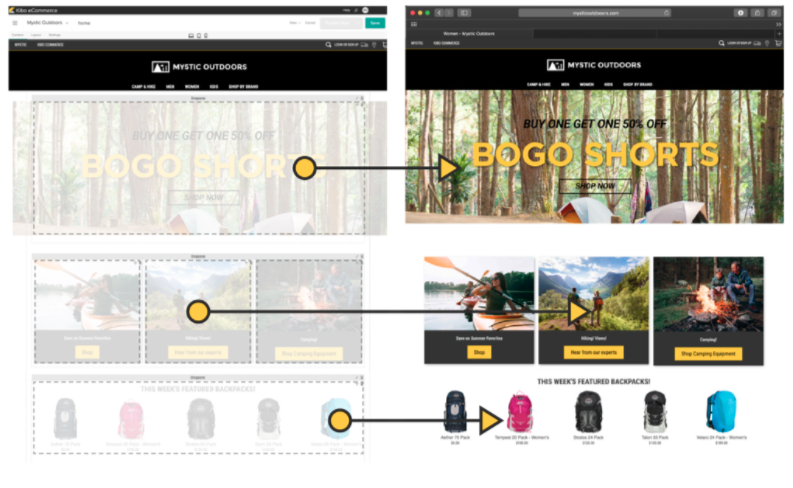
Kibo Software offers Kibo eCommerce (formerly Mozu), designed to support retailers with online offer creation and deployment, content publishing and landing pages, and many tools and widgets out of the box with a retail-oriented ecommerce solution.
Mozu was acquired by Kibo Software from Volusion in October 2016.
N/A
Pricing
Drupal
Kibo eCommerce
Editions & Modules
No answers on this topic
No answers on this topic
Offerings
Pricing Offerings
Drupal
Kibo eCommerce
Free Trial
No
No
Free/Freemium Version
No
No
Premium Consulting/Integration Services
No
No
Entry-level Setup Fee
No setup fee
No setup fee
Additional Details
—
—
More Pricing Information
Community Pulse
Drupal
Kibo eCommerce
Features
Drupal
Kibo eCommerce
Security
Comparison of Security features of Product A and Product B
Drupal
2.0
Ratings
120% below category average
Kibo eCommerce
-
Ratings
Role-based user permissions
2.00 Ratings
00 Ratings
Platform & Infrastructure
Comparison of Platform & Infrastructure features of Product A and Product B
Drupal
7.7
Ratings
2% above category average
Kibo eCommerce
-
Ratings
API
9.30 Ratings
00 Ratings
Internationalization / multi-language
6.00 Ratings
00 Ratings
Web Content Creation
Comparison of Web Content Creation features of Product A and Product B
Drupal
5.3
Ratings
37% below category average
Kibo eCommerce
-
Ratings
WYSIWYG editor
1.00 Ratings
00 Ratings
Code quality / cleanliness
9.30 Ratings
00 Ratings
Admin section
3.00 Ratings
00 Ratings
Page templates
4.00 Ratings
00 Ratings
Library of website themes
3.00 Ratings
00 Ratings
Mobile optimization / responsive design
10.00 Ratings
00 Ratings
Publishing workflow
9.30 Ratings
00 Ratings
Form generator
3.00 Ratings
00 Ratings
Web Content Management
Comparison of Web Content Management features of Product A and Product B
Drupal
5.0
Ratings
38% below category average
Kibo eCommerce
-
Ratings
Content taxonomy
10.00 Ratings
00 Ratings
SEO support
1.00 Ratings
00 Ratings
Bulk management
10.00 Ratings
00 Ratings
Availability / breadth of extensions
2.00 Ratings
00 Ratings
Community / comment management
2.00 Ratings
00 Ratings
Online Storefront
Comparison of Online Storefront features of Product A and Product B
Drupal
-
Ratings
Kibo eCommerce
8.3
Ratings
6% above category average
Product catalog & listings
00 Ratings
8.40 Ratings
Product management
00 Ratings
8.20 Ratings
Bulk product upload
00 Ratings
7.60 Ratings
Branding
00 Ratings
8.20 Ratings
Mobile storefront
00 Ratings
8.50 Ratings
Product variations
00 Ratings
8.50 Ratings
Website integration
00 Ratings
8.00 Ratings
Visual customization
00 Ratings
8.10 Ratings
CMS
00 Ratings
8.70 Ratings
Online Shopping Cart
Comparison of Online Shopping Cart features of Product A and Product B
Drupal
-
Ratings
Kibo eCommerce
9.0
Ratings
16% above category average
Checkout user experience
00 Ratings
9.00 Ratings
Online Payment System
Comparison of Online Payment System features of Product A and Product B
Drupal
-
Ratings
Kibo eCommerce
8.4
Ratings
1% above category average
eCommerce security
00 Ratings
8.40 Ratings
eCommerce Marketing
Comparison of eCommerce Marketing features of Product A and Product B
Drupal
-
Ratings
Kibo eCommerce
7.7
Ratings
0% below category average
Promotions & discounts
00 Ratings
8.50 Ratings
SEO
00 Ratings
7.00 Ratings
eCommerce Business Management
Comparison of eCommerce Business Management features of Product A and Product B
We developed a corporate website using Drupal, which features a large number of static pages and several dynamic functions, including a contact us form, location finder, and job posting. We utilized Drupal with some customization to achieve the desired functionalities. We have also worked on e-commerce sites using Drupal, and there is a scope for improvements, specifically in cataloging.
Content Types... these are amazing. Whereas a more simplistic CMS like Wordpress will basically allow you to make posts and build pages, Drupal 8 gives you the ability to define different types of content that behave differently, and are served up differently in different areas of the website.
Extensibility... it scales, ohhhh does it scale. They've really figured out server-side caching, and it makes all the difference. Once a page has been cached, it's available instantly to all users worldwide; and when coupled with AWS, global redundancy and localization mean that no matter where you're accessing the site, it always loads fast and crisp.
Workflows... you have the ability to define very specific roles and/or user-based editorial workflows, allowing for as many touchpoints and reviews between content creation and publication as you'll require.
Security and new release notifications are a hassle as they happen too often
Allowing them to write PHP modules is a big advantage, but sometimes integrating them is a small challenge due to the version the developer is working on.
Prebuilt Integration - There is not currently a large number of preexisting integrations, but custom integrations are fairly quick
Time to Deploy - Don't get me wrong, We have deployed in the timeline we expected, but if you are trying to get something off the ground fast, Kibo might not be right for you. It is a robust platform that take some time to get up and running.
Complicated Shipping - if you have a complicated shipped process, you might want to look for a tool to help, Kibo does not have very robust out of the box shipping capabilities.
I really like Drupal, and besides the one major issue with not being able to update from version 6 to version 7 and I am happy to continuing using it. Hopefully as time goes on they will make it easier to upgrade or provide better tools for mid-level web designers like myself to build out new sites without the help of expensive 3rd party's.
It has a very steep learning curve. When starting with Drupal, the functionality and setup have to be learned, which is complex in comparison to tools like WordPress. Drupal is more powerful and can create a wider range of applications, but it definitely has a learning curve. I would recommend it to anyone who wants to make a dynamic web application bigger than the scale of a WordPress blog.
Drupal itself does not tend to have bugs that cause sporadic outages. When deployed on a well-configured LAMP stack, deployment and maintenance problems are minimal, and in general no exotic tuning or configuration is required. For highest uptime, putting a caching proxy like Varnish in front of Drupal (or a CDN that supports dynamic applications).
Drupal page loads can be slow, as a great many database calls may be required to generate a page. It is highly recommended to use caching systems, both built-in and external to lessen such database loads and improve performance. I haven't had any problems with behind-the-scenes integrations with external systems.
As noted earlier, the support of the community can be rather variable, with some modules attracting more attraction and action in their issue queues, but overall, the development community for Drupal is second to none. It probably the single greatest aspect of being involved in this open-source project.
One positive note is that I have always been able to get someone on the phone in support whenever I have called, even at 1 AM. Getting someone on the phone is only half the battle though. In the first few months of using Mozu it often seemed that support didn’t know anymore about Mozu than we did. This has slowly started to change, but as a daily user you are likely to be on par with support in terms of knowing what to do when you encounter a problem. The support phone number is really most useful for having them put in a support ticket for you rather than typing it all out yourself and emailing it. It is very rare that the support reps are actually empowered to solve the problem at hand. Unless the issue you are having is user error, they will just take your information and pass it on the proper department. Your request or problem will then be ignored for months on end. Some day, it might actually get fixed but you are unlikely to be notified that this has happened. Most of these issues are assigned an internal ID that they use for tracking. Support is more than happy to pass this ID along, but it is useless. There is no way to actually see where the issue lies in the endless queue of similar issues.
I was part of the team that conducted the training. Our training was fine, but we could have been better informed on Drupal before we started providing it. If we did not have answers to tough questions, we had more technical staff we could consult with. We did provide hands-on practice time for the learners, which I would always recommend. That is where the best learning occurred.
The on-line training was not as ideal as the face-to-face training. It was done remotely and only allowed for the trainers to present information to the learners and demonstrate the platform online. There was not a good way to allow for the learners to practice, ask questions and have them answered all in the same session.
Plan ahead as much you can. You really need to know how to build what you want with the modules available to you, or that you might need to code yourself, in order to make the best use of Drupal. I recommend you analyze the most technically difficult workflows and other aspects of your implementation, and try building some test versions of those first. Get feedback from stakeholders early and often, because you can easily find yourself in a situation where your implementation does 90% of what you want, but, due to something you didn't plan for, foresee, or know about, there's no feasible way to get past the last 10%
At the time of our implementation Mozu did not have any processes or procedures set up around going live. We basically were forced to just wing it and hope for the best
Drupal's capabilities outpace WordPress by miles. Drupal is more customizable, scales better for larger companies and has advanced content types. If you own a small business or work at a startup company, I would recommend WordPress but if your firm is trying to scale and you have more than 50 employees I would recommend Drupal.
We had a custom, in-house ecommerce website before moving to Kibo. It was brittle, slow, and wasn't going to scale nearly well enough or fast enough to keep up with our requirements
Drupal is well known to be scalable, although it requires solid knowledge of MySQL best practices, caching mechanisms, and other server-level best practices. I have never personally dealt with an especially large site, so I can speak well to the issues associated with Drupal scaling.
Drupal helped us launch a creative, marketing- and product-focused website with custom coding integrations tailored to our goals.
Drupal allows us to rely on secure and consistently updated core code.
Drupal's code taxing on the server does start to get a bit heavy as you go along with customizations, so at some point, we decided to stop. We want to ensure our Google Page Score remains high, including paying close attention to page load speed.