Drupal is a free, open-source content management system written in PHP that competes primarily with Joomla and Plone. The standard release of Drupal, known as Drupal core, contains basic features such as account and menu management, RSS feeds, page layout customization, and system administration.
N/A
Kentico Xperience
Score8.2 out of 10
N/A
Kentico is a web content management system for building websites, online stores, intranets, and Web 2.0 community sites. Kentico CMS uses ASP.NET and Microsoft SQL Server for development via its Portal Engine, using Visual Studio, or through Microsoft MVC.
A de minimis incentive was given to thank the reviewer for their time. The incentive was not used to bias or drive a particular response, nor was the incentive contingent on a positive endorsement. More Info
Software Engineer in Information Technology at Avastone Technology (Computer Software, 501-1000 employees)
Chose Kentico Xperience
Out of these CMS systems I've worked in, Kentico is still hands down the easiest to build and manage.
Ingeniux was a failed project, it was too cumbersome to work in (MVC based), it was a nightmare to do any custom dev work in it, couldn't debug, and their own staff couldn't get …
Vice President, Technology in Information Technology at Rockfish (Marketing and Advertising, 201-500 employees)
Chose Kentico Xperience
When discussing Kentico with clients, I find myself uttering the same phrase repeatedly. "Kentico provides 95% of the functionality of high-dollar CMSs at a fifth of the price." This allows clients to use the dollars they would have previously put towards licencing into feature …
A de minimis incentive was given to thank the reviewer for their time. The incentive was not used to bias or drive a particular response, nor was the incentive contingent on a positive endorsement. More Info
Account Manager in Sales at Ascedia (Internet, 11-50 employees)
Chose Kentico Xperience
There is flexibility in what you can do in Kentico but also simple to manage and find content to edit. Other CMS like Drupal and Orchard feels like digging to locate content to edit. Kentico feels very neat and tidy.
Overall, I would give my rating of Drupal a 7/10 because there is an easy user experience for those without a website background but there is some technology work required to build more website capabilities that aren't as user-friendly. Drupal is specifically well suited to update content (like changing Relationship Manager cards when there is employee turnover), post announcements (putting up a holiday banner to let our customers know the dates we will be closed over Thanksgiving, Christmas, etc., and creating a sophisticated website hierarchy of pages (for our firm, several dropdowns depending on if you're looking for personal banking, business banking, investment banking, about us, etc.).
A de minimis incentive was given to thank the reviewer for their time. The incentive was not used to bias or drive a particular response, nor was the incentive contingent on a positive endorsement. More Info
Kentico is a robust and flexible CMS platform that is great for managing multiple websites and multiple environments (dev, stage, and production for instance). It makes content management very easy and makes it easy to keep the environments synced with the same content. However, the Kentico CMS does require a bit more technical understanding to get it set up properly and requires a bit more effort and support than, say, free open-source options.
A de minimis incentive was given to thank the reviewer for their time. The incentive was not used to bias or drive a particular response, nor was the incentive contingent on a positive endorsement. More Info
It has excellent security features and consistent updates.
It allows for extensive customization with the integrated themes and core code, especially when you first install it. This allows our dev team to get creative with marketing initiatives.
There is a large online community of Drupal users that consistently help answer any questions and issues
A de minimis incentive was given to thank the reviewer for their time. The incentive was not used to bias or drive a particular response, nor was the incentive contingent on a positive endorsement. More Info
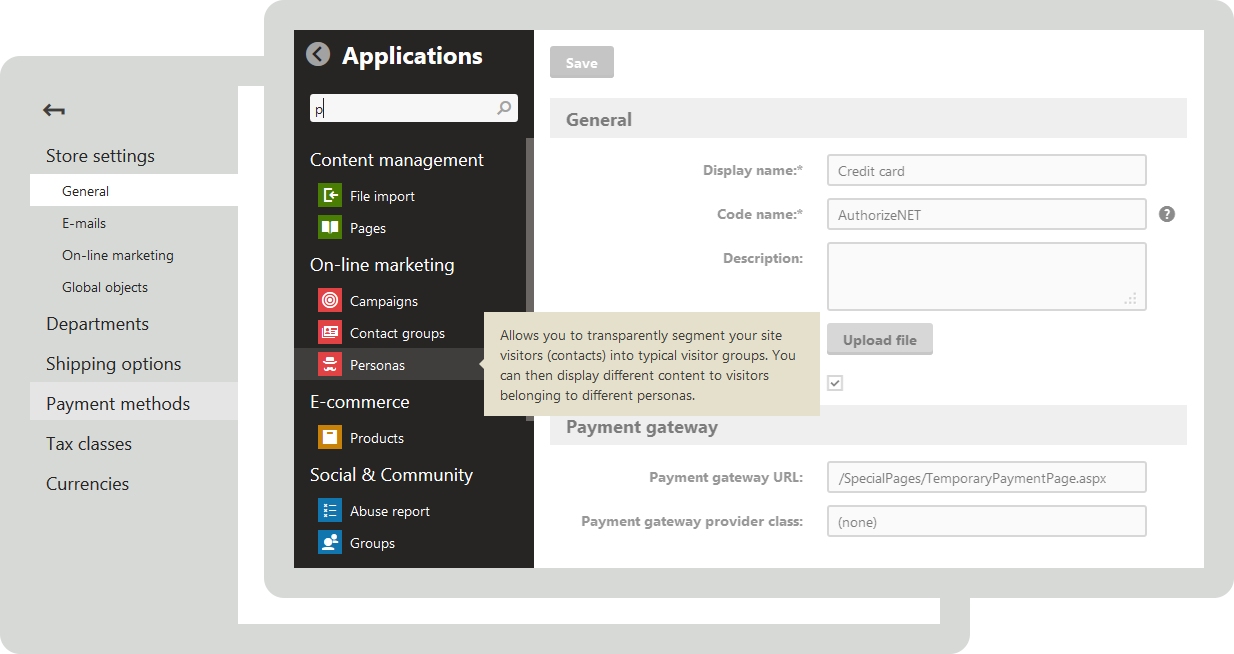
I love the intuitive top and left navigation within the content management platform. I can easily find what section, sub-section, and page I'm looking to edit
For creating content, the WYSIWYG editor is so intuitive; it feels like you're working on an MS Word doc!
The tab for adding metadata in simple fields takes away the headache of having to hunt and peck through code to add H1 tag, page description etc.
A de minimis incentive was given to thank the reviewer for their time. The incentive was not used to bias or drive a particular response, nor was the incentive contingent on a positive endorsement. More Info
Security and new release notifications are a hassle as they happen too often
Allowing them to write PHP modules is a big advantage, but sometimes integrating them is a small challenge due to the version the developer is working on.
A de minimis incentive was given to thank the reviewer for their time. The incentive was not used to bias or drive a particular response, nor was the incentive contingent on a positive endorsement. More Info
Kentico needs to invest in more enterprise class environment management utilities -- example: global CDN support via the CMS is sorely lacking. There are work-arounds, but it should be more elegant.
The Kentico staging module could be improved to support the concept of bundled releases. Current staging module functionality is good, but could be improved.
Kentico ecommerce support is a touch immature. While content management is superb, Kentico lags in this area when compared to many open source ecommerce engines.
Kentico is lacking MVC support. 99% of the time this isn't an issue for the end-user or business user, but can be a hurdle for technology teams depending on the team's makeup.
A de minimis incentive was given to thank the reviewer for their time. The incentive was not used to bias or drive a particular response, nor was the incentive contingent on a positive endorsement. More Info
The time and money invested into this platform were too great to discontinue it at this point. I'm sure it will be in use for a while. We have also spent time training many employees how to use it. All of these things add up to quite an investment in the product. Lastly, it basically fulfills what we need our intranet site to do.
We are locked into Kentico for the long haul. It provides us with an easy and flexible solution for a very non technical company to create a site and have the features they want, especially with the inclusion of EMS into our license. Now we have a true platform to build and grow our solutions.
As a team, we found Drupal to be highly customizable and flexible, allowing our development team to go to great lengths to develop desired functionalities. It can be used as a solution for all types of web projects. It comes with a robust admin interface that provides greater flexibility once the user gets acquainted with the system.
A de minimis incentive was given to thank the reviewer for their time. The incentive was not used to bias or drive a particular response, nor was the incentive contingent on a positive endorsement. More Info
It seriously is one of the best interfaces I have ever used. I also love the fact that I can use UI personalization to secure any functionality by user or role that I don't want that role to have access to. The best part is the customization of the UI, I can add in any button, tab, or menu item I want through it, no code required.
A de minimis incentive was given to thank the reviewer for their time. The incentive was not used to bias or drive a particular response, nor was the incentive contingent on a positive endorsement. More Info
Drupal itself does not tend to have bugs that cause sporadic outages. When deployed on a well-configured LAMP stack, deployment and maintenance problems are minimal, and in general no exotic tuning or configuration is required. For highest uptime, putting a caching proxy like Varnish in front of Drupal (or a CDN that supports dynamic applications).
Drupal page loads can be slow, as a great many database calls may be required to generate a page. It is highly recommended to use caching systems, both built-in and external to lessen such database loads and improve performance. I haven't had any problems with behind-the-scenes integrations with external systems.
A de minimis incentive was given to thank the reviewer for their time. The incentive was not used to bias or drive a particular response, nor was the incentive contingent on a positive endorsement. More Info
As noted earlier, the support of the community can be rather variable, with some modules attracting more attraction and action in their issue queues, but overall, the development community for Drupal is second to none. It probably the single greatest aspect of being involved in this open-source project.
A de minimis incentive was given to thank the reviewer for their time. The incentive was not used to bias or drive a particular response, nor was the incentive contingent on a positive endorsement. More Info
Their support staff is friendly, knowledgeable, and will work with you until your issue is fixed. This could take a few phone calls back and forth, but they are very diligent in helping you.
A de minimis incentive was given to thank the reviewer for their time. The incentive was not used to bias or drive a particular response, nor was the incentive contingent on a positive endorsement. More Info
I was part of the team that conducted the training. Our training was fine, but we could have been better informed on Drupal before we started providing it. If we did not have answers to tough questions, we had more technical staff we could consult with. We did provide hands-on practice time for the learners, which I would always recommend. That is where the best learning occurred.
The on-line training was not as ideal as the face-to-face training. It was done remotely and only allowed for the trainers to present information to the learners and demonstrate the platform online. There was not a good way to allow for the learners to practice, ask questions and have them answered all in the same session.
Plan ahead as much you can. You really need to know how to build what you want with the modules available to you, or that you might need to code yourself, in order to make the best use of Drupal. I recommend you analyze the most technically difficult workflows and other aspects of your implementation, and try building some test versions of those first. Get feedback from stakeholders early and often, because you can easily find yourself in a situation where your implementation does 90% of what you want, but, due to something you didn't plan for, foresee, or know about, there's no feasible way to get past the last 10%
A de minimis incentive was given to thank the reviewer for their time. The incentive was not used to bias or drive a particular response, nor was the incentive contingent on a positive endorsement. More Info
Drupal can be more complex to learn, but it offers a much wider range of applications. Drupal’s front and backend can be customized from design to functionality to allow for a wide range of uses. If someone wants to create something more complex than a simple site or blog, Drupal can be an amazing asset to have at hand.
A de minimis incentive was given to thank the reviewer for their time. The incentive was not used to bias or drive a particular response, nor was the incentive contingent on a positive endorsement. More Info
I've used Sitecore, Ektron, Joomla!, WordPress, and SharePoint (if you want to count that as a competitor for CMS). Kentico 8 blows them all out of the water. Nothing is more intuitive in the way that content is created, the way the site is setup, and how efficient rollouts can be with Content Staging.
A de minimis incentive was given to thank the reviewer for their time. The incentive was not used to bias or drive a particular response, nor was the incentive contingent on a positive endorsement. More Info
Drupal is well known to be scalable, although it requires solid knowledge of MySQL best practices, caching mechanisms, and other server-level best practices. I have never personally dealt with an especially large site, so I can speak well to the issues associated with Drupal scaling.
A de minimis incentive was given to thank the reviewer for their time. The incentive was not used to bias or drive a particular response, nor was the incentive contingent on a positive endorsement. More Info
Kentico has enabled faster speed to market for SMEs. They are empowered to enter content them selves while still having that content go through editorial review to ensure tone of voice and brand are maintained.
Deploying Kentico has freed up web developer resources from manual content entry enabling them to build more useful solutions to support the business efforts
Tapping into the Kentico event pipelne allows us to trigger external system events when product content is published.