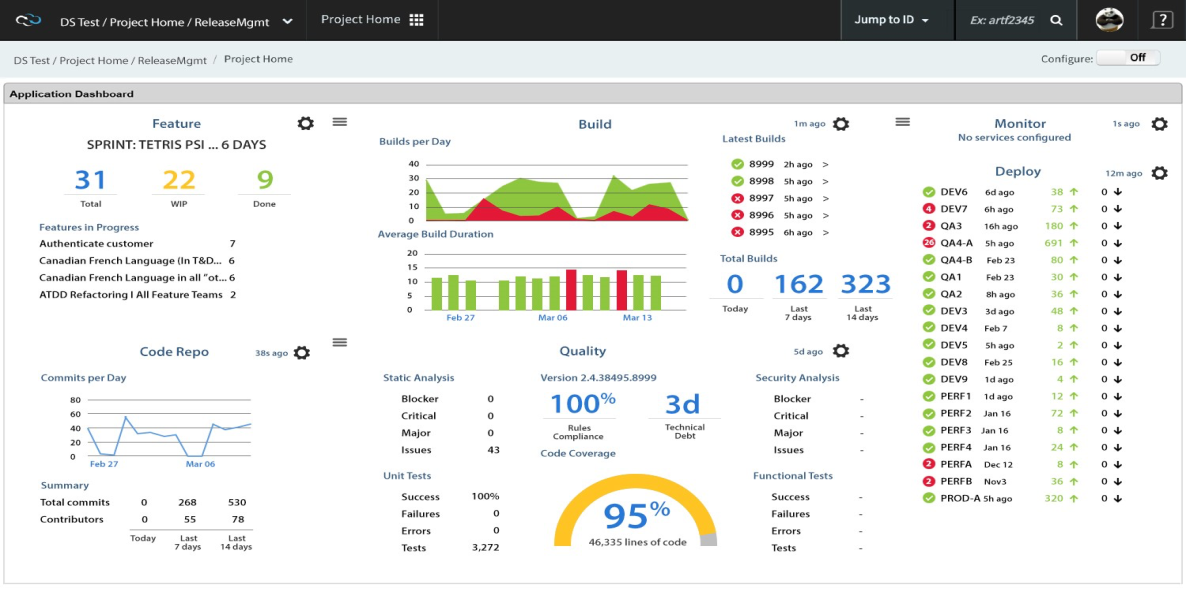
Digital.ai (formerly CollabNet) aims to help enterprises and government organizations deliver high-quality software at speed with TeamForge, its application lifecycle management suite. According to the vendor, Digital.ai offers innovative solutions, provides consulting and Agile training services, supports more than 10,000 customers with 6 million users in 100 countries, and has been recognized for 13 consecutive years as SD Times 100 “Best in Show” winner in the…
N/A
IBM Engineering Lifecycle Management
Score7 out of 10
N/A
IBM Engineering Lifecycle Management (ELM) is an end-to-end engineering solution used to manage system requirements to design, workflow, and test management, extending the functionality of ALM tools for better complex-systems development.
N/A
Pricing
Digital.ai TeamForge
IBM Engineering Lifecycle Management
Editions & Modules
No answers on this topic
No answers on this topic
Offerings
Pricing Offerings
Digital.ai TeamForge
IBM Engineering Lifecycle Management
Free Trial
Yes
No
Free/Freemium Version
No
No
Premium Consulting/Integration Services
Yes
No
Entry-level Setup Fee
No setup fee
No setup fee
Additional Details
—
—
More Pricing Information
Community Pulse
Digital.ai TeamForge
IBM Engineering Lifecycle Management
Considered Both Products
Digital.ai (formerly XebiaLabs, CollabNet VersionOne, and Arxan)
Digital.ai (formerly XebiaLabs, CollabNet VersionOne, and Arxan)
CollabNet TeamForge is more well-suited for technically knowledgeable users such as developers, systems analysts, QA but not for non-technical users due to the technical data used throughout the tool. CollabNet TeamForge is appropriate for most applications development. In any industry especially suited for high demand software delivery environments.
A de minimis incentive was given to thank the reviewer for their time. The incentive was not used to bias or drive a particular response, nor was the incentive contingent on a positive endorsement. More Info
IBM Engineering Requirements Management DOORS former IBM Rational DOORS profits very much from the mighty market position it had till today. It had been the most favored requirement engineering tools suite with the highest investments in the infrastructure concerning hardware, software, and knowledge sources. It was embedded in knowledge sources of test stands, hardware labs, and knowledge database servers. It allowed for some of the highest profit changes and made the fame with it. But the paradigms of requirements engineering change. If not were superseded by completely different approaches for the target solution worlds. The foremost position in the selling tables is unstable if changes are not solved or coped with by the strategist at IBM and their customers. Since the highly successful alternative suits are already at the market, and some are from IBM already the lifecycle for IBM Engineering Requirements Management DOORS is at the later highs. But the suite is still at the very top and very popular. There are still many problems unsolved and many wishes at the customers to make the use more comfortable and efficient at the overall level. If the time of setting up the software package is passed the adoption get more extended and complicated. There is a lot of work at the stage around and the expertise will be required for a long time from now.
A de minimis incentive was given to thank the reviewer for their time. The incentive was not used to bias or drive a particular response, nor was the incentive contingent on a positive endorsement. More Info
A de minimis incentive was given to thank the reviewer for their time. The incentive was not used to bias or drive a particular response, nor was the incentive contingent on a positive endorsement. More Info
Easy to use with well defined template and user defined fields. New team can setup a project area easily by copying an existing template and adding customized fields for their special needs.
It can be used during almost the whole project cycle and give us a better view and control on the projects.
A de minimis incentive was given to thank the reviewer for their time. The incentive was not used to bias or drive a particular response, nor was the incentive contingent on a positive endorsement. More Info
Digital.ai (formerly XebiaLabs, CollabNet VersionOne, and Arxan)
I would like to see personalization for managing artifacts, that is, allowing the user to customize pages and save personalized settings and then save them as bookmarks.
I would like an improved subversion browser such as a graphical user interface rather than a basic file explorer.
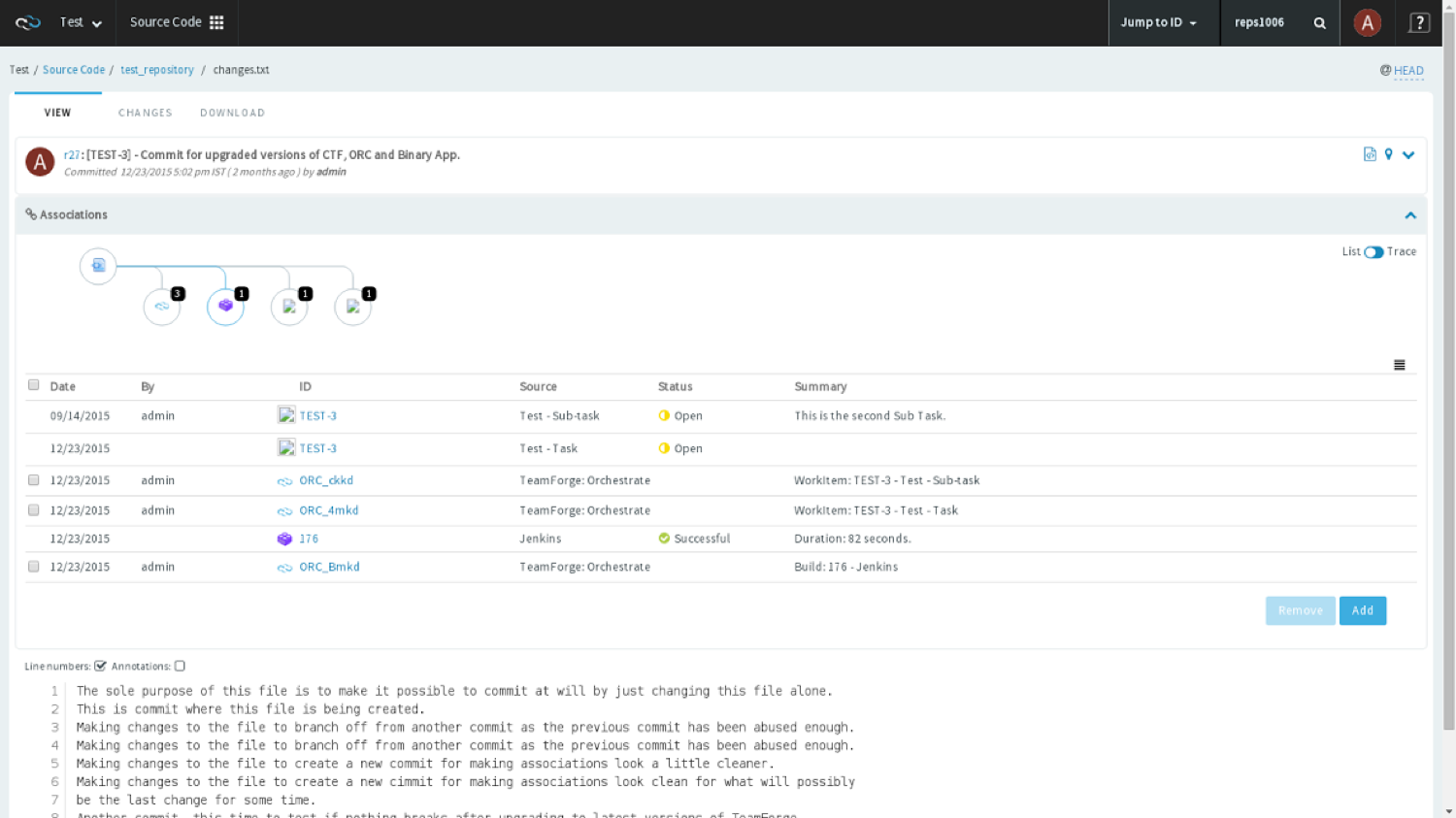
I would like built in features for CollabNet TeamForge integrated with subversion so that i can associate my private code branches and code changes.
A de minimis incentive was given to thank the reviewer for their time. The incentive was not used to bias or drive a particular response, nor was the incentive contingent on a positive endorsement. More Info
Wireframes are quite basic. If you need intuitive and interactive wireframes to elaborate the requirements. you probably need to define outside the tool and then upload as image.
ER (define data dictionaries) modeling is not there.
Use case modeling is quite basic. You can visualize the use case and actors relation but the tool does not enforce the rules.
A de minimis incentive was given to thank the reviewer for their time. The incentive was not used to bias or drive a particular response, nor was the incentive contingent on a positive endorsement. More Info
Digital.ai (formerly XebiaLabs, CollabNet VersionOne, and Arxan)
No answers on this topic
IBM
At the moment we are required by contract to continue to use the IBM DOORS software for our current client. Given that it can be expensive, if we were to use it after our current client's needs were met, we would have to secure other projects in order to justify the continued use of the software.
A de minimis incentive was given to thank the reviewer for their time. The incentive was not used to bias or drive a particular response, nor was the incentive contingent on a positive endorsement. More Info
Digital.ai (formerly XebiaLabs, CollabNet VersionOne, and Arxan)
No answers on this topic
IBM
The UI is terrible and not intuitive. Users need training in order to complete tasks. Much like SAP, it's not the clearest tool. The tracing feature is especially complicated because you must write the scripts yourself. There is a learning curve. Also, even the setup, installation, and logging in each time takes a considerable amount of time.
A de minimis incentive was given to thank the reviewer for their time. The incentive was not used to bias or drive a particular response, nor was the incentive contingent on a positive endorsement. More Info
Digital.ai (formerly XebiaLabs, CollabNet VersionOne, and Arxan)
They always answer the phone when we put a call in, any time. They have consistently sent out contractors when needed and were there every step of the way when we switched over from ClearCase to TeamForge years ago. The support is what you really pay for when you buy into TeamForge.
A de minimis incentive was given to thank the reviewer for their time. The incentive was not used to bias or drive a particular response, nor was the incentive contingent on a positive endorsement. More Info
It does a basic job and has the potential to complete some robust reporting tasks, however, it really is a clunky piece of software with a terrible user interface that makes using it routinely quite unpleasant. Many of our legacy and maintenance projects still use DOORS but our department and company use many alternatives and are looking for better tools.
A de minimis incentive was given to thank the reviewer for their time. The incentive was not used to bias or drive a particular response, nor was the incentive contingent on a positive endorsement. More Info
A de minimis incentive was given to thank the reviewer for their time. The incentive was not used to bias or drive a particular response, nor was the incentive contingent on a positive endorsement. More Info
Digital.ai (formerly XebiaLabs, CollabNet VersionOne, and Arxan)
CollabNet TeamForge is superior to Mercury mainly because it has a subversion change management tool integrated with the product. CollabNet TeamForge offers more complexity but with more flexibility for managing and tracking projects. I think CollabNet TeamForge is more comprehensive than either Mercury and JIRA. They're all user friendly tools with short learning curves but CollabNet TeamForge is most efficient in my experience. JIRA was recently adopted for particular applications and is currently being evaluated by various technology teams.
A de minimis incentive was given to thank the reviewer for their time. The incentive was not used to bias or drive a particular response, nor was the incentive contingent on a positive endorsement. More Info
It was easier to do all the change management-related activities, even configurations were handled very effectively. New process definitions and initiatives made it easier for better project deliverables. Effective resource allocations and better reporting and defect management. The overall cost of the tool is great too and well within budget.
A de minimis incentive was given to thank the reviewer for their time. The incentive was not used to bias or drive a particular response, nor was the incentive contingent on a positive endorsement. More Info
A de minimis incentive was given to thank the reviewer for their time. The incentive was not used to bias or drive a particular response, nor was the incentive contingent on a positive endorsement. More Info
A de minimis incentive was given to thank the reviewer for their time. The incentive was not used to bias or drive a particular response, nor was the incentive contingent on a positive endorsement. More Info