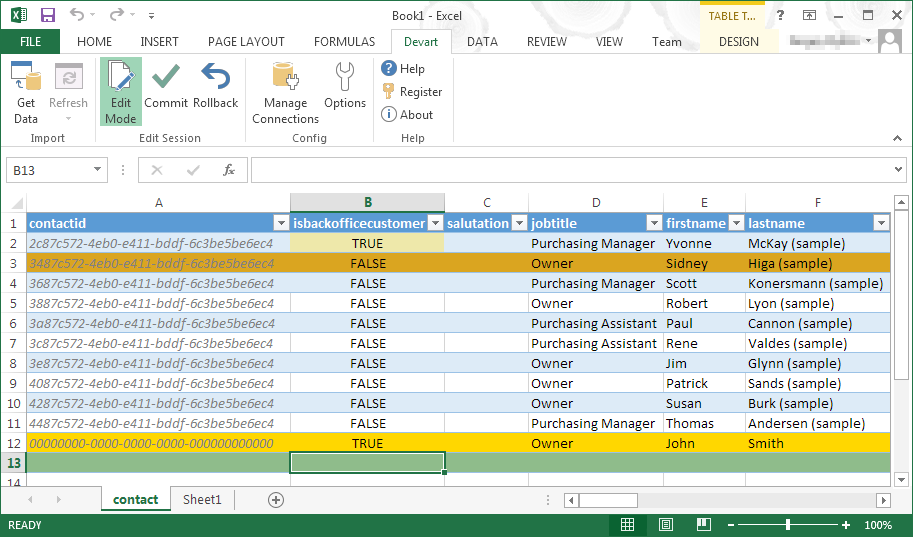
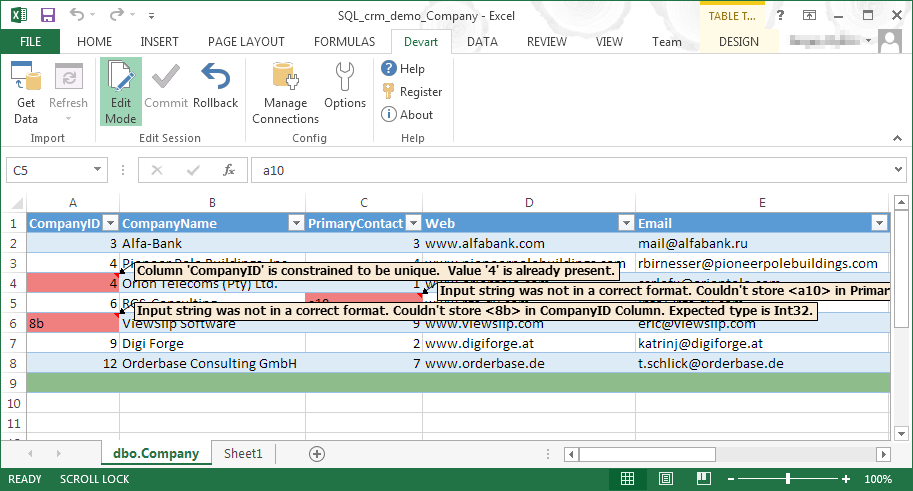
Devart Excel Add-ins allow you to use Excel capabilities to import, process, and analyze data from cloud applications and relational databases. The Excel Add-ins also allow users to make data changes and then save those changes back to the data source they were originally imported from.
$399.95
one-time fee
Informatica Intelligent Data Management Cloud
Score7 out of 10
N/A
The Informatica® Intelligent Data Management Cloud™ (IDMC) is designed to help businesses efficiently handle the complex challenges of dispersed and fragmented data to innovate with their data on virtually any platform, any cloud, multi-cloud and multi-hybrid.
N/A
Pricing
Devart Excel Add-ins
Informatica Intelligent Data Management Cloud
Editions & Modules
Excel Add-in Database Pack
$399.95
one-time fee
Excel Add-in Cloud Pack
$499.95
one-time fee
Excel Add-in Universal Pack
$599.95
one-time fee
No answers on this topic
Offerings
Pricing Offerings
Devart Excel Add-ins
Informatica Intelligent Data Management Cloud
Free Trial
Yes
No
Free/Freemium Version
No
No
Premium Consulting/Integration Services
No
No
Entry-level Setup Fee
No setup fee
No setup fee
Additional Details
Purchases include a perpetual license and 1 year of subscription which includes the product updates and premium support.
Devart Excel Add-ins is really good for data comparison of one database table against another database table. There are plenty of times where the business users need help understanding with their Power BI data models are not connecting correctly and I use this tool to break down the differences between the tables they are trying to connect.
A de minimis incentive was given to thank the reviewer for their time. The incentive was not used to bias or drive a particular response, nor was the incentive contingent on a positive endorsement. More Info
Informatica Cloud is a great tool for use when data must be formatted consistently. Once configured, it is very robust and reliable. It is also well-suited for an organization without a robust IT staff to maintain a full server infrastructure. It offers a cost-effective approach to high-quality data integration for even the largest organizations. Organizations without staff experienced in data analytics may find it challenging to take advantage of the more complex results of this tool.
A de minimis incentive was given to thank the reviewer for their time. The incentive was not used to bias or drive a particular response, nor was the incentive contingent on a positive endorsement. More Info
A de minimis incentive was given to thank the reviewer for their time. The incentive was not used to bias or drive a particular response, nor was the incentive contingent on a positive endorsement. More Info
Once the secure connection is established it’s quite easy to operate and create new jobs. The controls are simple, and we appreciate the fact there are not a lot of complex fine-tunings required. Navigation is also easy, and we enjoy the ability to open multiple tabs in the browser to work on multiple projects.
The monitoring functionality works well to help track the progress of the jobs, again, without too much complication. In a fast dev environment, speed is essential and we quickly seeing the status/progress of jobs as well as any errors if the jobs fail helps us maintain speed.
The web interface is a lot easier to interact with than the client/on-prem version. Putting much of the heavy lifting of interacting with the tool onto the shoulders of the browser makes it easier to keep multiple sessions open and get in/out quickly without having to VPN into the office.
A de minimis incentive was given to thank the reviewer for their time. The incentive was not used to bias or drive a particular response, nor was the incentive contingent on a positive endorsement. More Info
A de minimis incentive was given to thank the reviewer for their time. The incentive was not used to bias or drive a particular response, nor was the incentive contingent on a positive endorsement. More Info
A de minimis incentive was given to thank the reviewer for their time. The incentive was not used to bias or drive a particular response, nor was the incentive contingent on a positive endorsement. More Info
I've never had trouble getting into contact with Informatica's support for technical help. I give it a nine because it does pretty well for mid to enterprise-scale workflows.
A de minimis incentive was given to thank the reviewer for their time. The incentive was not used to bias or drive a particular response, nor was the incentive contingent on a positive endorsement. More Info
Devart Excel stacks up very well against its alternatives. It has significant advantages as it keeps getting an update. Features are very much suitable for smaller organizations. For larger organizations the features cannot be used directly because of the size of the company and more native requirements of IT software requirements.
A de minimis incentive was given to thank the reviewer for their time. The incentive was not used to bias or drive a particular response, nor was the incentive contingent on a positive endorsement. More Info
First, the wizard is easy to use making the learning curve for simple ETL tasks nice. Second, since Informatica is mature there are a good variety of connectors available. Finally, we have driven some fairly complex ETL solutions using only the cloud.
A de minimis incentive was given to thank the reviewer for their time. The incentive was not used to bias or drive a particular response, nor was the incentive contingent on a positive endorsement. More Info
A de minimis incentive was given to thank the reviewer for their time. The incentive was not used to bias or drive a particular response, nor was the incentive contingent on a positive endorsement. More Info
A de minimis incentive was given to thank the reviewer for their time. The incentive was not used to bias or drive a particular response, nor was the incentive contingent on a positive endorsement. More Info