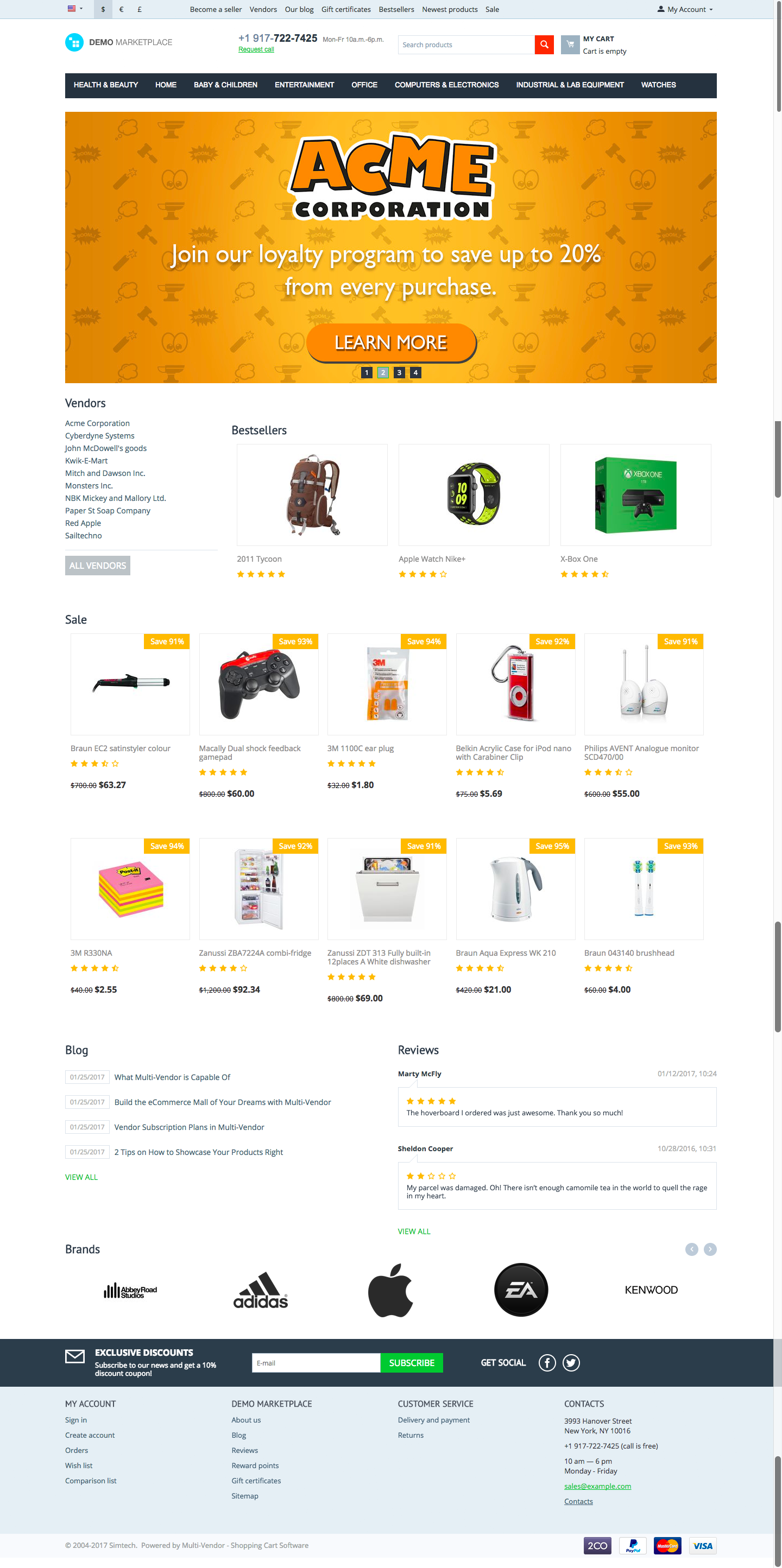
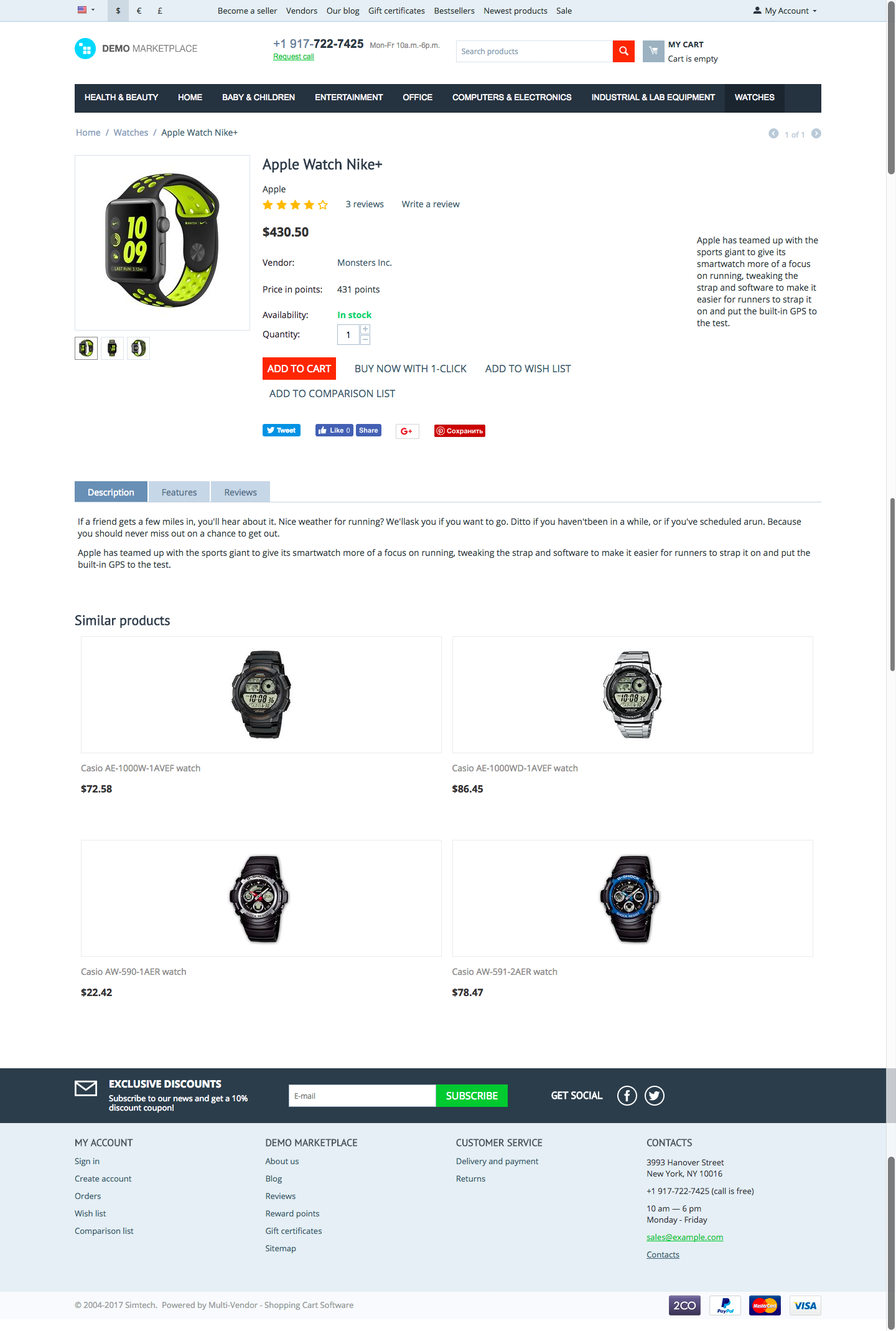
CS-Cart Multi-Vendor is an eCommerce marketplace software for SMBs available in cloud (No-Code) and self-hosted (On-Premises) versions. It allows users to open an online marketplace, where the user is the admin, and all the others—invited sellers. Each seller has his or her own micro-store with a customizable storefront, categories, filters, and search. Just like in Amazon. In the CS-Cart Multi-Vendor marketplace platform, managing vendors is designed to be simple:…
$660
per year
Red Hat OpenShift
Score 9.3 out of 10
N/A
OpenShift is Red Hat's Cloud Computing Platform as a Service (PaaS) offering. OpenShift is an application platform in the cloud where application developers and teams can build, test, deploy, and run their applications.
N/A
Pricing
CS-Cart Multi-Vendor
Red Hat OpenShift
Editions & Modules
Standard
$660
per year
Plus
$1,320
per year
Ultimate
$3,300
per year
Unlimited
Contact Sales
one-time fee
No answers on this topic
Offerings
Pricing Offerings
CS-Cart Multi-Vendor
Red Hat OpenShift
Free Trial
Yes
Yes
Free/Freemium Version
No
Yes
Premium Consulting/Integration Services
No
No
Entry-level Setup Fee
Optional
No setup fee
Additional Details
—
—
More Pricing Information
Community Pulse
CS-Cart Multi-Vendor
Red Hat OpenShift
Features
CS-Cart Multi-Vendor
Red Hat OpenShift
Online Storefront
Comparison of Online Storefront features of Product A and Product B
CS-Cart Multi-Vendor
8.6
Ratings
9% above category average
Red Hat OpenShift
-
Ratings
Product catalog & listings
8.80 Ratings
00 Ratings
Product management
8.90 Ratings
00 Ratings
Bulk product upload
8.30 Ratings
00 Ratings
Branding
8.70 Ratings
00 Ratings
Mobile storefront
8.00 Ratings
00 Ratings
Product variations
8.50 Ratings
00 Ratings
Website integration
8.60 Ratings
00 Ratings
Visual customization
8.70 Ratings
00 Ratings
CMS
8.80 Ratings
00 Ratings
Online Shopping Cart
Comparison of Online Shopping Cart features of Product A and Product B
CS-Cart Multi-Vendor
8.4
Ratings
9% above category average
Red Hat OpenShift
-
Ratings
Abandoned cart recovery
8.20 Ratings
00 Ratings
Checkout user experience
8.50 Ratings
00 Ratings
Online Payment System
Comparison of Online Payment System features of Product A and Product B
CS-Cart Multi-Vendor
8.9
Ratings
7% above category average
Red Hat OpenShift
-
Ratings
eCommerce security
8.90 Ratings
00 Ratings
eCommerce Marketing
Comparison of eCommerce Marketing features of Product A and Product B
CS-Cart Multi-Vendor
8.4
Ratings
9% above category average
Red Hat OpenShift
-
Ratings
Promotions & discounts
8.80 Ratings
00 Ratings
Personalized recommendations
8.00 Ratings
00 Ratings
SEO
8.40 Ratings
00 Ratings
eCommerce Business Management
Comparison of eCommerce Business Management features of Product A and Product B
CS-Cart Multi-Vendor
8.0
Ratings
0% below category average
Red Hat OpenShift
-
Ratings
Multi-site management
8.70 Ratings
00 Ratings
Order processing
8.50 Ratings
00 Ratings
Inventory management
6.50 Ratings
00 Ratings
Shipping
7.30 Ratings
00 Ratings
Custom functionality
8.90 Ratings
00 Ratings
Platform-as-a-Service
Comparison of Platform-as-a-Service features of Product A and Product B
Great for a quick and easy setup of a multi-vendor solution, supporting multiple stores / languages / payment options. Will probably need some tuning if you have 1 million products or so. Great if you have a PHP dev or team, probably not the best option if you don't know the language and need to customise backend logic.
Red Hat OpenShift, despite its complexity and overhead, remains the most complete and enterprise-ready Kubernetes platform available. It excels in research projects like ours, where we need robust CI/CD, GPU scheduling, and tight integration with tools like Jupyter, OpenDataHub, and Quiskit. Its security, scalability, and operator ecosystem make it ideal for experimental and production-grade AI workloads. However, for simpler general hosting tasks—such as serving static websites or lightweight backend services—we find traditional VMs, Docker, or LXD more practical and resource-efficient. Red Hat OpenShift shines in complex, container-native workflows, but can be overkill for basic infrastructure needs.
One thing is the way how it works with the GitHubs model on an enterprise business, how the hub and spoke topology works. Hub cluster topology works the way how there is a governance model to enforce policies. The R back models, the Red Hat OpenShift virtualization that supports the cube board and developer workspace is one big feature within. So yes, these are all some features I would call out.
So I don't know that this is a specific disadvantage for Red Hat OpenShift. It's a challenge for anything that Kubernetes face is. There's an extremely large learning curve associated with it and once you get to the point where you're comfortable with it, it's really not bad. But beating that learning curve is a challenge. I've done a couple presentations on our implementation of Red Hat OpenShift at various conferences and one of the slides I always have in there is a tweet from years ago that said, "I tried to teach somebody Kubernetes once. Now neither of us knows what it is."
This is the current strategy for the company, most of the products in the organisation are aligning to Openshift and various use cases it support. Also lot of applications are being developed for AI use case, openshift.AI provides opportunity to host and leverage the AI capabilities for these applications
The software consists of most of all e-commerce related features. Also, there are plenty of third party addons are available in the market which can improve our business. There are a lot of powerful themes available in the cs cart market which improve the look and feel on the front store. If CS-cart adjusted the price on their software license cost, controlling the third party addon cost and provide more freelancers with cheaper hourly rate for the customization on the cs-cart multi vendor software, the cs-cart company can be a master among other e-commerce software companies in the world.
The virtualization part takes some getting used to it you are coming from a more traditional hypervisor. Customization options are not intuitive to these users. The process should be more clear. Perhaps a guide to Openshift Virtualization for users of RHV, VMware, etc. would ease this transition into the new platform
Redhat openshift is generally reliable and available platform, it ensures high availability for most the situations. in fact the product where we put openshift in a box, we ensure that the availability is also happening at node and network level and also at storage level, so some of the factors that are outside of Openshift realm are also working in HA manner.
Overall, this platform is beneficial. The only downsides we have encountered have been with pods that occasionally hang. This results in resources being dedicated to dead or zombie pods. Over time, these wasted resources occasionally cause us issues, and we have had difficulty monitoring these pods. However, this issue does not overshadow the benefits we get from Openshift.
Every time we need to get support all the Red Hat team move forward looking to solve the problem. Sometimes this was not easy and requires the scalation to product team, and we always get a response. Most of the minor issues were solved with the information from access.redhat.com
I was not involved in the in person training, so i can not answer this question, but the team in my org worked directly with Openshift and able to get the in person training done easily, i did not hear problem or complain in this space, so i hope things happen seamlessly without any issue.
We went thru the training material on RH webesite, i think its very descriptive and the handson lab sesssions are very useful. It would be good to create more short duration videos covering one single aspect of openshift, this wll keep the interest and also it breaks down the complexity to reasonable chunks.
For big vision in doing something in online marketplace, I think CS-Cart can help to scale up and run business smoothly. CS-Cart started their business in 2005 and since [then has been] running successfully worldwide. It means they have a large scale of experience in implementing online marketplace based software and we can rely on them.
We utilized the Thycotic Secret Service to manage all our application secrets, resulting in seamless integration with our applications. We developed all the applications using Red Hat Fuse (currently migrated to Quarkus). We used the built-in Kali Linux support of OpenShift to manage and configure the services and API. Additionally, the Red Hat Developer Studio facilitates faster development.
This is a great platform to deployment container applications designed for multiple use cases. Its reasonably scalable platform, that can host multiple instances of applications, which can seamlessly handle the node and pod failure, if they are configured properly. There should be some scalability best practices guide would be very useful
From an investment point of view, it is naturally much more profitable to purchase CS-Cart Multi-Vendor than to assemble a team of developers and try to create such a platform from scratch.
Creating a marketplace is a rather risky business. If you don't know a lot about marketplace building technologies, consider investing in a different business. But if you have already decided on the idea, and all you have to do is find a suitable platform, then CS-Cart Multi-Vendor will probably be a profitable investment. And if your sales go at least half a year after purchasing this platform, then you will quickly enough recoup these several thousand dollars.
It has allowed us to see where we need to be in the container world. I'm going to call it a net neutral impact, not negative or positive. It has given us a sense of what we are ready for and what we're not ready for. You know where you stand.
You don't know what you don't know, so it helps us know what we want to know.