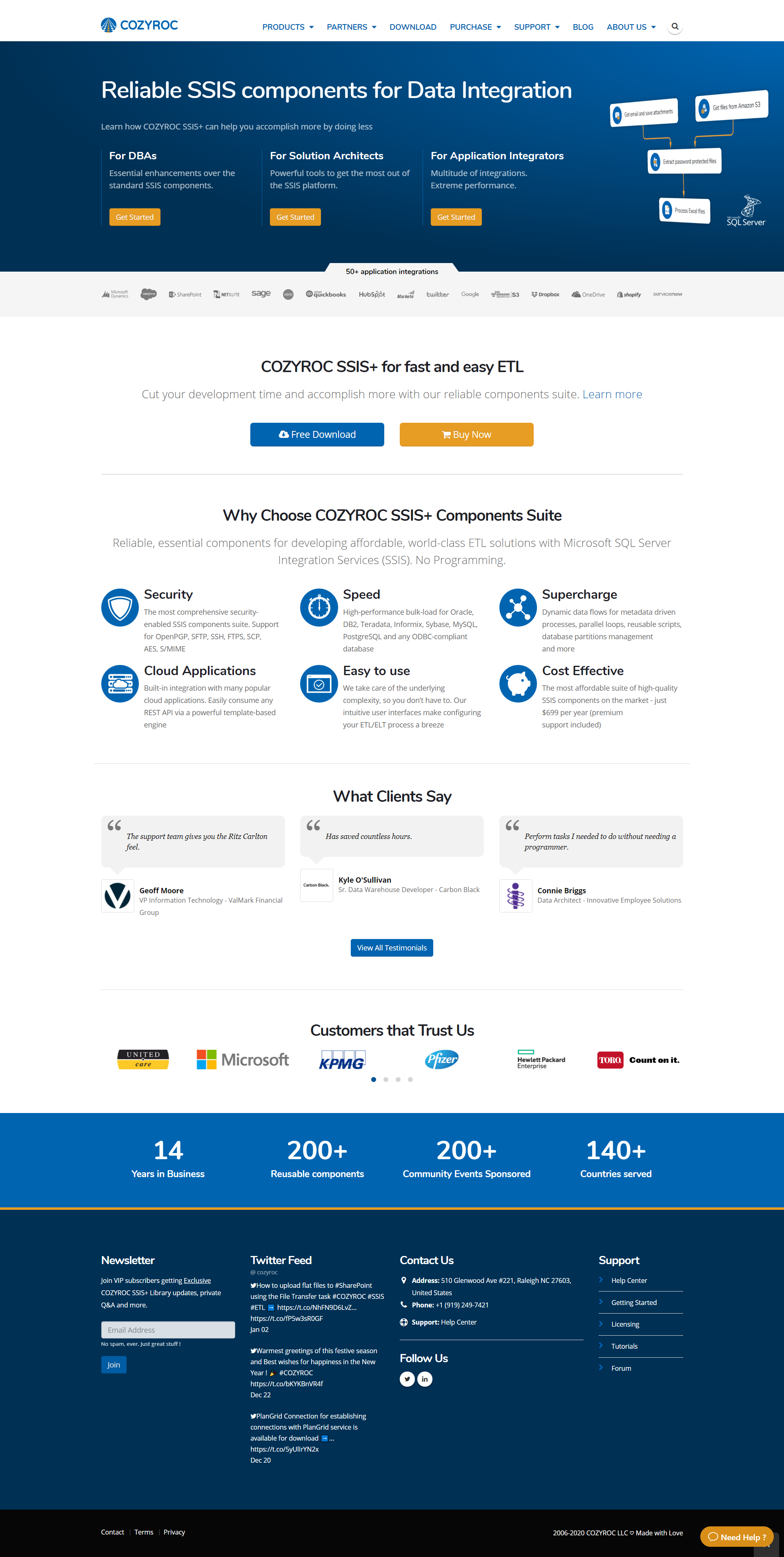
COZYROC SSIS+ is a suite of 240+ advanced components for developing ETL solutions with Microsoft SQL Server Integration Services. The vendor states that COZYROC is an easy-to-use, code-free library of tasks, components and reusable scripts that aim to significantly cut development time and improve the execution speed of SSIS packages. They further provide that COZYROC SSIS+ Components Suite has been successfully used by thousands of businesses in more than 140 countries around the…
$199.95
per year
SSIS
Score 6.5 out of 10
N/A
Microsoft's SQL Server Integration Services (SSIS) is a data integration solution.
N/A
Pricing
COZYROC
SQL Server Integration Services
Editions & Modules
COZYROC Excel Add-in for SAS®
$199.95
per year
COZYROC SSIS+ Premium Priority Support
$499.95
per year
COZYROC SSIS+ Ultimate Subscription
$1,199
per year
COZYROC SAS® SSIS Adapters
$2,499.95
per year
COZYROC SSIS+ 2.1 Lifetime
$7,999
one-time fee
No answers on this topic
Offerings
Pricing Offerings
COZYROC
SSIS
Free Trial
Yes
No
Free/Freemium Version
Yes
No
Premium Consulting/Integration Services
No
No
Entry-level Setup Fee
No setup fee
No setup fee
Additional Details
COZYROC SSIS+ Ultimate Subscription - $999 /per year
2 license keys (for two servers)
* Free upgrades to newer versions
* Free to use in Visual Studio
* Premium support
(Priority over regular free support.
Guaranteed one business day response time.)
—
More Pricing Information
Community Pulse
COZYROC
SQL Server Integration Services
Features
COZYROC
SQL Server Integration Services
Data Source Connection
Comparison of Data Source Connection features of Product A and Product B
COZYROC
1.5
Ratings
139% below category average
SQL Server Integration Services
7.5
Ratings
11% below category average
Connect to traditional data sources
1.90 Ratings
8.80 Ratings
Connecto to Big Data and NoSQL
1.00 Ratings
6.20 Ratings
Data Transformations
Comparison of Data Transformations features of Product A and Product B
COZYROC
1.5
Ratings
138% below category average
SQL Server Integration Services
8.1
Ratings
1% below category average
Simple transformations
2.00 Ratings
8.50 Ratings
Complex transformations
1.00 Ratings
7.70 Ratings
Data Modeling
Comparison of Data Modeling features of Product A and Product B
COZYROC
3.5
Ratings
78% below category average
SQL Server Integration Services
7.4
Ratings
8% below category average
Metadata management
1.10 Ratings
7.10 Ratings
Business rules and workflow
1.10 Ratings
8.20 Ratings
Testing and debugging
8.20 Ratings
6.10 Ratings
Data model creation
00 Ratings
8.60 Ratings
Collaboration
00 Ratings
7.30 Ratings
Data Governance
Comparison of Data Governance features of Product A and Product B
COZYROC is great if you have a number of sources or destinations where vanilla SSIS either does not provide connectors, they are difficult to work with, or they are not fully featured. SFTP is a prime example. Almost any web service is another. It also includes some nice helper components, such as script task plus. This speeds up the development of script tasks by making the configuration easier. That said, it is not a silver bullet for all your SSIS woes. I've found that none of the SSIS 3rd party components spans all my needs and generally end up running a couple of different ones to cover all the functionality required.
Ideal for daily standard ETL use cases whether the data is sourced from / transferred to the native connectors (like SQL Server) or FTP. Best if the company uses MS suite of tools. There are better options in the market for chaining tasks where you want a custom flow of executions depending on the outcome of each process or if you want advanced functionality like API connections, etc.
SSIS is responsible for running core business processed managing core business data. It can be managed, improved and expanded using minimal internal resources. It is also able to support all of our current data infrastructure. Replacing SSIS would be time consuming and costly with no apparent ROI.
SSIS has a drag and drop based developer interface, so it is relatively straight forward to get started. You can start to get into the weeds pretty quickly as your solution becomes more complex. However, most of the base functions are right in front of you for a developer. You can also set project and solution level parameters, so when you deploy to new environments, you don't have to jump into each package to change your variables and settings. (For example, default directory to ingest flat files).
Raw performance is great. At times, depending on the machine you are using for development, the IDE can have issues. Deploying projects is very easy and the tool set they give you to monitor jobs out of the box is decent. If you do very much with it you will have to write into your projects performance tracking though.
The support, when necessary, is excellent. But beyond that, it is very rarely necessary because the user community is so large, vibrant and knowledgable, a simple Google query or forum question can answer almost everything you want to know. You can also get prewritten script tasks with a variety of functionality that saves a lot of time.
The implementation may be different in each case, it is important to properly analyze all the existing infrastructure to understand the kind of work needed, the type of software used and the compatibility between these, the features that you want to exploit, to understand what is possible and which ones require integration with third-party tools
I think SQL Server Integration Services is better suited for on-premises data movement and ADF is more suited for the cloud. Though ADF has more connectors, SQL Server Integration Services is more robust and has better functionality just because it has been around much longer
Without this, we would have to manually update a spreadsheet of our SQL Server inventory
We would also have poor alerting; if an instance was down we wouldn't know until it was reported by a user
We only have one other person who uses SQL Server Integration Services , he's the expert. It would fall to me without him and I would not enjoy being responsible for it.