Concrete CMS (formerly Concrete5) is a free and open source, PHP built content management system for content on the web and also for intranets. It is optimized to support the creation of online magazines and newspapers.
N/A
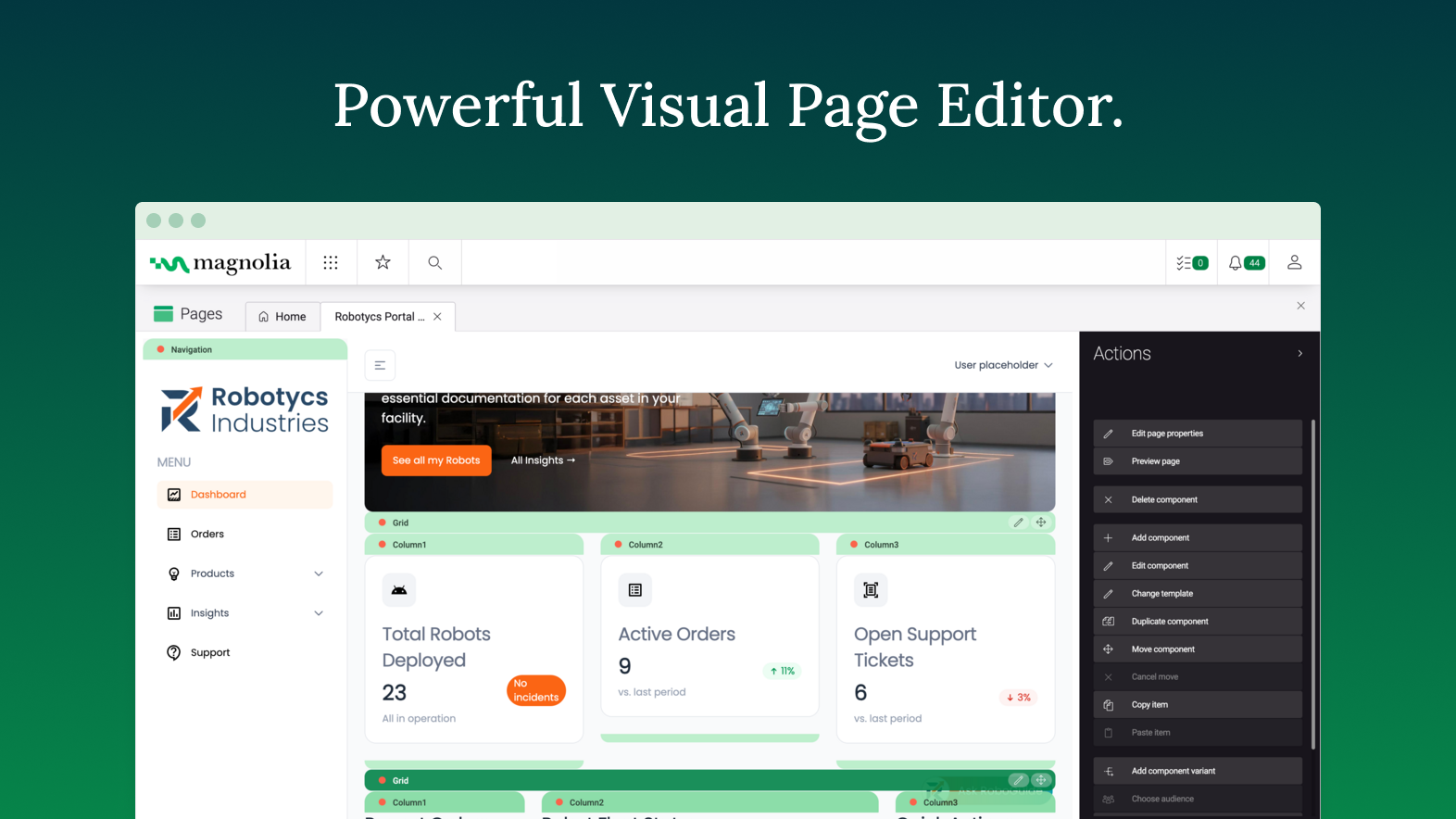
Magnolia
Score8.1 out of 10
Mid-Size Companies (51-1,000 employees)
Founded in Switzerland in 1997, Magnolia is a CMS used to build composable digital experiences. Magnolia helps create fully integrated customer experiences and speeds up digital delivery of content. Magnolia boasts 480 enterprise customers, thousands of Community Edition deployments, and more than 200 certified Magnolia Partners around the world. They further state that their enterprise customers include Sanofi, Generali, the Atlassian, The New York Times, Harley Davidson, and Union…
Suitable if you are part of small to large scale companies or web-houses which have PHP developers and frontend engineers with some budgets. [Also suitable if] you or your client want to build a website that requires some features or uniqueness [and needs] some customization and freedom. Additionally suitable if you want this project to be DevOps based project or if the project requires very tight security and is inside of a closed network.
Magnolia is a very capable DXP, that provides client with lots of flexibility in composing its own stack. While the core of the platform is a content management system, the open architecture of Magnolia DXP allows it to connect to any platform, allowing client to extend the capabilities. One scenario would be a centralized content hub - where through a single platform, content authors can choose which channel to distribute what content. For example, long form content for consumers viewing on a laptop, short form content for those using a mobile browser. This allow the client to personalized the experience based on channels. Another scenarios would be leveraging on GenAI - using Magnolia's built-in connector to ChatGPT. If that is not the service that one desire, you can always connect to another AI service such as Google Gemini. With GenAI, connected, content author can use AI as co-pilot to help them scale up their content production.
As a dev, the Page object (coupled with page attributes, nav menus and page lists) makes structuring a website or web app a dream. The separation of page templates from page types also helps, the former being about layout while the latter is more conceptual.
As an admin, you pretty much have as much control as the developers of the site decide to give you.
The versioning system allows admins to roll changes back and work on changes before publishing them.
The permissions system is exceptionally powerful, allowing roles and/or individual users to be included or excluded from each permission.
The attributes system allows pages, files and users to be given custom properties of various types (e.g. text, image, colour).
A de minimis incentive was given to thank the reviewer for their time. The incentive was not used to bias or drive a particular response, nor was the incentive contingent on a positive endorsement. More Info
Speed of development - time to delivery from zero to MVP was excellent
Ease of use - the authoring experience is very easy to build and train
PAAS/SAAS - the managed service platform removed the traditional overhead of running in-house technologies, meaning we could focus on value add, with less time spent keeping the lights on.
The documentation provides samples that are often out of context, and difficult to know where the provided example code should be implemented. More tutorials providing the full project or step-by-step instructions on how to implement subject material would help greatly. Baeldung is a resource I would consider the gold standard in how this is done in other spaces.
The use of JCR and Nodes makes object serialization/deserialization painful. Jackson compatibility or similar would be a welcome enhancement to the developer experience. Maybe leveraging code-gen from light modules to build model classes when possible could help accomplish this.
Modifying the home layout from light modules is frustrating. It seems that any configuration overrides made merge with the default rather than overwriting, which makes for a difficult combination of guess-and-check while referencing the documentation to see what should be in each row/column when making changes.
Including "mark all as read" or "delete all" in the notifications app would be a great quality of life improvement. It seems that by default, users have to individually select messages and operate them.
A de minimis incentive was given to thank the reviewer for their time. The incentive was not used to bias or drive a particular response, nor was the incentive contingent on a positive endorsement. More Info
Its a very solid, very consistent package that never lets you down or leaves you frustrated. It gets a 10/10 because its so much better than anything else currently available. It also gets a 10/10 because, even if not compared to others, it does not leave you wanting for features or functionality. It is an excellent piece of software that will answer almost every CMS need.
A de minimis incentive was given to thank the reviewer for their time. The incentive was not used to bias or drive a particular response, nor was the incentive contingent on a positive endorsement. More Info
I have used it on over 30 projects in the past 3 years and it's still a pleasure to work in. Doesn't always have all the answers, no CMS does, but I still find it very easy to use from prototyping to working to final project. Also there is no problem working on a localhost then moving to a live site, like there is with WordPress. It's my go to app in my CMS quiver.
A de minimis incentive was given to thank the reviewer for their time. The incentive was not used to bias or drive a particular response, nor was the incentive contingent on a positive endorsement. More Info
We've shown it to a number of users both clients and our own team and despite initial apprehensions, they "get it" very quickly. It's intuitive and friendly and quick to perform daily tasks. We once had a client tell us "Using Magnolia makes me smile" which says it all for us.
A de minimis incentive was given to thank the reviewer for their time. The incentive was not used to bias or drive a particular response, nor was the incentive contingent on a positive endorsement. TR verified that a representative sample of customers was invited. More Info
Since it's not tied to a central server (other than for authorizing updates and assigning licenses to specific sites), it's available pretty much 100% of the time.
A de minimis incentive was given to thank the reviewer for their time. The incentive was not used to bias or drive a particular response, nor was the incentive contingent on a positive endorsement. More Info
The site works extremely well, the front end flies, searches and form submissions are very fast indeed. The reason its a 9 not a ten? the back end can be a little slow at times, and this is unfair, because for the backend to be so amazing, it has to do a huge amount of work!
I gave [it] 7/10 only because of the loading time of pages. Otherwise, I think it deserves an 8. Normally this is not an issue per [se] but considering the rating matrix and as I have been asked to honestly write about it. Yes, the page loading times could be improved.
Concrete5 is open-source and has an incredibly strong, polite, and supportive community. You can get an answer to nearly anything you want to do with Concrete5 by googling for it, searching the Concrete5 discussion forums or stack overflow, or posting your question to the forum. Members are very courteous and do not look down on those with less knowledge. And answers are always quick, informative, and supportive.
A de minimis incentive was given to thank the reviewer for their time. The incentive was not used to bias or drive a particular response, nor was the incentive contingent on a positive endorsement. More Info
You always get an answer based on your SLA. But you always get a solution. That's the successfactor in this case. To often i was frustrated about people in a company without even a clue what there product is about or how to solve a problem. Magnolia's Support Team does a very good job and try to help you in most of the cases
Build off of an existing theme to speed up the creation of custom designed themed. Bootstrap is a good one but there are many others that are probably much simpler to build from than the Bootstrap one was. Make sure you host on a Unix/Linux server so you don't have to install PHP or MySQL separately. It's just smoother on those platforms.
WordPress at the time was riddled with security breaches in the news and while Concrete5 was smaller (and therefore a smaller attack vector), after eleven years of use, Concrete5 has only had one published incident with an add-on that resolved within hours and with excellent communication. You can talk to the CEO and the CTO (or the rest of the team). They are very engaged and you're working with a small company of people who care, not a call-center with people just waiting to go home.
A de minimis incentive was given to thank the reviewer for their time. The incentive was not used to bias or drive a particular response, nor was the incentive contingent on a positive endorsement. More Info
I've used several CMSs like AEM and EpiServer, and comparatively, they all excel at different things. Magnolia is the best to develop for/against. Episerver has the best/most fluid UI in terms of content editing, and the overall admin experience AEM is just all around sucks.
A de minimis incentive was given to thank the reviewer for their time. The incentive was not used to bias or drive a particular response, nor was the incentive contingent on a positive endorsement. More Info
Concrete5 is the customer-facing side of our business. It's where we host the site that potential customers see before they choose to purchase and create an account with us. We are able to keep that site clean, user-friendly, and with a lot of available options for customers to interact with thanks to Concrete5
The ability to have multiple users and admins for the site means that we all members of our team can go in and create new content, fix or troubleshoot issues, and edit the site easily.
Our CRM isn't directly integrated with Concrete5, so when customers go to make a purchase with us, they have to leave our Concrete5 site.
A de minimis incentive was given to thank the reviewer for their time. The incentive was not used to bias or drive a particular response, nor was the incentive contingent on a positive endorsement. More Info
Magnolia has brought about positive impacts. For instance, we need not outsource web design and marketing services because thanks to this software, we can handle most work inhouse
The software is affordable with no compromises on capabilities and therefore it is gives us value for money.
A de minimis incentive was given to thank the reviewer for their time. The incentive was not used to bias or drive a particular response, nor was the incentive contingent on a positive endorsement. More Info