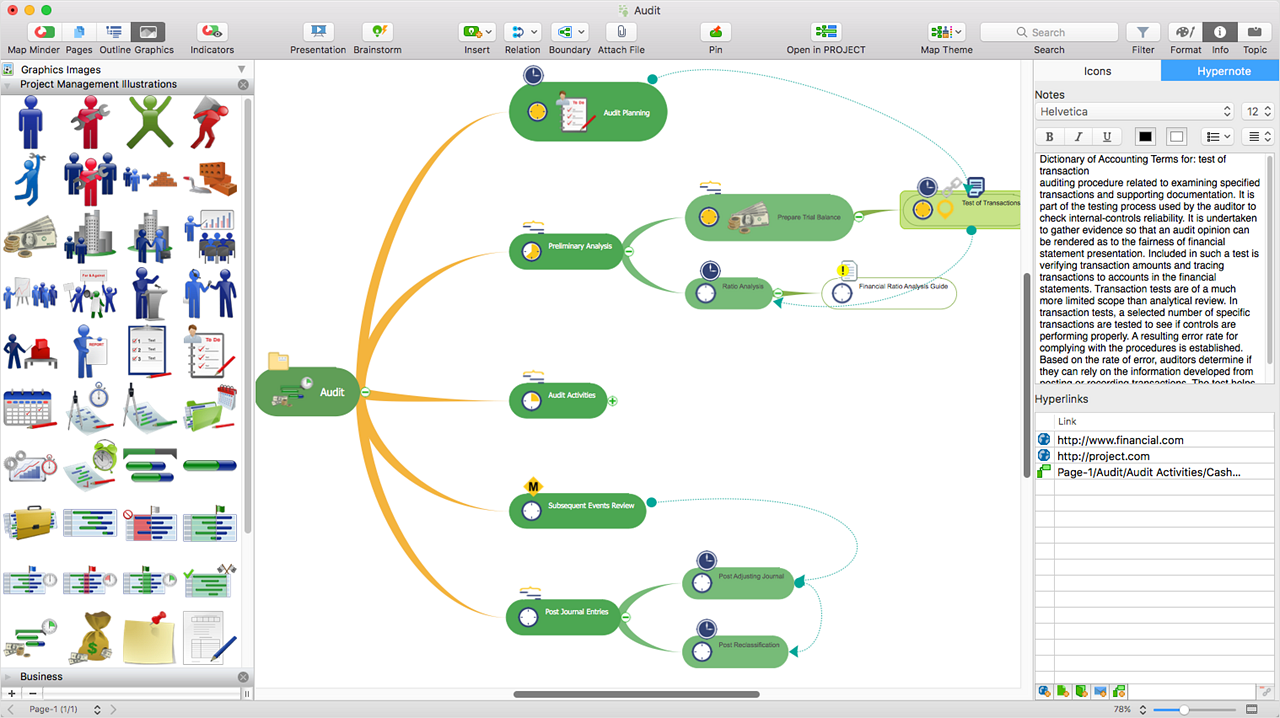
ConceptDraw MINDMAP is l mind mapping software application that can also resolve tasks for project management. According to the vendor, multiple shortcuts help users create new topics, re-arrange
them and highlight important points, and export to various
file formats. Enrich your mind map with in-built visual…
N/A
draw.io
Score 7.3 out of 10
N/A
draw.io is an online diagramming tool with integrations with Jira, Google, and Confluence available free online or at cost depending on integration chosen.
$5
per month
Pricing
ConceptDraw MINDMAP
draw.io
Editions & Modules
No answers on this topic
Up to 10 Users
$5
per month
Up to 20 Users
$11
per month
Up to 50 Users
$27.50
per month
Up to 75 Users
$41.25
per month
Up to 100 Users
$55
per month
Up to 200 Users
$95
per month
Up to 500 Users
$152.50
per month
Up to 750 Users
$190
per month
Up to 1,000 Users
$227.50
per month
Up to 2,000 Users
$377.50
per month
Up to 5,000 Users
$827.50
per month
Up to 10,000
1,577.50
per month
Offerings
Pricing Offerings
ConceptDraw MINDMAP
draw.io
Free Trial
Yes
No
Free/Freemium Version
No
No
Premium Consulting/Integration Services
No
No
Entry-level Setup Fee
$199 per seat
No setup fee
Additional Details
Price varies for Individual, Commercial, Academic, Nonprofit and Government
MINDMAP is very focused on brainstorming and branching hierarchies of ideas and planning. Outside of those uses a more general diagramming software package like ConceptDraw DIAGRAM is a better option.
If you need to create a diagram in the cloud, I haven't found a better tool yet. If you need further customizability or export options not offered, then a larger tool might make more sense, but wherever Draw.io can fit in, I think it's the ideal solution.
One element that was hard to use was converting pre-existing drawings and workflows from Gliffy to Draw.io once our company made the change. While we were able to complete the migration, when going back we noticed, oftentimes, some formatting and dependencies did not make it or were not compatible.
While the template repository is vast, it has a heavy focus on network style maps. It would be ideal for added diversity in the templates with a focus on workflows just as much.
While the integrations are strong, the cloud collaborative environment could still use some work. While you can save and edit in the cloud. Group editing and live dynamic sharing/editing similar to Microsoft office are still missing.
Draw.io could add some version control functionality for ease of rollback, auditing, & comparison.
The sales team is very responsive and willing to help out with questions, however the community of users is not as large as some other products so it can be difficult to find answers to more complex problems
The support for draw.io is pretty decent, considering it is a free website. I had a question one time when I was trying to do something, so I sent an email to their support email and got a response fairly quickly with an answer to my question. They also have some excellent support tools on their support website for helping you get more familiar with their program, and I found that very helpful.
As we were already using PROJECT, it became obvious that ConceptDraw MINDMAP was the product to use. The integration between those two products is very convenient and useful. The fact that ConceptDraw MINDMAP solutions was usable on Mac OS was also a pre requisite for us. We did not use any other Mind Map software.
Draw.io is a free online diagram drawing application for workflow, BPM, org charts, UML, ER, network diagrams. No login or registration are required and features include the ability to save locally (including svg), a range of stencils, .vsdx, Lucidchart and Gliffy import and real time diagram sharing. When I compare draw.io to Lucidchart, it's natural that the first point of comparison will be templates. Lucidchart provides many more templates for both beginners and professionals than draw.io but draw.io has all the essential tools and templates for both business professionals and students (engineering drawing, floor plans, etc). Lucidchart lets you import all the three Microsoft Visio formats — .vdx, .vsd, and .vsdx as well as diagrams from Gliffy, Draw.io, and Omnigraffle. Draw.io lets you import Google Drive, Dropbox, Trello, Gliffy and GitHub. Overall, if you plan to make simple drawings, Draw.io is perhaps the best tool for you. All you need is a Google account to upload and save documents. If you can live with the three documents and sixty objects rule of Lucidchart, you may want to give it a try instead.