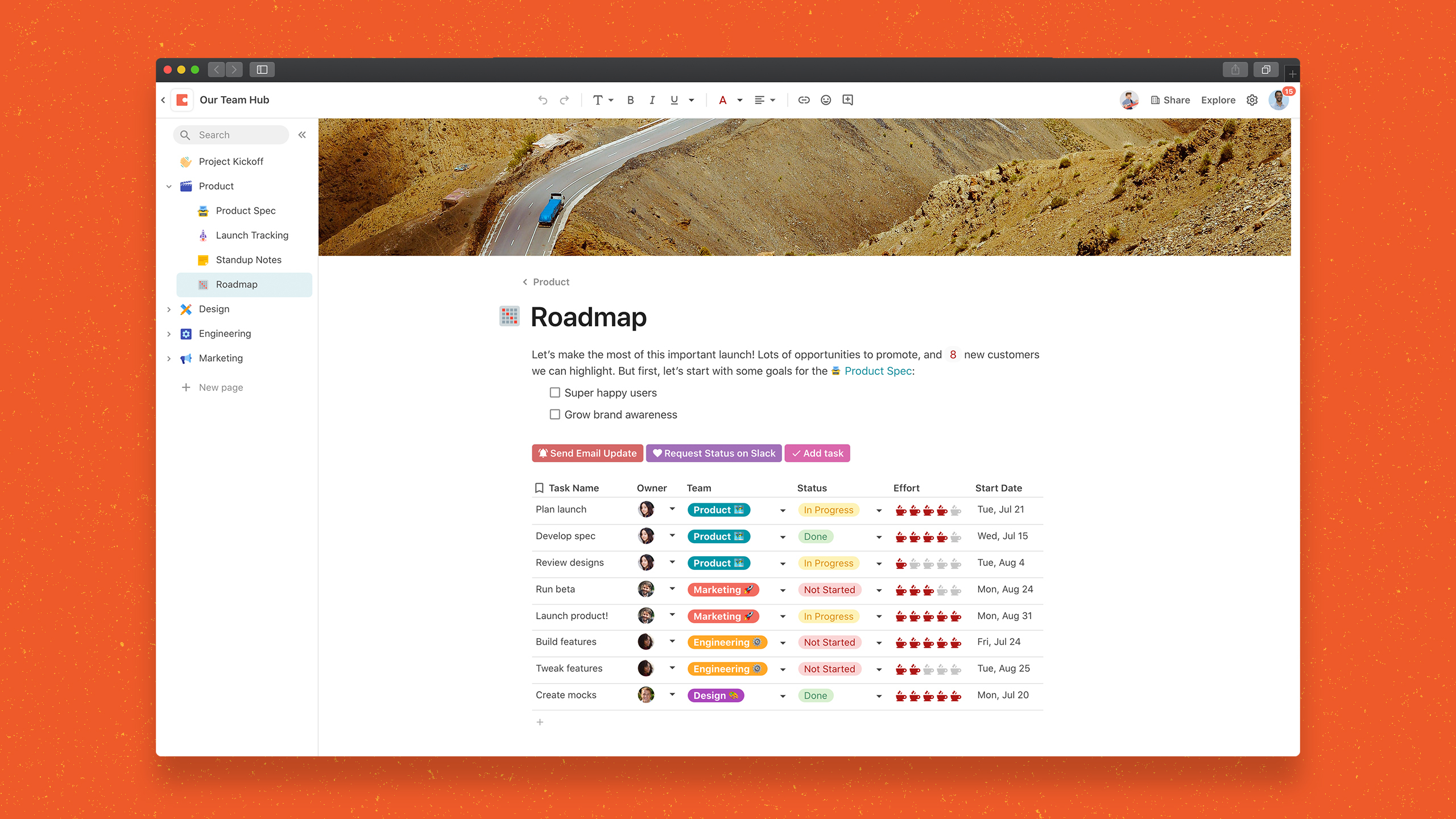
Coda, acquired by Grammarly in early 2025, is a template-based document creation and collaboration solution, supporting a variety of use cases.
$0
per month
HCL Notes
Score 3.5 out of 10
N/A
Notes from HCL (formerly from IBM, acquired by HCL in late 2018) is a collaboration platform based on the Lotus platform.
N/A
Pricing
Coda by Grammarly
HCL Notes
Editions & Modules
Free
$0.00
per month
Pro
$10.00
per month per doc maker; unlimited editors (paid annually)
Team
$30.00
per month per doc maker; unlimited editors (paid annually)
Enterprise
Custom Pricing
No answers on this topic
Offerings
Pricing Offerings
Coda by Grammarly
HCL Notes
Free Trial
Yes
No
Free/Freemium Version
Yes
No
Premium Consulting/Integration Services
No
No
Entry-level Setup Fee
No setup fee
No setup fee
Additional Details
With Coda, you only pay for Doc Makers.
Often one person creates a doc, others edit it, and some simply observe from afar. Instead of charging for everyone, we only charge for the people who create docs.
Interested in enterprise pricing? Visit coda.io/enterprise
—
More Pricing Information
Community Pulse
Coda by Grammarly
HCL Notes
Features
Coda by Grammarly
HCL Notes
Project Management
Comparison of Project Management features of Product A and Product B
Coda by Grammarly
-
Ratings
HCL Notes
6.9
Ratings
11% below category average
Task Management
00 Ratings
7.00 Ratings
Gantt Charts
00 Ratings
6.00 Ratings
Scheduling
00 Ratings
8.00 Ratings
Workflow Automation
00 Ratings
5.00 Ratings
Mobile Access
00 Ratings
8.00 Ratings
Search
00 Ratings
6.00 Ratings
Visual planning tools
00 Ratings
8.00 Ratings
Communication
Comparison of Communication features of Product A and Product B
Coda by Grammarly
-
Ratings
HCL Notes
9.2
Ratings
15% above category average
Chat
00 Ratings
6.00 Ratings
Notifications
00 Ratings
9.00 Ratings
Discussions
00 Ratings
9.50 Ratings
Surveys
00 Ratings
9.10 Ratings
Internal knowledgebase
00 Ratings
10.00 Ratings
Integrates with GoToMeeting
00 Ratings
10.00 Ratings
Integrates with Gmail and Google Hangouts
00 Ratings
10.00 Ratings
Integrates with Outlook
00 Ratings
10.00 Ratings
File Sharing & Management
Comparison of File Sharing & Management features of Product A and Product B
Coda is great to build a place for your users to go to and see information. It is easy to navigate through and the variety of content creation is great. However, it is not always easy to create what you want and there is a lot of playing around and learning. Coda also sometimes misses some functionality which is expected. For example, downloading a list of users that have access to the platform. Being able to send push notifications when a new page has been created etc. Overall it is a good tool to use just be prepared to invest time!
I often work with teams from other country and regions, hence HCL Notes is a very useful platform for internal company management operations. It standardized organisational work standards in most of the offices worldwide. HCL Notes also enables chat with other team around the world that I find very helpful when initiating conversation or just want to have a quick update rather than sending emails and waiting for replies. However, HCL Notes is not very efficient in web browsing and user still need to use other internet service providers.
One source of truth: It's incredibly easy to keep everything organized and easy to find.
Being able to show different views of the same information throughout your doc makes it really easy to customize the information.
In general, I love the "coding" aspect of it, and being able to do advanced functions has helped us create some really interesting automation and streamline our process.
Data sharing via small database format is valuable as they are quickly deployed, easily managed and distributed on backend email servers.
Integrated messaging allows quick communications between geographical sites reducing long distance costs.
Policy documents for registering new users, setting initial security levels, assigning default database access is managed easily with the admin client.
The simple user experience can be touted as a positive, but it is also a negative in some ways. Compared to other calendars, email and chat tools, IBM Notes looks like it is from the 90s.
We have constant issues with chat crashing. This is the main reason so many people in our organization chose to switch away from Notes.
There aren't a lot of integrations with IBM Notes and other applications we regularly use. Notes seems to have been left behind by many.
Coda is definitely something that has been proven to drive positive impact in our organization. We have many divisions that can benefit from this that we have yet to explore. It would definitely be worth renewing.
Since companies started to moved their email systems to the Exchange platform and the cloud, we are unable to find any new projects with IBM Notes, the marketing share and software price is another issue, so we have to move to another platform.
There is a little bit of a learning curve on where to point and click to add in different elements and make edits. But it is still very manageable once you get the hang of it. I do still have some issues with some of my connected pages updating each other when I don't want them to sync. So I'll end up editing one page, and it will make the same edits on another page.
Easy to use for the user, most of the apps we developed, there is not much need for user training. Most of the times, we just do a demo to the users group and they can pick up from there.
We haven't done any integrations - the initial part of our experience we found that for docs with complex formulas, the page tends to load slowly but in recent months, Coda has improved and optimized the loading times in general and we generally don't find any problems in terms of speed anymore.
Mainly due to timezone differences. I think Coda's support in general is well implemented and executed. They know their stuff and are helpful. But since I'm not in the same timezone, solution rates are slower for me, and that's not something I prefer. I work in customer service, too, and more often than not, time is important. Shortening the solution time would be a much greater experience.
I've been using the production for a very long time and very happy with it. Also, all the online resources and forums for notes is very friendly and easy/quick for getting help. I found out that compared to Microsoft or Oracle or any other platforms, IBM Notes online forum is the best I have seen.
I'm relatively inexperienced but this experience is meaningful. It would have been nice to have some guidance from Coda so that we understood more on Coda's purpose and potential.
Implementation is easy and smooth if the requirement is well gathered/documented. Notes is a RAD platform, all projects in Notes is simple in the implementation step.
For general use cases, Google Docs or Airtable are often a better starting place. But if things get complex or you're constantly pairing the two together, consider graduating to Coda to save yourself long-term headaches. Notion is great for personal use, but the powerful automation and collaboration features in Coda make it a better fit for teams in my experience so far.
I've already answered this question in the previous questions however to sum it up IBM Notes stacks up VERY WELL! It has a LOT of really good business/enterprise features like enterprise-grade Dropbox-like storage, synced email/calendar/contacts, it supports a LOT of third-party add-ins, easy-to-use and friendly, very strong and robust, and most importantly it's a LOT more secure in my opinion than the competition.
I think scalability is definitely good here since it's based on number of doc makers. Implementation into each dept becomes simpler. That being said, due to the nature of our work, we find it easier that we have a "super user" and then a team of other doc makers. This would make the doc creation and management more efficient.
ROI for us has been extreme. In the late 1990's we automated dozens and dozens of paper-based processes and created workflows for activities that had never been formalized before. Additionally all those forms with their comments, etc. have been captured in a central place to serve as audit trails.
Whenever we need faster access to data (mail or otherwise), it's quick and easy to deploy a new Domino server somewhere, setup replication of appropriate databases, and get the local Notes clients pointed to those resources. So that to me is positive ROI because it represents time savings based on user need.
Tech. Support would claim a negative ROI in terms of supporting the Notes client, Notes updates, peculiar Notes issues, and users who complain about Notes. That is certainly true to a point. The Notes client is a much more complex piece of software than, say, Outlook. But we have to remember that Notes deployments are not just for Mail but many, many applications as well. In the end I'd say we might have 1 or 2 user complaints per month, typically around Calendar issues more than anything else.