Cloudshot vs. Nagios Core

Overview
ProductRatingMost Used ByProduct SummaryStarting Price
Cloudshot
Score 0.0 out of 10
N/A
Cloudshot is a cloud infrastructure management platform. Key Benefits of Cloudshot: Real-Time Monitoring: Offers instant insights into the cloud's performance and health, enabling proactive issue prevention. Cost Optimization: Analyzes and optimizes cloud spending to reduce expenses. Simplified Management: Visualizes the entire cloud ecosystem. Service Scheduling: Schedules cloud…
$19
per month per user
Nagios Core
Score 8.6 out of 10
N/A
Nagios provides monitoring of all mission-critical infrastructure components. Multiple APIs and community-build add-ons enable integration and monitoring with in-house and third-party applications for optimized scaling.N/A
Pricing
CloudshotNagios Core
Editions & Modules
Starter
$19
per month per user
Pro
$99
per month per user
Enterprise
Contact Sales
Single License
Free
Single License
Free
Offerings
Pricing Offerings
CloudshotNagios Core
Free Trial
YesYes
Free/Freemium Version
NoYes
Premium Consulting/Integration Services
NoNo
Entry-level Setup FeeOptionalNo setup fee
Additional Details
More Pricing Information
Community Pulse
CloudshotNagios Core
Best Alternatives
CloudshotNagios Core
Small Businesses
VMware Cloud Director
Score 8.6 out of 10
Veeam ONE
Veeam ONE
Score 8.2 out of 10
Medium-sized Companies
IBM Turbonomic
IBM Turbonomic
Score 9.3 out of 10
Icinga
Icinga
Score 7.8 out of 10
Enterprises
vRealize Operations (discontinued)
Score 10.0 out of 10
Zabbix
Zabbix
Score 8.7 out of 10
All AlternativesView all alternativesView all alternatives
User Ratings
CloudshotNagios Core
Likelihood to Recommend
-
(0 ratings)
8.5
(0 ratings)
Likelihood to Renew
-
(0 ratings)
9.9
(0 ratings)
Usability
-
(0 ratings)
4.0
(0 ratings)
Support Rating
-
(0 ratings)
7.7
(0 ratings)
User Testimonials
CloudshotNagios Core
Likelihood to Recommend
Cloudshot's smart automation has greatly reduced manual work for our DevOps team. Deployments are faster, and security is better. If you manage a big cloud setup this tool is a must-have.
Read full review
Nagios is simply a very configurable and rock solid monitoring engine. For these reasons I would recommend it to any IT professional in any medium to large organization where creating custom checks and programming ones custom needs into the configuration is practical. I would be more hesitant to recommend it as a first monitoring solution for a small business which is usually accompanied by a less experienced and/or more time constrained admin.
Read full review
Pros
No answers on this topic
  • Network and server status alerts if a device is in a down state.
  • Gives you the top view down of your entire network infrastructure.
  • It can be customized to your exact needs.
  • You have two options of agentless and agent monitoring.
Read full review
Cons
No answers on this topic
  • It's built by engineers for engineers so setting it up and configuring it is relatively complicated. It could really use a simplified configuration approach, or a GUI to set it up instead of editing config files.
  • I'd like to see the option to have service notification settings inherited from the host setting notifications. They have to be set up separately but they are often the same, so it would be nice to have less redundancy.
Read full review
Likelihood to Renew
No answers on this topic
We're currently looking to combine a bunch of our network montioring solutions into a single platform. Running multiple unique solutions for monitoring, data collection, compliance reporting etc has become a lot to manage.
Read full review
Usability
I gave Cloudshot a 10/10 rating because it makes cloud management effortless.
Read full review
The Nagios UI is in need of a complete overhaul. Nice graphics and trendy fonts are easy on the eyes, but the menu system is dated, the lack of built in graphing support is confusing, and the learning curve for a new user is too steep.
Read full review
Support Rating
No answers on this topic
I haven't had to use support very often, but when I have, it has been effective in helping to accomplish our goals. Since Nagios has been very popular for a long time, there is also a very large user base from which to learn from and help you get your questions answered.
Read full review
Alternatives Considered
No answers on this topic
We have tested several other monitoring products which were able to monitor the basic matrix (Memory, DiskUsage, CPU%, UpTime, Running Service Status, Port 80 Up/Down). Although some offered far better UIs, they lacked the ability to monitor ANYTHING. Zabbix, being the only contender worthy of competing, is a good alternative to Nagios. We also tried Zenoss Core & OpenNMS which were good enough for non-Linux engineers to get started with. OP5 was another service-oriented monitoring solution we evaluated. Apart from Nagios, Consul is heavily used to monitor & register the micro-service systems & end-point URLs. Due to the time invested (9+years) in Nagios, we were able to get more components installed/configured easily than alternatives.
Read full review
Return on Investment
No answers on this topic
  • With it being a free tool, there is no cost associated with it, so it's very valuable to an organization to get something that is so great and widely used for free.
  • You can set up as many alerts as you want without incurring any fees.
Read full review
ScreenShots

Cloudshot Screenshots

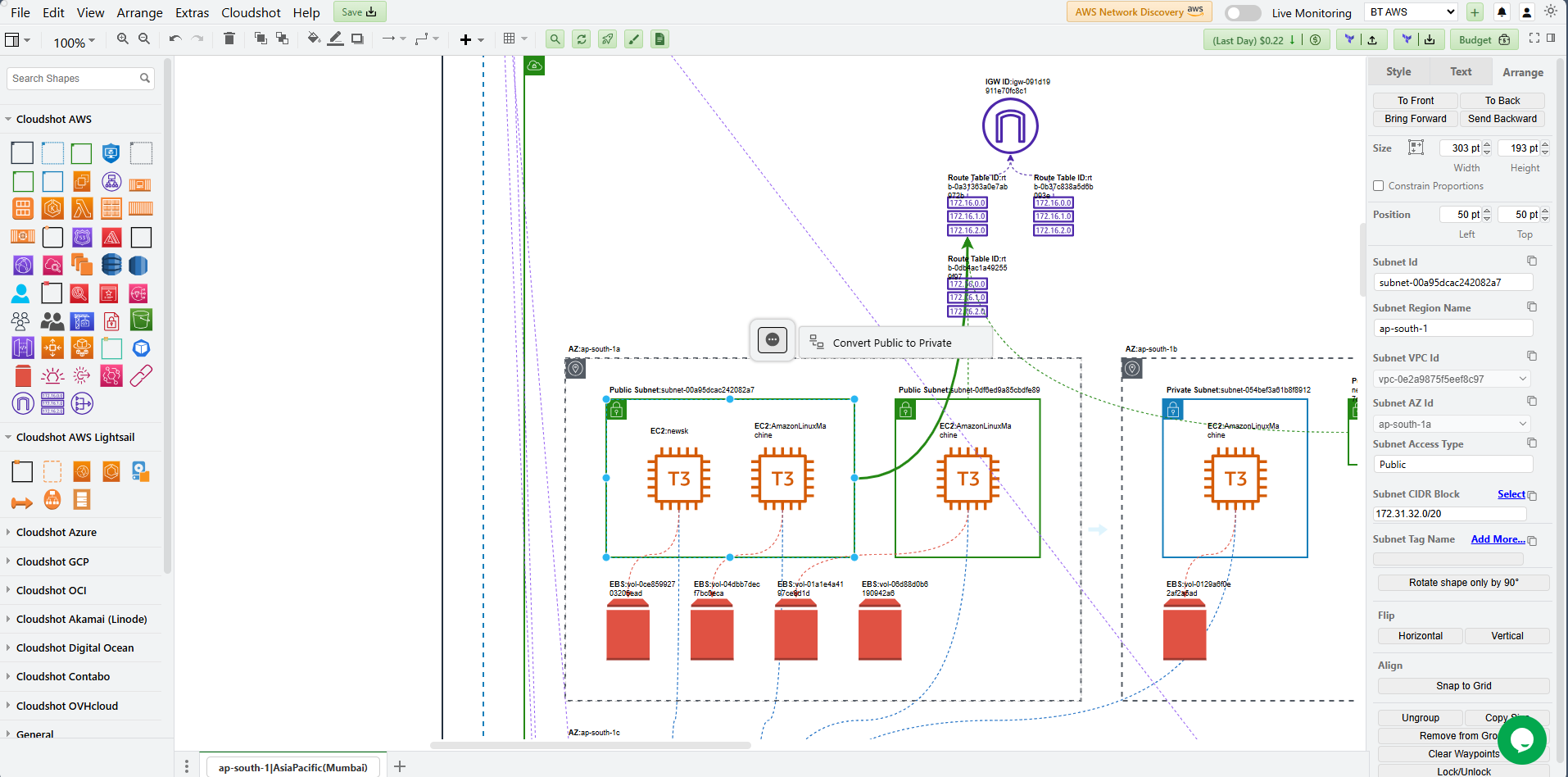
Screenshot of a visualization of a cloud networkScreenshot of the available 8 supported Cloud providersScreenshot of some of the multiple features for every cloud providerScreenshot of where routine DevOps automations are simplified e.g. converting AWS public subnet to privateScreenshot of how Cloudshot provides a plan of action before executing so that users remain in total controlScreenshot of where to manage AWS EC2,Azure VM/GCP Compute Engine & Co easily. No need to do the actions manually and/or writing Terraform script