Cloudshot vs. Icinga

Overview
ProductRatingMost Used ByProduct SummaryStarting Price
Cloudshot
Score 0.0 out of 10
N/A
Cloudshot is a cloud infrastructure management platform. Key Benefits of Cloudshot: Real-Time Monitoring: Offers instant insights into the cloud's performance and health, enabling proactive issue prevention. Cost Optimization: Analyzes and optimizes cloud spending to reduce expenses. Simplified Management: Visualizes the entire cloud ecosystem. Service Scheduling: Schedules cloud…
$19
per month per user
Icinga
Score 7.8 out of 10
N/A
Icinga is an open source network monitoring platform. It includes automation, modularized integration packages, and prebuilt alerts and reporting capabilities.N/A
Pricing
CloudshotIcinga
Editions & Modules
Starter
$19
per month per user
Pro
$99
per month per user
Enterprise
Contact Sales
No answers on this topic
Offerings
Pricing Offerings
CloudshotIcinga
Free Trial
YesNo
Free/Freemium Version
NoNo
Premium Consulting/Integration Services
NoNo
Entry-level Setup FeeOptionalNo setup fee
Additional Details
More Pricing Information
Community Pulse
CloudshotIcinga
Best Alternatives
CloudshotIcinga
Small Businesses
VMware Cloud Director
Score 8.6 out of 10
Veeam ONE
Veeam ONE
Score 8.2 out of 10
Medium-sized Companies
IBM Turbonomic
IBM Turbonomic
Score 9.3 out of 10
Logz.io
Logz.io
Score 7.0 out of 10
Enterprises
vRealize Operations (discontinued)
Score 10.0 out of 10
Zabbix
Zabbix
Score 8.7 out of 10
All AlternativesView all alternativesView all alternatives
User Ratings
CloudshotIcinga
Likelihood to Recommend
-
(0 ratings)
8.0
(0 ratings)
Likelihood to Renew
-
(0 ratings)
9.0
(0 ratings)
User Testimonials
CloudshotIcinga
Likelihood to Recommend
Cloudshot's smart automation has greatly reduced manual work for our DevOps team. Deployments are faster, and security is better. If you manage a big cloud setup this tool is a must-have.
Read full review
If you're running bare-metal in a datacenter and your hosts are fairly static, it's probably okay to use something like Icinga to monitor your systems. In general, I would not recommend using any monitoring software based on Nagios (Icinga is a fork of Nagios) due to the outdated concepts inherent in those systems. There are a number of good SaaS monitoring solutions which are superior and several open source projects which implement an automation-centric approach to monitoring
Read full review
Pros
No answers on this topic
  • I think Icinga has a great search feature. I can always search for the hosts, host groups, or check names. When using just regular Nagios, I don't recall being able to do this search.
  • The fact that I can use Active Directory or LDAP for logins is a great feature.
  • If you are familiar with Nagios, it's very simple to combine the two products to get a polished finished product.
Read full review
Cons
No answers on this topic
  • Decluttering - the dashboard seems to get very overwhelming
  • Segregation - would be helpful to split environments or clients into different areas
  • Alerting
Read full review
Likelihood to Renew
No answers on this topic
Icinga is a solid solution which does everything it promises. It is backwards compatible with most Nagios instances, making the transition very easy. Once you get the hang of installing new plugins and editing configuration files expanding its monitoring capabilities are easy.
Read full review
Usability
I gave Cloudshot a 10/10 rating because it makes cloud management effortless.
Read full review
No answers on this topic
Alternatives Considered
No answers on this topic
Icinga was initially a fork of Nagios. Over time, the configuration language was replaced with something more programmatic. This configuration language is one of the big sellers of this product. It allows flexible, quick configuration of large sets of hosts and services with minimal input. Comparing it to other products like WhatsUp Gold, Zenoss, Zabbix, etc., it stands out as incredibly flexible. Adding additional features to Icinga can be as simple as searching for them online. And if they don't yet exist, there is a full API available for custom extensions.
Read full review
Return on Investment
No answers on this topic
  • With one check you know which applications are faulty e.g. after an upgrade. Which is big time saver
  • You easily detect outages ion the applications so that your customer ideally does not even realize there was an outage.
  • Detect if the environment does deliver the same result as in the same time as before to detect shortages.
  • Additional information when debugging. Saved us several hours where we could simply point to a database which was slow.
Read full review
ScreenShots

Cloudshot Screenshots

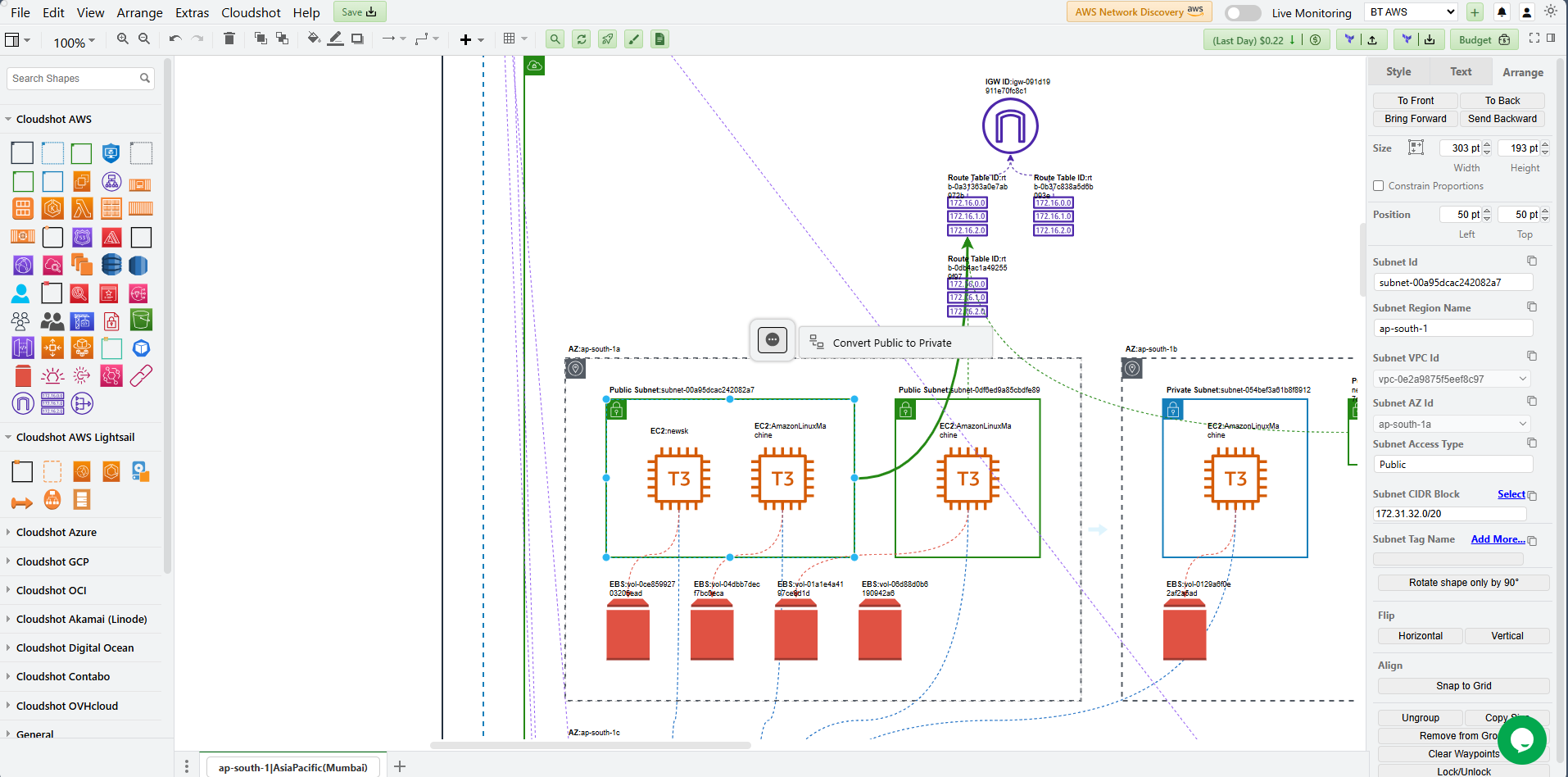
Screenshot of a visualization of a cloud networkScreenshot of the available 8 supported Cloud providersScreenshot of some of the multiple features for every cloud providerScreenshot of where routine DevOps automations are simplified e.g. converting AWS public subnet to privateScreenshot of how Cloudshot provides a plan of action before executing so that users remain in total controlScreenshot of where to manage AWS EC2,Azure VM/GCP Compute Engine & Co easily. No need to do the actions manually and/or writing Terraform script