Cloudflare’s connectivity cloud is a unified platform of cloud-native services designed to help enterprises regain control over their IT environments. Powered by an intelligent, programmable global cloud network, it is built to offer security, performance, visibility, and reliability.
$20
per month
NGINX
Score9.2 out of 10
Mid-Size Companies (51-1,000 employees)
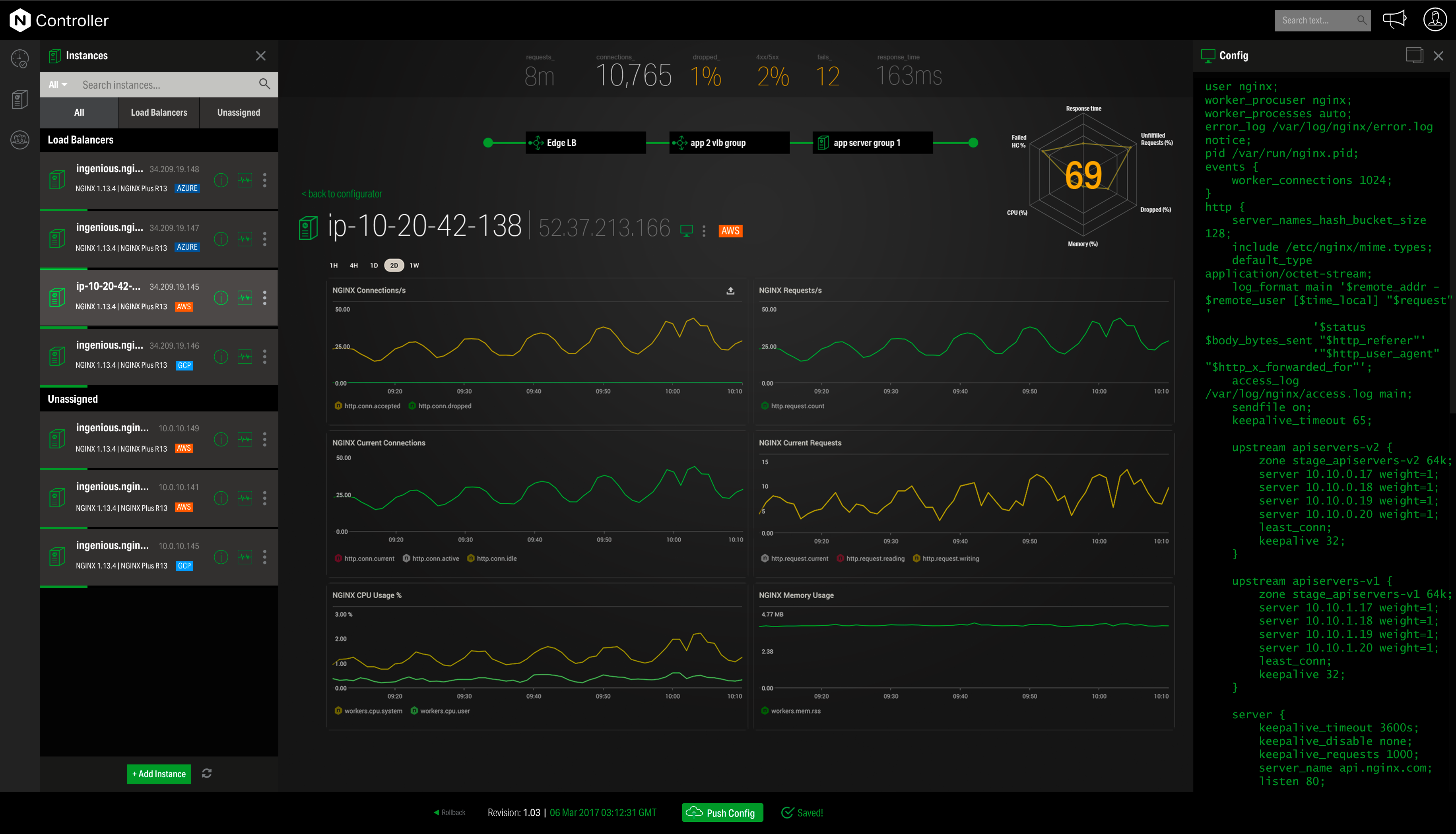
NGINX, a business unit of F5 Networks, powers over 65% of the world's busiest websites and web applications. NGINX started out as an open source web server and reverse proxy, built to be faster and more efficient than Apache. Over the years, NGINX has built a suite of infrastructure software products o tackle some of the biggest challenges in managing high-transaction applications. NGINX offers a suite of products to form the core of what organizations need to create…
Owner in Engineering at Lime Daley (Telecommunications, 1-10 employees)
Chose Cloudflare
Akamai and Edgecast/Verizon are way over-priced, and also require hassling sales people to negotiate prices, and cloudflare just has their prices posted, and don't require a multi-year contract, etc. StackPath is a regular CDN provider, and is probably cheaper than Cloudflare …
A de minimis incentive was given to thank the reviewer for their time. The incentive was not used to bias or drive a particular response, nor was the incentive contingent on a positive endorsement. More Info
Cloudflare works well as security measure that gives peace of mind without needing to work too hard to get it functioning well. It provides great tools to customize the security experience as well. This is all the same for the caching tools as well. They have a lot of built in tools that make using the caching easy right out of the box, but they provide the customization options to get things just right for your site.
A de minimis incentive was given to thank the reviewer for their time. The incentive was not used to bias or drive a particular response, nor was the incentive contingent on a positive endorsement. TR verified that a representative sample of customers was invited. More Info
[NGINX] is very well suited for high performance. I have seen it used on servers with 1k current connections with no issues. Despite seeing it used in many environments I've never seen software developers use it over apache, express, IIS in local dev environments so it may be more difficult to setup. I've also seen it used to load balance again without issues.
A de minimis incentive was given to thank the reviewer for their time. The incentive was not used to bias or drive a particular response, nor was the incentive contingent on a positive endorsement. More Info
The best part is the content delivery network. Cloudflare has a large network of data centres around the world that helps cache and delivers content quickly to our customers.
Cloudflare offers us with a fast and reliable DNS service and with the world class features such as Cloudflare workers, SSL verification, certificate management and web application firewall. When all of these are combined together, it provides very strict security for our organization.
One of the most important feature that we use is the analytics and threat detection. It provides us with the real time insights of all the threats originating from multiple locations and landing on our websites.
A de minimis incentive was given to thank the reviewer for their time. The incentive was not used to bias or drive a particular response, nor was the incentive contingent on a positive endorsement. TR verified that a representative sample of customers was invited. More Info
A de minimis incentive was given to thank the reviewer for their time. The incentive was not used to bias or drive a particular response, nor was the incentive contingent on a positive endorsement. More Info
In some cases, using Cloudflare can actually lead to slower website speeds if the network is congested or if the website's traffic is particularly heavy.
Some website owners may find that the level of customization offered by Cloudflare is limited, especially in comparison to other solutions.
While Cloudflare is easy to set up and manage, it may be too complex for users who are not familiar with web technologies.
A de minimis incentive was given to thank the reviewer for their time. The incentive was not used to bias or drive a particular response, nor was the incentive contingent on a positive endorsement. More Info
Customer support can be strangely condescending, perhaps it's a language issue?
I find it a little weird how the release versions used for Nginx+ aren't the same as for open source version. It can be very confusing to determine the cross-compatibility of modules, etc., because of this.
It seems like some (most?) modules on their own site are ancient and no longer supported, so their documentation in this area needs work.
It's difficult to navigate between nginx.com commercial site and customer support. They need to be integrated together.
I'd love to see more work done on nginx+ monitoring without requiring logging every request. I understand that many statistics can only be derived from logs, but plenty should work without that. Logging is not an option in many environments.
A de minimis incentive was given to thank the reviewer for their time. The incentive was not used to bias or drive a particular response, nor was the incentive contingent on a positive endorsement. More Info
A de minimis incentive was given to thank the reviewer for their time. The incentive was not used to bias or drive a particular response, nor was the incentive contingent on a positive endorsement. More Info
Everything is extremely concise and all settings apply immediately and take effect globally. There is no reason to explicitly plan/think in terms of individual regions as one would have to traditional cloud offerings (AWS, OCI, Azure). All Cloudflare products integrate seamless as part of a single pipeline that executes from request to response.
A de minimis incentive was given to thank the reviewer for their time. The incentive was not used to bias or drive a particular response, nor was the incentive contingent on a positive endorsement. More Info
Front end proxy and reverse proxy of Nginx is always useful. I always prefer to Nginx in overall usability when you have application server and database or multiple application servers and single database i.e. clustered application. Nginx provides really good features and flexibility which helps the system administrator in case of troubleshooting and also from the administration perspective. Also, Nginx doesn't delay any request because of internal performance issues.
A de minimis incentive was given to thank the reviewer for their time. The incentive was not used to bias or drive a particular response, nor was the incentive contingent on a positive endorsement. More Info
A de minimis incentive was given to thank the reviewer for their time. The incentive was not used to bias or drive a particular response, nor was the incentive contingent on a positive endorsement. More Info
A de minimis incentive was given to thank the reviewer for their time. The incentive was not used to bias or drive a particular response, nor was the incentive contingent on a positive endorsement. More Info
Excellent product, Cloudflare is a true pioneer of the modern Internet, providing tools, services, and expertise that vastly improve the performance and security of web services. Any issues are resolved quickly with detailed RCA and follow-ups published publicly. I'm thankful to Cloudflare and use their services both at work and at home.
A de minimis incentive was given to thank the reviewer for their time. The incentive was not used to bias or drive a particular response, nor was the incentive contingent on a positive endorsement. More Info
Community support is great, and they've also had a presence at conferences. Overall, there is no shortage of documentation and community support. We're currently using it to serve up some WordPress sites, and configuring NGINX for this purpose is well documented.
A de minimis incentive was given to thank the reviewer for their time. The incentive was not used to bias or drive a particular response, nor was the incentive contingent on a positive endorsement. More Info
A de minimis incentive was given to thank the reviewer for their time. The incentive was not used to bias or drive a particular response, nor was the incentive contingent on a positive endorsement. More Info
A de minimis incentive was given to thank the reviewer for their time. The incentive was not used to bias or drive a particular response, nor was the incentive contingent on a positive endorsement. More Info
We have used Traffic, Apache, Google Cloud Load Balancing and other managed cloud-based load balancers. When it comes to scale and customization nothing beats Nginx. We selected Nginx over the others because
we have a large number of services and we can manage a single Nginx instance for all of them
we have high impact services and Nginx never breaks a sweat under load
individual services have special considerations and Nginx lets us configure each one uniquely
A de minimis incentive was given to thank the reviewer for their time. The incentive was not used to bias or drive a particular response, nor was the incentive contingent on a positive endorsement. More Info
A de minimis incentive was given to thank the reviewer for their time. The incentive was not used to bias or drive a particular response, nor was the incentive contingent on a positive endorsement. More Info
Immediate ROI on Registrar and DNS hosting while giving a single plane of glass to managing both with domain registrations at cost, and no cost DNS hosting
WAF helped us move at risk servers/applications into a protected state allowing us to perform remediations at a measured pace and get them done right instead of band aide solutions.
CDN proxying increase the speed of our website while simultaneously reducing server load.
DMARC management and report interpretation allow use to identify weak points in our email systems, remediate and move to stricter policies without significantly increasing staff time spent managing it.
A de minimis incentive was given to thank the reviewer for their time. The incentive was not used to bias or drive a particular response, nor was the incentive contingent on a positive endorsement. More Info
Nginx has decreased the burden of web server administration and maintenance, and we are spending less time on server issues than when we were using Apache.
Nginx has allowed more people in our company to get involved with configuring things on the web server, so there's no longer a single point of failure ("the Apache guy").
Nginx has given us the ability to handle a larger number of requests without scaling up in hardware quite so quickly.
A de minimis incentive was given to thank the reviewer for their time. The incentive was not used to bias or drive a particular response, nor was the incentive contingent on a positive endorsement. More Info