The Huawei NetEngine series of DC switches is, the vendor states, a diversified product portfolio that supports flexible networking ranging from 500 to over 50,000 servers, with a unified open architecture that supports seamless evolution from the traditional data center network to the SDN and multi-cloud era.
It fits perfectly in all our data centers where we are using it. For small companies or smaller racks or something. I don't think it fits there because Cisco Nexus Series Switches is a big one. It's the most advanced one.
The focus of the solution is datacenter, so it is a waste of resources to use them as SOHO or as access switches. All your robustness needs to be used correctly, so that there is no wasted investment. I also note that, as good practices, it is necessary to ensure redundancy and availability of assets and connections, so the investment is high, even more so if you need to mix fiber and twisted pair solutions.
Maintenance, upgrades, and software certification can be performed without service interruptions because of the modular nature of NX-OS and features such as In-Service Software Upgrade (ISSU) and the capability for processes to restart dynamically
FabricPath:
Enables each device to build an overall view of the topology; this is similar to other link state routing protocols. Each device in the FabricPath topology is identified by a switch-id. The Layer 2 forwarding tables are built based on reachability to each switch-id, not by the MAC address. Eliminates spanning-tree to maximize network bandwidth and flexibility in topological configurations, as well as simplify operational support and configuration. This enables a tremendous amount of flexibility on the topology because you can now build FabricPath topologies for Layer 2-based networks the same as for Layer 3-based networks
Overlay Transport Virtualization (OTV): Enables the Layer 2 extension between distributed data centers over any transport Layer 3 network
Implementing jumbo frames on interfaces of its fabric extender series (N2k, etc.) by editing the network QoS does not have to be a global configuration that would affect all its interfaces. It can be improved to become just an interface configuration.
Licensing on the NXOS is a bit complicated and expensive. I understand that the Nexus is made for core data center switching but it does not have to break the bank.
OTV technology is for Nexus only. Based on the advantage of the technology, it should be made vendor-neutral to accommodate other vendor devices.
Documentation, like every huawei product, needs improvement
The official training of this solution is extremely boring and theoretical. It is necessary to make something more practical and useful in everyday life.
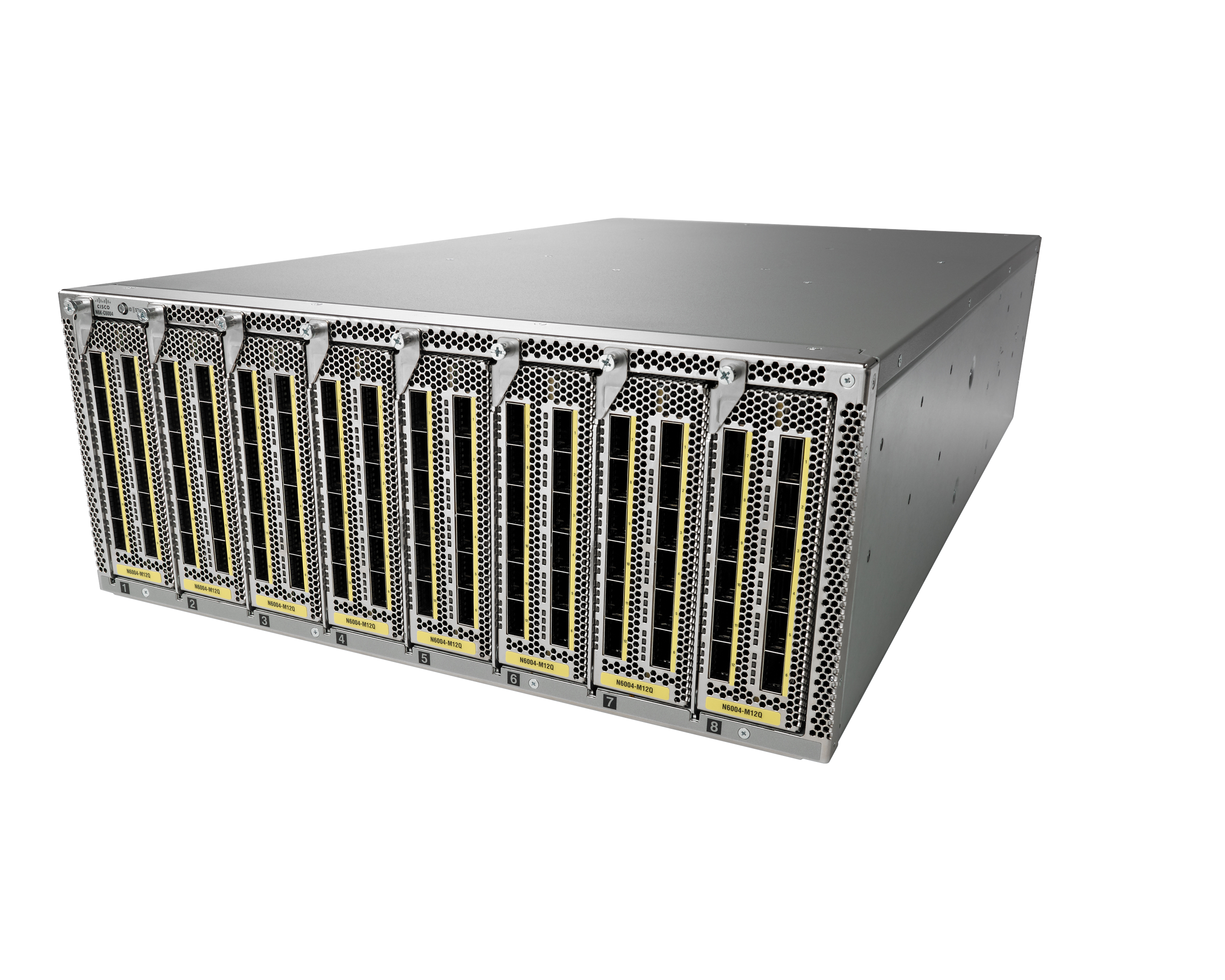
As it is a line for datacenters, I believe that the product needs a better development in its chassis. It seems very fragile to me.
overall a great product with high reliability . Nexus switches offer advanced features tailored for modern data centers. They support high-speed Ethernet (10G to 800G), scalable spine-leaf architectures, and unified fabric for LAN and SAN convergence. Nexus switches integrate with Cisco ACI for software-defined networking, enabling automated policy management and virtualization. Security features include microsegmentation, telemetry, and flow monitoring. They support programmability through NX-API, REST APIs, and scripting tools like Python and Ansible, making them ideal for DevOps environments. Nexus switches also offer low-latency performance for high-frequency trading and HPC workloads, and support Fibre Channel over Ethernet (FCoE) for storage integration. With robust automation, telemetry, and cloud-readiness, they are widely used in enterprise, financial, and service provider networks for mission-critical operations.
These switches are very fast. They've been designed to work within the data center. We connect them to Cisco UCS-B Mini servers with the storage being directly attached. They are able to handle the data traffic pretty easily. We can also move servers pretty fast from data center to data center without overloading them. This has allowed our company to stay running during any kind of conditional outage. We have come to really rely on them for business continuity.
Overall, Cisco has great products and I believe that they believe in the philosophy of a great customer experience. Although there have been a few technical support issues that caused a lot of company anxiety, in most cases, Cisco has gone above and beyond in making a valiant effort to help the customer solve any issues.
We made a simple overview of the market, Cisco is still a leader. vPC is a must know for any Cisco lover and any network engineer, actually is the most simple way to aggregate switches and provide high performance without going to a more complex solution and also we choose to keep standard solution of the market.
The Huawei CloudEngine Data Center Switches solution, as the name implies, is aimed at Datacenters and ToR applications. The development of such equipment was all designed to meet high processing loads and connections of servers, storages and other high-performance assets. The other solutions evaluated (and some we even have in our park) are for other purposes, such as access and edge.
The Nexus 3000 series switches are data center switches, so I would say they have similar security ability to other switches in this segment. I don't have a lot of experience doing more than basic ACL security on switches, but I know these can be integrated into other security solutions like Cisco ISE and 802.1x authentication. It could also be integrated into an ACI solution to add micro segmentation, which would bring in other security functions.