Cisco Intersight is an operations platform that helps IT operations teams control and automate Cisco UCS, converged, and hyperconverged infrastructure. Intersight consolidates and automates infrastructure lifecycle management from data centers to the edge in one solution delivered as-a-service.
N/A
IBM Turbonomic
Score 9.3 out of 10
Enterprise companies (1,001+ employees)
IBM Turbonomic is a performance and cost optimization platform for public, private, and hybrid clouds used by cloud, infrastructure operations, and architecture to assure application performance while eliminating inefficiencies by dynamically resourcing applications through automated actions. One of the key features of IBM Turbonomic is its ability to continuously adjust application resources in real time. By monitoring resource utilization and application performance,…
N/A
Pricing
Cisco Intersight
IBM Turbonomic
Editions & Modules
No answers on this topic
IBM® Turbonomic On-Prem
Varies - Request a Quote
per month IBM Turbonomic On-prem optimizes data center resources in real time, ensuring app performance at the lowest cost by aligning infrastructure supply with dynamic application demand.
IBM® Turbonomic Cloud Standard
Varies - Request a Quote
per month For customers with more than USD 1.6 million in annual cloud spend or 50 Managed Virtual Servers (MVS) or greater
IBM® Turbonomic Hybrid Standard
Varies - Request a Quote
per month Advanced hybrid cloud optimization capabilities for customers with 200 managed virtual servers (MVS) or more
Offerings
Pricing Offerings
Cisco Intersight
IBM Turbonomic
Free Trial
Yes
Yes
Free/Freemium Version
No
No
Premium Consulting/Integration Services
No
No
Entry-level Setup Fee
No setup fee
Optional
Additional Details
—
Volume discounting available.
More Pricing Information
Community Pulse
Cisco Intersight
IBM Turbonomic
Features
Cisco Intersight
IBM Turbonomic
Cloud Management
Comparison of Cloud Management features of Product A and Product B
Cisco Intersight is very well suited for doing firmware upgrades across all of your cisco hardware. So far we have had no problems pushing out new firmware. It's also well suited for hardware management. Cisco TAC has the ability to pull logs for the IMC for themselves, which saves you from having to pull the logs yourself and then uploading them to the case. It may or may not be appropriate for upgrading operating systems. I have not been able to test it.
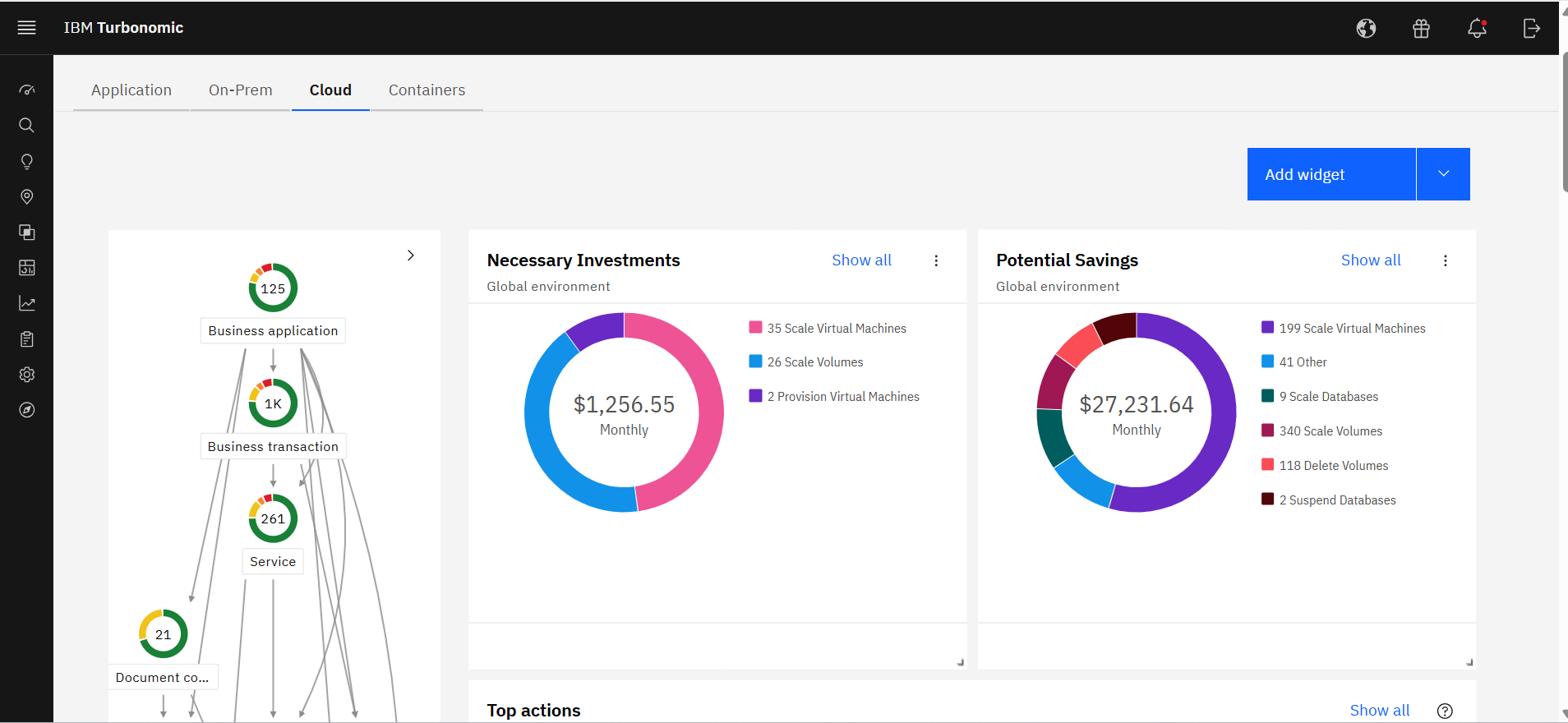
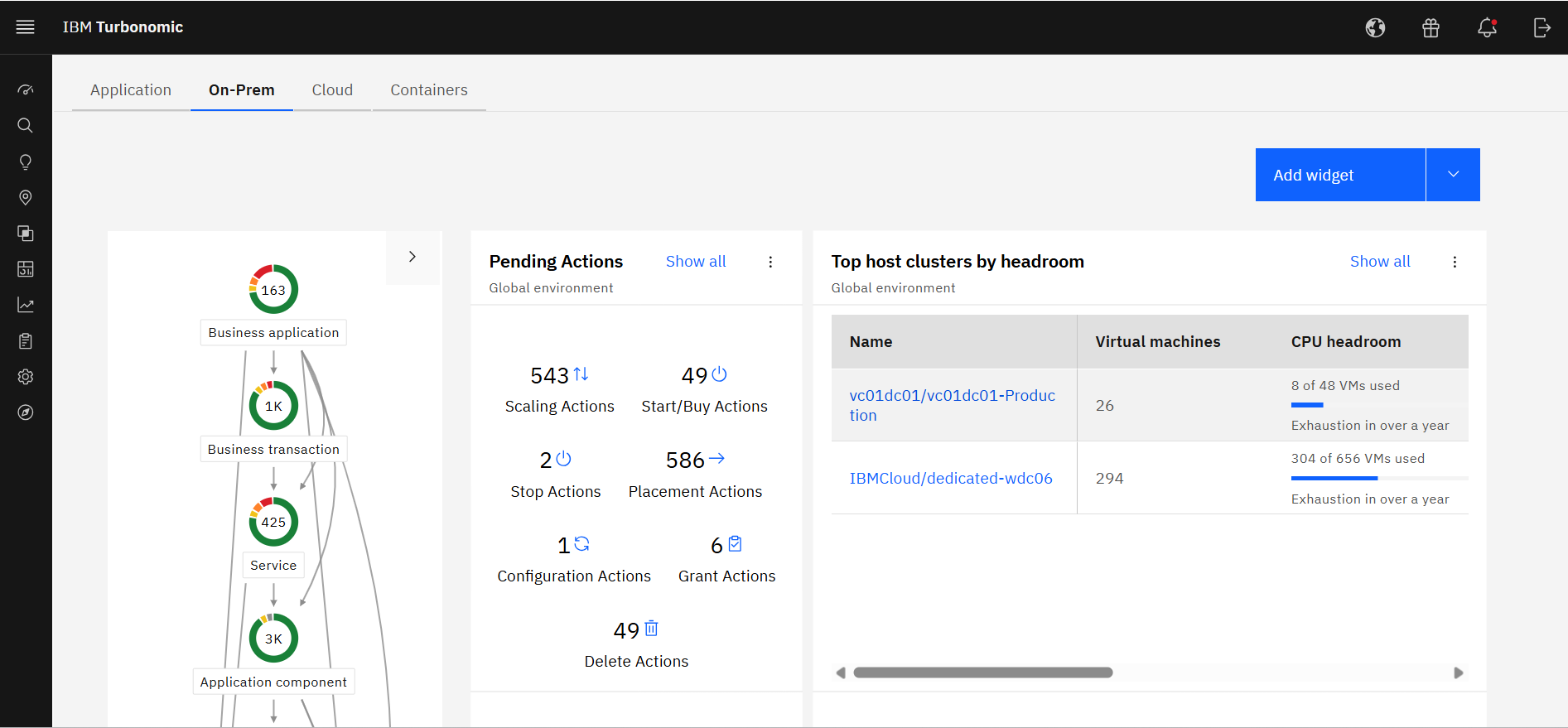
Measure the usage of resources across different platforms, from Kubernetes to VMs on-premises or in the cloud, to obtain current capacity metrics and plan for future scenarios. Reduce IT infrastructure costs by taking automated actions based on resource underutilization, such as shutting down VMs or changing resource definitions.
Standardising the environment by enforcing use of updating templates.
Show the difference on a profile between what has changed and what setting was last deployed.
Perform bulk deploy operation on profiles (like server profiles).
Policies underpin all settings (e.g. no more defining individual VLANs before being able to use them, or having to clean them up manually when they are no longer in use. You deploy a Domain VLAN policy that states which VLANs are configured on a domain (either standalone) or a domain profile template (if domains profiles are bound to an updating domain profile template).
It is difficult to spot an added or removed VLAN in an Ethernet Network Group Policy or VLAN Policy. The comparison widget will show you that something has changed, but if you have 100s of VLANs, the difference does not stand out. Workaround: we copy the data out and compare it in a text editor.
If you are transitioning from UMM to IMM, you lose some functionality like vNIC redundancy pairs.
It is not easy to map the UMM version 4.x server firmware version to the equivalent IMM version 5.x firmware version.
It is not possible to configure out-of-band management IP addresses on a per-domain basis. You have to configure these ranges via an IMC Access policy (which contains the IP address range/pool) on the server profile. This leads to "server profile template sprawl" where we have to maintain multiple server profile templates since our domains sit on different ranges, even though the servers are for the most part configured identically.
UCS domains in IMM only support one Ethernet Network Group Policy (VLAN group) per vNIC template.
It would be nice if the UI included a break-down of features that are both licensed as well as un-licensed. That way, you could not only see what you have, but what you don't.
The right-sizing recommendations are great, but very little info is given about why the recommendation is being made. More info would not only increase understanding, but would also help drive decision-making.
Been using Cisco Software as a service (SaaS) platform in a production environment for a large medical and health professionals that has critical healthcare and patients care dependency.
Support team is very helpful getting system updated as needed, and vendor support is fantastic. Also get a dedicated Cisco networking engine to review and advise system health and recommendations.
I have not found a better tool for capacity planning my VM environment than Turbonomic. If that is the use case, I would highly recommend. Similarly, if you are looking for automation and VM rightsizing automation I would also highly recommend. For troubleshooting scenarios where deep levels of infrastructure metrics are required, there are better tools available.
Usability of Cisco Intersight is highly dependent on the licensing purchased. The default (free) license level provides a lot of value for the minimal amount of effort to implement. The paid license levels provide additional features (detailed inventory, configuration management and deployment, etc.)
Excellent approach to larger VM organizational management. They have an very clean integrated dashboard that allows us to see everything in our environment and what that is doing in real-time. It works on multiple hyper-visors really well and integrates capacity planning on my local site as well as my cloud locations.
It allocates resources among applications by showing more on the cost breakdown by cloud service, with metrics on cloud provider information like Azure Management, Identity, Networking, Storage with costs per day, and total services costs. This then could facilitate and show the corresponding actions thereafter upon scaling.
If you have bigger problems with the on-prem version, the support team is sometimes a bit slow in their reactions and you have to keep going, to get your help. But finally, all problems, that we have addressed, have been resolved to my full appreciation!
Just this week we had an issue where security permissions we had done wrong were causing problems in VMTurbo Operations Manager. Despite this being our fault the service request was handled very quickly. In addition we are routinely contacted proactively to see if there is anything we need or they could do for us.
Alex (from VMTurbo) has worked with the product for years and helped develop the product. He was very knowledgeable and was able to provide our support team with details knowledge on how to get our deployment configured correctly as well as help with another VMTurbo POC within another customers environment.
After buying VMTurbo Operations Manager, I was invited to an online user training event. I felt this training was effective and dug just deep enough to be informative yet still keep my attention. Additionally, the webinar was free.
VMTurbo was easy to setup and implement. Probably helped by the remote telephone support we received. It was a simple process and and fairly painless. More complex configuration was achieved via a webex session and the support was greatly appreciated
Our organisation has some experience with Dell OME (the centralised management plane for Dell PowerEdge server, equivalent to Cisco Intersight Infrastructure Service and UCS Manager, but not enough to contrast the two or say why one is better than the other.
As the organization had experience of years in using IBM products, we had the confidence that they will provide us with great support. And we needed a reliable solution as a financial institute to ensure continuous operations. Even though the price was very high, we made the correct decision to go ahead with IBM Turbonomic as the feedback from existing users in the region was very positive. We needed a solution which was capable of handling our automation requirements. All these were green in IBM Turbonomic.
The negative thing is that we prefer to use the UCS Manager in our company because this bare metal is integrated into the FI and no extra appliance is required. SaaS is generally not viewed favorably in Germany.
Telling the user that they have to buy Intersight licenses even if they use UCS Manager annoys our customers.
Application performance has been a big one. With Turbonomic keeping everything running at top performance, it can make changes when extra resources are need, quicker than somebody being notified and then making the necessary changes.
Turbonomic has been a great cost savings for us on multiple occasions. We use it every time we are improving servers.
With the planning feature we get the best performance form new hardware purchases