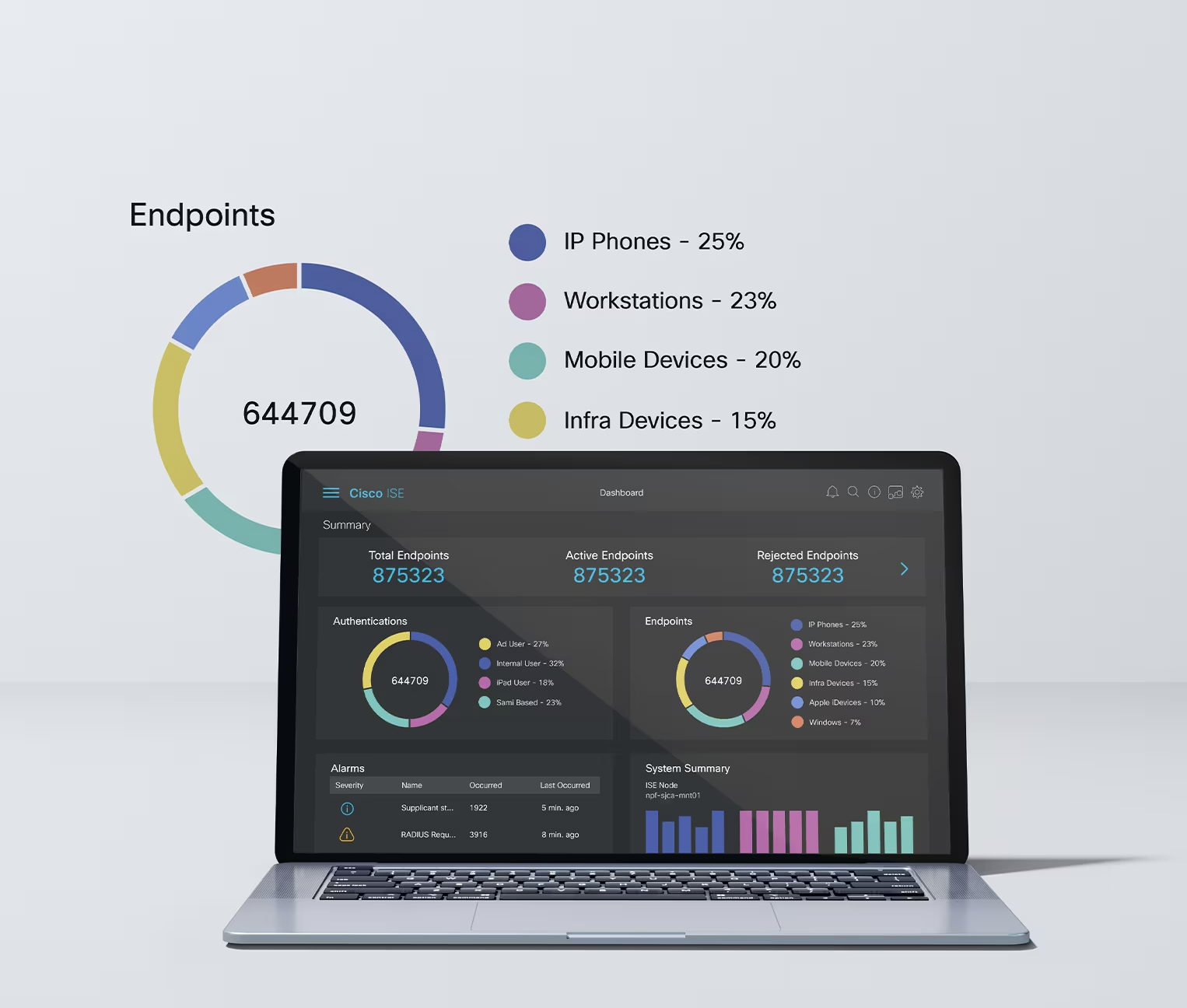
The Cisco Identity Services Engine (ISE) offers a network-based approach for adaptable, trusted access everywhere, based on context. It gives the user intelligent, integrated protection through intent-based policy and compliance solutions.
N/A
Zscaler Private Access
Score 7.9 out of 10
N/A
Zscaler Private Access™ (ZPA) gives users secure access to private apps and OT devices while enabling zero trust connectivity for workloads.
N/A
Pricing
Cisco Identity Services Engine (ISE)
Zscaler Private Access
Editions & Modules
No answers on this topic
No answers on this topic
Offerings
Pricing Offerings
Cisco Identity Services Engine (ISE)
Zscaler Private Access
Free Trial
No
No
Free/Freemium Version
No
No
Premium Consulting/Integration Services
No
Yes
Entry-level Setup Fee
No setup fee
No setup fee
Additional Details
—
—
More Pricing Information
Community Pulse
Cisco Identity Services Engine (ISE)
Zscaler Private Access
Features
Cisco Identity Services Engine (ISE)
Zscaler Private Access
Threat Intelligence
Comparison of Threat Intelligence features of Product A and Product B
Cisco Identity Services Engine (ISE)
-
Ratings
Zscaler Private Access
10.0
1 Ratings
13% above category average
Network Analytics
00 Ratings
10.01 Ratings
Automated Alerts and Reporting
00 Ratings
10.01 Ratings
Zero Trust Security
Comparison of Zero Trust Security features of Product A and Product B
Cisco ISE integrates will with a Cisco solution such as firewalls, network switches and routers. It does an incredible job of granting access based on the role that an individual or groups have, and the ability to remove access to that individual or group is also east. In our environment ISE is used to authenticate external users that have access by vpn, and also to manage access to the large network infrastructure
Zscaler Private Access works really well in environments setup for FQDNs and where you know what users should/shouldn't be accessing on what ports. You can use Zscaler Private Access to figure out these kinds of features but that doesn't always mean you'll be correct. It also provides a consistent experience for users as they can access their materials anywhere. It also makes the user the last line of defense. If a user's account is compromised then the attacker has access to everything they already did. It doesn't work great in OT environments or Server based environments. Flows have to be initiated from the client and not the server for stuff to behave properly.
The most beneficial thing that I love about it, there are tons of things that I love about ISE and that it does well, but the most fascinating that I feel about is its integration with DNA center or Catalyst Center using PX Grid as the protocol wherein ISE acts as a policy server for the entire campus hand in hand with Catalyst Center to make sure that the policy policy follows the user and also in the background hand in hand with DNA Center or Catalyst Center makes sure microsegmentation is implemented so that east west traffic is blocked and takes care of the campus.
Application Segmentation and Listener Configuration - The way applications are defined and listened for is fundamental to ZPA, but can be a source of frustration, especially when dealing with legacy or non-HTTP protocols
The ZCC is the user's primary gateway, but its control over local system network behavior can sometimes clash with enterprise requirements.
For us the solution is very easily useable on its own. Perhaps that has to do because we started using ISE in the 1.2 days and have seen it grow during the years. Policy creation, etc. is all very visible and thus easy to use. Deployment of multiple nodes is also incredibly easy and flexible. You can easily add or remove nodes as you wish.
The environment feels more secure, and we are seeing that users are adapting to it fast. The fact that we have tools to assist the users with their day-to-day access helps, as we can hand it off to the helpdesk without any escalations to the Network team. It is a work in progress for our agency, but we are seeing the benefits from the solution.
We do have to occasionally reboot the servers when they get low on memory, but we're also a few versions behind. Availability has generally been pretty good though with no major outages in the time that we've had it implemented.
Cisco support is second to none, both in terms of how you access support but also the knowledge of the individual support teams. If you focus on one technology and provide "manufacturer support" then you can rest assured that you are accessing Cisco's top individuals. I feel like this is a USP for Cisco support.
I did participate in the implementation of Cisco ISE and while there were times when it was confusing and we had a lot of trial and error, overall the experience was fine.
I think all give some visibility of device monitoring and management, but Cisco Identity Services Engine gives a good way to manage more details about the device in a centralized way that gives a wider range of monitoring and control than the other softwares individually. I don't think Cisco Identity Services Engine eliminates the need for these other software as of now, but there is potential for Cisco Identity Services Engine to be able to take over more of these roles.
Well ZPA is a good solution, however everyone has their own advantage and disadvantages, with ZPA you can deploy ZTNA model, which will help you better control on access, however Palo Alto, Fortinet they are also market leading firewall solution, and you can not deny if they are not providing the same features.
It's fully customised and comprehensive. only thing is you need to know what you want. Proper research and planning would save lots of time and effort .
I don't know about negatives because we haven't seen it right now, but positive impact is one is the roadmap we have. And now since we are going ahead with doing the deployment of Cisco ISE, we see that we are getting closure to, so at the end of the day, we have to make sure that operationally we stay excellent. So that's where operational excellence comes in. Cisco ISE is basically addressing that for us. Right now we are in a situation if there is a WIFI issue or if there is an authentication issue, it gets really difficult to isolate the problem. But with Cisco ISE , this functionality is going to come in. So we believe that it would be a good ROI.
Positive: We have now charged users internally for the service
Negative: Dealing with users who also have the Zscaler Client Connector for their company, can cause confusions
Negative: Enabling the Zscaler Internet Access entitlement has been a major headache for us because Zscaler Private Access users can't autheniticate through ZIA on a non corporate device.