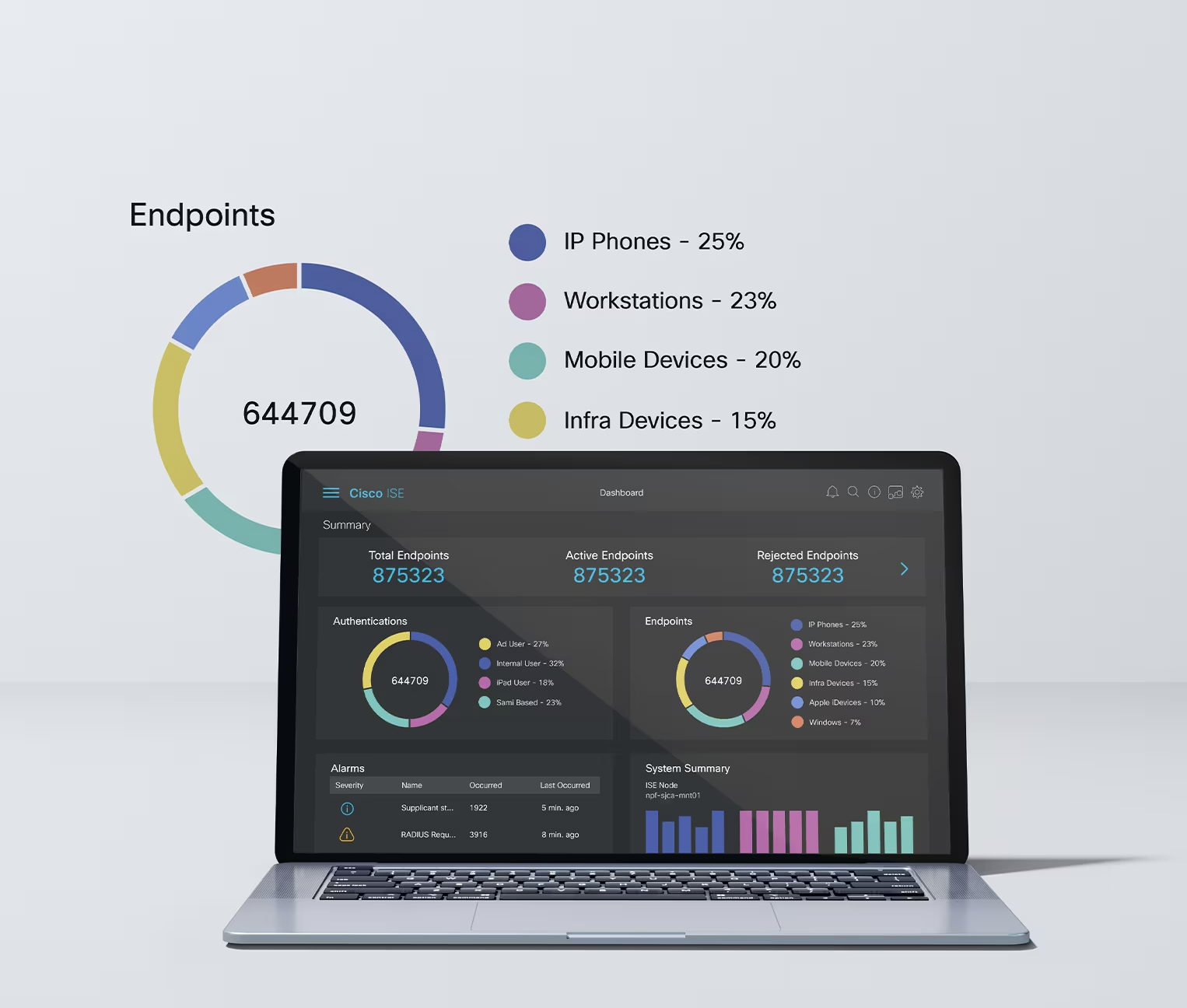
The Cisco Identity Services Engine (ISE) offers a network-based approach for adaptable, trusted access everywhere, based on context. It gives the user intelligent, integrated protection through intent-based policy and compliance solutions.
N/A
Cisco Meraki MX
Score 9.2 out of 10
N/A
Cisco Meraki MX Firewalls is a combined UTM and Software-Defined WAN solution. Meraki is managed via the cloud, and provides core firewall services, including site-to-site VPN, plus network monitoring.
$595
per appliance
Pricing
Cisco Identity Services Engine (ISE)
Cisco Meraki MX
Editions & Modules
No answers on this topic
MX64
$595
per appliance
MX67
$695
per appliance
MX68
$995
per appliance
MX84
$1,995
per appliance
MX100
$4,995
per appliance
MX250
$9,995
per appliance
MX450
$19,995
per appliance
Offerings
Pricing Offerings
Cisco Identity Services Engine (ISE)
Cisco Meraki MX
Free Trial
No
Yes
Free/Freemium Version
No
No
Premium Consulting/Integration Services
No
No
Entry-level Setup Fee
No setup fee
No setup fee
Additional Details
—
—
More Pricing Information
Community Pulse
Cisco Identity Services Engine (ISE)
Cisco Meraki MX
Features
Cisco Identity Services Engine (ISE)
Cisco Meraki MX
Firewall
Comparison of Firewall features of Product A and Product B
Cisco Identity Services Engine (ISE)
-
Ratings
Cisco Meraki MX
7.9
Ratings
9% below category average
Identification Technologies
00 Ratings
8.30 Ratings
Visualization Tools
00 Ratings
8.70 Ratings
Content Inspection
00 Ratings
8.10 Ratings
Policy-based Controls
00 Ratings
7.60 Ratings
Active Directory and LDAP
00 Ratings
7.90 Ratings
Firewall Management Console
00 Ratings
6.60 Ratings
Reporting and Logging
00 Ratings
7.70 Ratings
VPN
00 Ratings
8.80 Ratings
High Availability
00 Ratings
9.10 Ratings
Stateful Inspection
00 Ratings
7.40 Ratings
Proxy Server
00 Ratings
6.70 Ratings
Best Alternatives
Cisco Identity Services Engine (ISE)
Cisco Meraki MX
Small Businesses
NinjaOne
Score 9.0 out of 10
pfSense
Score 9.9 out of 10
Medium-sized Companies
Cisco Meraki MX
Score 9.2 out of 10
Quantum Firewalls and Security Gateways
Score 9.6 out of 10
Enterprises
Cisco Meraki MX
Score 9.2 out of 10
Palo Alto Networks Virtualized Next-Generation Firewalls - VM Series
Cisco ISE integrates will with a Cisco solution such as firewalls, network switches and routers. It does an incredible job of granting access based on the role that an individual or groups have, and the ability to remove access to that individual or group is also east. In our environment ISE is used to authenticate external users that have access by vpn, and also to manage access to the large network infrastructure
We used Meraki MX with our remote sites and connected the MX 68 to our main MX 85. We routed traffic to our enterprise network and shared application and internet access to remote sites. We have routed traffic and allow only trusted IP address sources using the firewall rules implemented in the Meraki MX. In other scenarios, if the internet is lost, the Meraki will go offline; thus, stable internet access is important to maintain connectivity
The most beneficial thing that I love about it, there are tons of things that I love about ISE and that it does well, but the most fascinating that I feel about is its integration with DNA center or Catalyst Center using PX Grid as the protocol wherein ISE acts as a policy server for the entire campus hand in hand with Catalyst Center to make sure that the policy policy follows the user and also in the background hand in hand with DNA Center or Catalyst Center makes sure microsegmentation is implemented so that east west traffic is blocked and takes care of the campus.
It provides a really good single pane of glass so you can really easily identify end to end, what is going on in your environment.
It provides the ability for someone that doesn't necessarily need a really deep level of knowledge to be able to operate and maintain it. I think that's probably a big selling point, but I think definitely for the people that I'm selling the products who just having a dashboard and being able to log onto it and see if things are good or bad is quite key. So it does that really well.
I guess the user experience itself, it's sometimes a little bit slow, but this is also dependent on the platform and the scale of the deployment of course. But actually functionality-wise it's really, really good. But yeah, it could sometimes be a little quicker to react on the good front.
Layer seven firewall rules. Just making them more granular. We've been in meetings with Cisco SES where I've said feature requests many times and that's one of the big ones where it's just a little cumbersome to implement layer seven rules right now.
Just making them more granular. We've been in meetings with Cisco SES where I've said feature requests many times and that's one of the big ones where it's just a little cumbersome to implement layer seven rules right now.
It is already in place and the client is happy with it. We don't see a need to change what is already working. We want the Meraki to stay out of the way and keep things operating, and that's what it does.
For us the solution is very easily useable on its own. Perhaps that has to do because we started using ISE in the 1.2 days and have seen it grow during the years. Policy creation, etc. is all very visible and thus easy to use. Deployment of multiple nodes is also incredibly easy and flexible. You can easily add or remove nodes as you wish.
The Cisco Meraki MX series is very easy to use. Setting up user VPN access, site to site VPN to tie multiple locations together and managing all your devices. You can even download the latest firmware and install without ever leaving the dashboard. Meraki is the very definition of easy to use
We do have to occasionally reboot the servers when they get low on memory, but we're also a few versions behind. Availability has generally been pretty good though with no major outages in the time that we've had it implemented.
Meraki MX devices support high availability (HA) configurations, which ensures minimal downtime if one device goes offline. This feature has helped us maintain a stable and reliable network, even in cases of hardware failures. ince Meraki is cloud-managed, we've noticed that the cloud infrastructure is generally highly reliable, with minimal service interruptions or downtime. This makes it easier to manage the network remotely without significant availability concerns. Meraki automatically pushes firmware updates and patches, which helps maintain system stability without requiring manual intervention. These updates are rolled out in a manner that ensures minimal disruption to service.
The interface is pretty responsive. The lower end devices are easy to overwhelm if you have a lot of throughput. Be sure the model you get is rated for the amount of traffic you will have. Overbuild if possible, otherwise you won't be fully leveraging the connection from your ISP.
Cisco support is second to none, both in terms of how you access support but also the knowledge of the individual support teams. If you focus on one technology and provide "manufacturer support" then you can rest assured that you are accessing Cisco's top individuals. I feel like this is a USP for Cisco support.
I haven't ever had a bad experience with Meraki support. On the few occasions where I wasn't understanding the UI or needed some clarification about what a setting actually would do, I contacted them and they were very quickly able to provide help. Returns are simple and fast, too. We had to return a defective device one time and they shipped the replacement before we had even un-racked the one that was faulty. Unlike many other vendors, they didn't ask use to a do long list of scripted diagnostics, they just took my word for it that the device was broken and sent out a replacement immediately
great when they offered it, really tested your knowledge with hands on and see what your peers from other orgs know. glad to see that we were ahead of the curve of what our peers knew
I did participate in the implementation of Cisco ISE and while there were times when it was confusing and we had a lot of trial and error, overall the experience was fine.
Implementing Meraki MX devices in phases—starting with a pilot group or select branch offices—was invaluable. This allowed us to identify potential configuration issues, troubleshoot problems, and refine our setup before rolling it out company-wide. It also helped to get feedback from early users and adjust the deployment strategy accordingly. The SD-WAN capabilities in Meraki MX were essential for optimizing our WAN traffic and ensuring better application performance across various locations.
I think all give some visibility of device monitoring and management, but Cisco Identity Services Engine gives a good way to manage more details about the device in a centralized way that gives a wider range of monitoring and control than the other softwares individually. I don't think Cisco Identity Services Engine eliminates the need for these other software as of now, but there is potential for Cisco Identity Services Engine to be able to take over more of these roles.
We previously evaluated WatchGuard Firebox Cloud, but we needed a solution that was a bit more straightforward to deploy and manage. The MX met that need for us. However licensing costs for both solutions are still a bit high.
It's fully customised and comprehensive. only thing is you need to know what you want. Proper research and planning would save lots of time and effort .
When I first started with my company we had various infrastructure and a mix of tech. Since going to Cisco Meraki MX we have noticed better network performance and our new sites are much easier to bring online. Users have noticed an improvement in VPN connection and getting into all our systems.
I don't know about negatives because we haven't seen it right now, but positive impact is one is the roadmap we have. And now since we are going ahead with doing the deployment of Cisco ISE, we see that we are getting closure to, so at the end of the day, we have to make sure that operationally we stay excellent. So that's where operational excellence comes in. Cisco ISE is basically addressing that for us. Right now we are in a situation if there is a WIFI issue or if there is an authentication issue, it gets really difficult to isolate the problem. But with Cisco ISE , this functionality is going to come in. So we believe that it would be a good ROI.
From a positive impact? Basically it allows us to set up shop very quickly. It allowed us to add sites to our network very quickly. From a negative perspective, I think the only thing is that I can see from a negative perspective is I have a preference to working with ACLI in terms of how I engage with the youth tool At the moment, the only way to actually engage with a tool is on a gui and sometimes what I'd actually like is more detailed information in terms of actual configuration that you'll actually get out of ACLI.