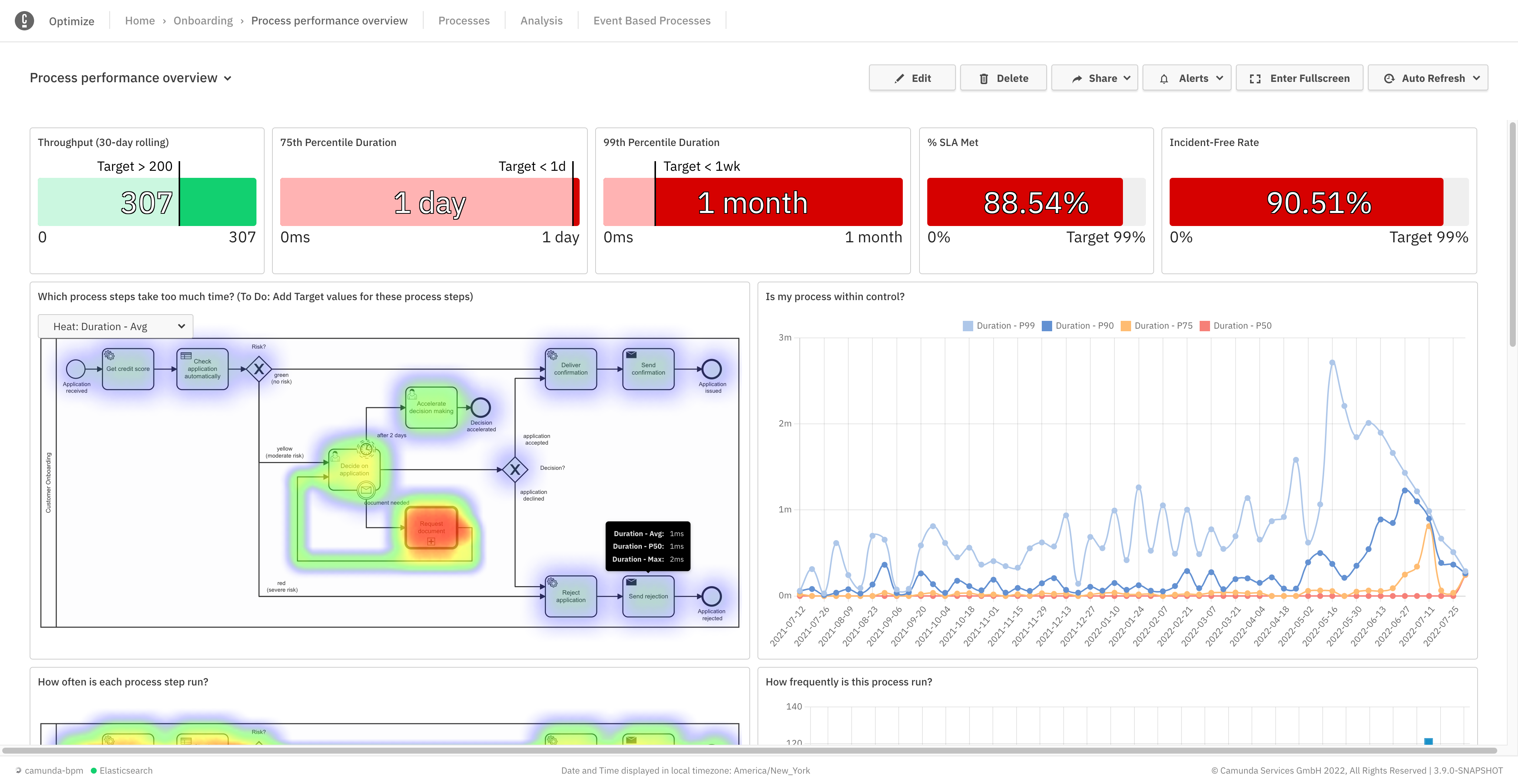
Camunda is a process orchestration tool designed to help organizations design, automate, and improve any process. Built for business and IT collaboration using BPMN and DMN standards, Camunda aims to enable seamless integration across endpoints to transform mission-critical processes.
N/A
ServiceNow Now Platform
Score 9.2 out of 10
N/A
The ServiceNow Now Platform is a digital workflow building and extension tool for ServiceNow featuring a number of low-code / no code tools.
N/A
Pricing
Camunda
ServiceNow Now Platform
Editions & Modules
Self-Managed Enterprise
Contact Sales
per year
SaaS Enterprise
Contact Sales
per year
No answers on this topic
Offerings
Pricing Offerings
Camunda
ServiceNow Now Platform
Free Trial
Yes
No
Free/Freemium Version
Yes
No
Premium Consulting/Integration Services
Yes
No
Entry-level Setup Fee
No setup fee
No setup fee
Additional Details
—
—
More Pricing Information
Community Pulse
Camunda
ServiceNow Now Platform
Features
Camunda
ServiceNow Now Platform
Customization
Comparison of Customization features of Product A and Product B
Camunda
9.0
1 Ratings
38% above category average
ServiceNow Now Platform
-
Ratings
API for custom integration
9.01 Ratings
00 Ratings
Reporting & Analytics
Comparison of Reporting & Analytics features of Product A and Product B
Camunda
8.0
1 Ratings
1% below category average
ServiceNow Now Platform
-
Ratings
Dashboards
8.01 Ratings
00 Ratings
Standard reports
7.01 Ratings
00 Ratings
Custom reports
9.01 Ratings
00 Ratings
Process Engine
Comparison of Process Engine features of Product A and Product B
Camunda
8.5
2 Ratings
17% above category average
ServiceNow Now Platform
-
Ratings
Process designer
9.02 Ratings
00 Ratings
Process simulation
9.01 Ratings
00 Ratings
Business rules engine
7.02 Ratings
00 Ratings
SOA support
9.02 Ratings
00 Ratings
Process player
9.02 Ratings
00 Ratings
Form builder
5.02 Ratings
00 Ratings
Model execution
10.02 Ratings
00 Ratings
Business Process Automation
Comparison of Business Process Automation features of Product A and Product B
Camunda Platform is well suited for scenarios where there are different stages in a business flow and the flow is driven by user action at each stage. For example placing of an order on an ecommerce platform. Depending on whether user was able to make the payment or not the workflow would go to dispatch or retry stage. Now the retry stage would trigger further actions like sending follow up emails etc. Likewise, dispatch stage would have a different set of actions. Since every order is important and we need to know where it stands, using Camunda Platform is imperative. Camunda Platform might not be a right choice where just a one off thing needs to be done. For example, uploading of product information by user or periodic processing of heavy images by a worker. These are all either one step processes or periodic automated processes where we can track the status without using a business modeler like Camunda Platform.
ITSM is straight forward creation of Incidents and Requests. It can get more confusing as you layer more modules on top of it with event management, risk, project, etc. It also becomes more costly as everything is a different license. Integration between other external applications is very easy to do with their API. You can easily create endpoints for external apps to talk to or create REST messages for the platform to reach out directly.
It helps put manage the request really well. It is easier to create a request, track the request and manage the request. It doesn't get lost into a pile of requests.
We've already pre-setted some settings into our ServiceNow. So it automatically assigns the level of urgency and mentions on the ticke if its a high or low priority request.
I really like the ServiceNow dashboards. They ate setup in a really nice way. The dashboards show the real time data aswell as old data incase if we need to see if there is a pattetn in the request or to fix any recurring issue.
The ServiceNow performance speed has big room for improvement, as it is quite slow in loading Dashboards with more than 5-6 widgets. We are keeping our ServiceNow version up to date with latest releases.
Usually there are issues with having multiple ServiceNow tabs open in the browser and have different dashboards open in those tabs.
The way of showing a history log of all activities on Incident ticket is not optimal and easy to use or search in and have very old design.
While we are very likely to renew, we are also assessing if we should renew all of what we currently subscribe to as we try to reduce costs. Some parts of the business feel there may be a better tool out there to fit their process requirements. We are currently working with them to identify what those requirements are to see if it makes sense while also pointing out a reduced cost of tooling is not always the best fit if we have an increased cost of customization and maintenance between tools.
It provides a lot of modification options which is wonderful for certain team usage but becomes too much of a job when it comes to the Service Desk. Also on the app support side, since too much information can be carried, it affects the GUI and makes it complex.
I was not in the team that take care of the installation of ServiceNow but their feedback was very positive. Go live was done by the planned date and their support at the beginning provided always a timely response. Their customer service is friendly and easy to reach. Today we don't use their customer service anymore because we have an internal IT dedicated to maintaining the system.
We went through a re-implementation last year with a partner and were very pleased with the outcome. We looked at several partners and chose one that was able to provide an entire scope and cost upfront of what would be required to complete our requirements. We worked very closely with the dedicated team assigned to our project throughout the process and they fully delivered on all of our requirements that we presented in the initial scope.
Lacks good documentation. Training and documentation is geared towards those who are already technically adept. Does not have as many data integrations as other full fledged products. Paid version of Camunda is not as fully fledged as other products.
ServiceNow is by far a better tool over Remedy. Its ability to integrate so seamlessly to so many tools allows for plenty of opportunity to streamline and improve processes. Servicenow has intuitive flows that allow you to quickly pivot if process change. Its adaptiveness is what makes it far better solution over Remedy
1. It is not great when they can't seperate apps/products from a particular sku, forcing you to make a business case for a larger portion of functionlity than your current business case seeks to address. 2. ServiceNow reps are able to work with you when economies of scale are projected out. They are willing to start at a desired tier and provide pricing at applicable upgraded tiers
Very easy to use. Capture more data from the Incident and problem management. Easier to escalate and following the change management process to resole the issues.
The positive impact is that we are able to ensure the business process is being followed and that results in orders getting processed successfully leading to customer satisfaction and revenue
Another positive impact is that we are able to track any anomalies and any errors in the order flow and retry them so that users don't have a negative experience.
A negative point is that it is an overhead to maintain so there is significant engineering effort getting invested there
Fast implementation of our Sales & Operation/Projects controls and process - tool adapted to our needs, not us to adapt to the tool.
Once we are a consulting/implementation company, our customers are happy to see that we use what we sell, and it is easy to show them how this platform/tool can have an impact on our own business.